Story code: ST-001206
Part 4: The River Wins
The silence in the Community Hub was brittle, held together only by the quiet, synthetic strum of the indie-folk music playing from the ceiling speakers. Julian stared at the fermented yellow sludge oozing over the toe of his pristine white sneaker. When he finally looked up at David, the immaculate, curated warmth in his eyes was entirely gone. The customer-service mask didn’t just slip; it shattered into something cold, rigid, and deeply ugly.
“Turn it off,” Julian snapped. He wasn’t looking at the crowd anymore. He glared at the nearest videographer, slicing his hand across his throat in a sharp, jagged motion. “I said cut the damn feed!”
The videographer scrambled to kill the camera. The politicians in the front row took a collective, synchronized step backward, putting desperate distance between themselves and the man in the stained apron.
Julian didn’t try to explain the rent hike. He didn’t try to spin a narrative about synergy or compromise. Instead, he reached into his distressed denim jacket, pulled out his phone, and dialed with sharp, aggressive jabs of his thumb.
“I need police at the corner of 8th and Lex,” Julian said, his voice loud, clipped, and devoid of any performative slang. He kept his eyes locked on David. “I have a hostile trespasser. He is erratic. He just assaulted me with biological waste. Yes. He is refusing to leave.”
David stood completely still, his hands resting at his sides. He listened to the words echo in the high-ceilinged room. *Hostile. Erratic.* Less than an hour ago, in the cramped, sweaty aisle of the bodega, Julian had broadcast David’s face to thousands, calling him the definition of quiet immigrant hustle. The model minority. The backbone of the city. But the absolute second the backbone stood up and spoke, the script flipped. To Julian, David was no longer a legacy to be celebrated; he was a vagrant to be neutralized.
Sirens wailed in the distance almost immediately. This was a newly gentrified block; response times had miraculously improved over the last two years.
“You need to step back,” Julian told David, his voice trembling with a potent mix of adrenaline and manufactured fear. “You are unstable.”
David didn’t argue. He didn’t yell. *The stone does not argue with the river.* He just looked at the crowd. The people who had been applauding the concept of his existence just minutes ago now stared at him with naked apprehension. The smell of the rotting plantains filled the sterile air, a heavy, unavoidable truth that no amount of eucalyptus soap could mask.
Two police officers pushed through the heavy glass doors, their hands resting cautiously on their duty belts. Julian instantly pointed a manicured finger at David.
“That’s him,” Julian said, retreating behind one of the officers. “He barged in, started screaming, and threw garbage at me. He’s completely unhinged.”
The officers approached, barking orders for David to turn around and show his hands. David felt the sharp, humiliating twist of his arms being pulled behind his back. The metal cuffs bit into his coffee-burned knuckles, but he kept his jaw locked. He didn’t resist as they marched him out of the Hub, past the floor-to-ceiling windows, and into the back of a cruiser. He watched through the wire mesh as Julian accepted a clean towel from a staff member, dabbing at his shoes, playing the victim of a random, senseless attack by a neighborhood crazy.
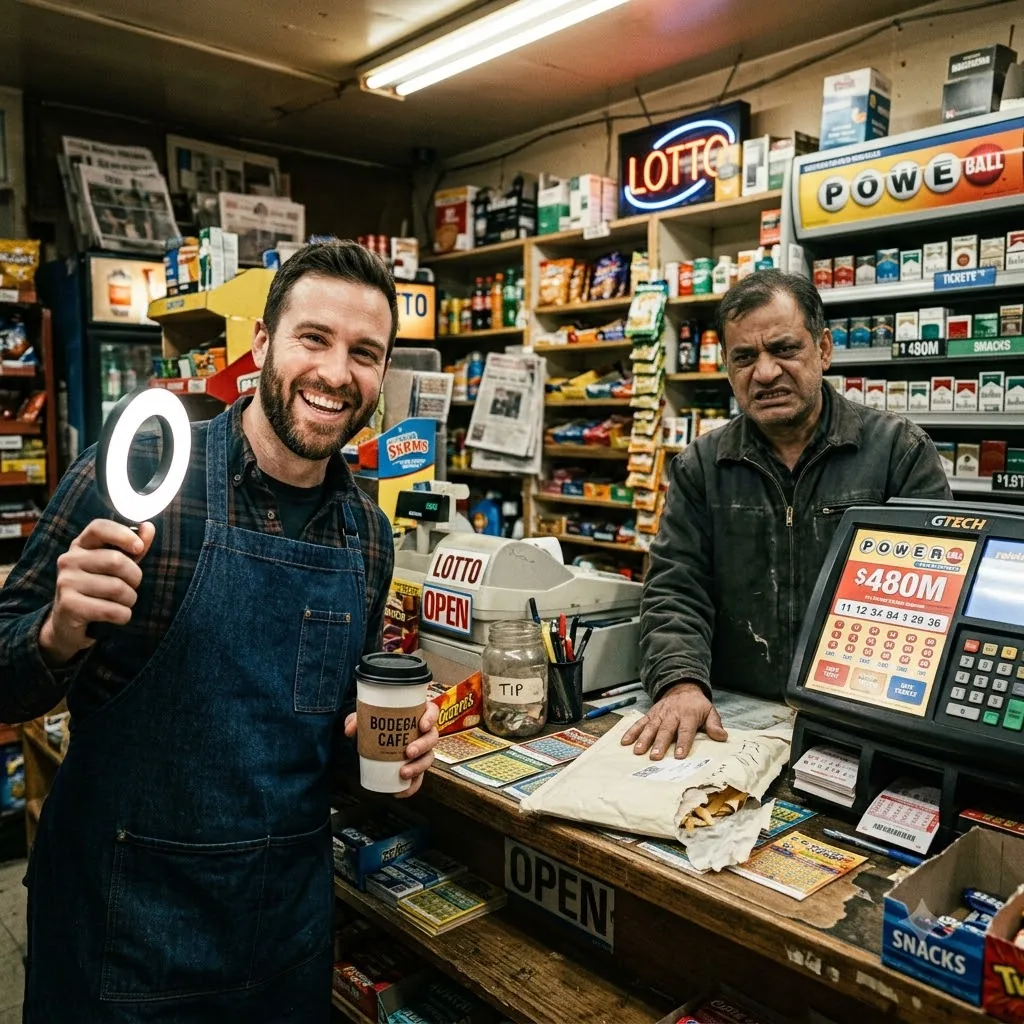
Thirty days later, the air in the bodega was stifling, but the silence was worse.
The ancient refrigeration unit in the back was unplugged, robbing the room of its violent, familiar shudder. The shelves were stripped down to bare, dusty metal. The neon, handwritten price tags that his grandfather had painstakingly taped to the racks were stuffed into a black contractor bag by the door.
David stood behind the scarred laminate counter one last time. There was no lottery dispenser. There was no register. There was just the faded, circular stain in the wood where his grandfather used to set his coffee mug every morning at five a.m. for forty years.
David reached into his pocket and pulled out a heavy brass key. His burned knuckles had healed into tight, shiny pink scars. He dragged his thumb across the worn edge of the laminate, feeling the deep gouges left by decades of box cutters and dropped cans.
Outside, a crew of men in neon vests was already setting up scaffolding against the brick facade. A massive roll of matte black vinyl leaned against the fire hydrant.
David picked up the trash bag. He walked out the front door, the overhead bells chiming a tinny, hollow farewell into the empty room. He pulled the door shut, inserted the key, and turned the deadbolt. Then, he reached up and grabbed the rusted handle of the metal security gate.
He pulled it down. The metal tracks shrieked, a harsh, grating wail that echoed down the rapidly changing avenue. The heavy steel slammed into the concrete pavement with a final, echoing crash. David snapped the padlocks shut, trapping forty years of history in the dark, and walked away without looking back.