Story code: ST-001231
Part 4: The Adverse Reaction
The heavy reinforced door finally gave way with a sickening, metallic screech. The remaining frosted glass exploded inward, raining jagged pebbles across the linoleum as three clinic security guards breached the room. They spilled through the frame in a coordinated rush, tactical batons raised, heavy tasers drawn and glowing with red targeting lasers. Overlapping, barked commands filled the small space, demanding compliance, demanding hands on heads, demanding immediate surrender.
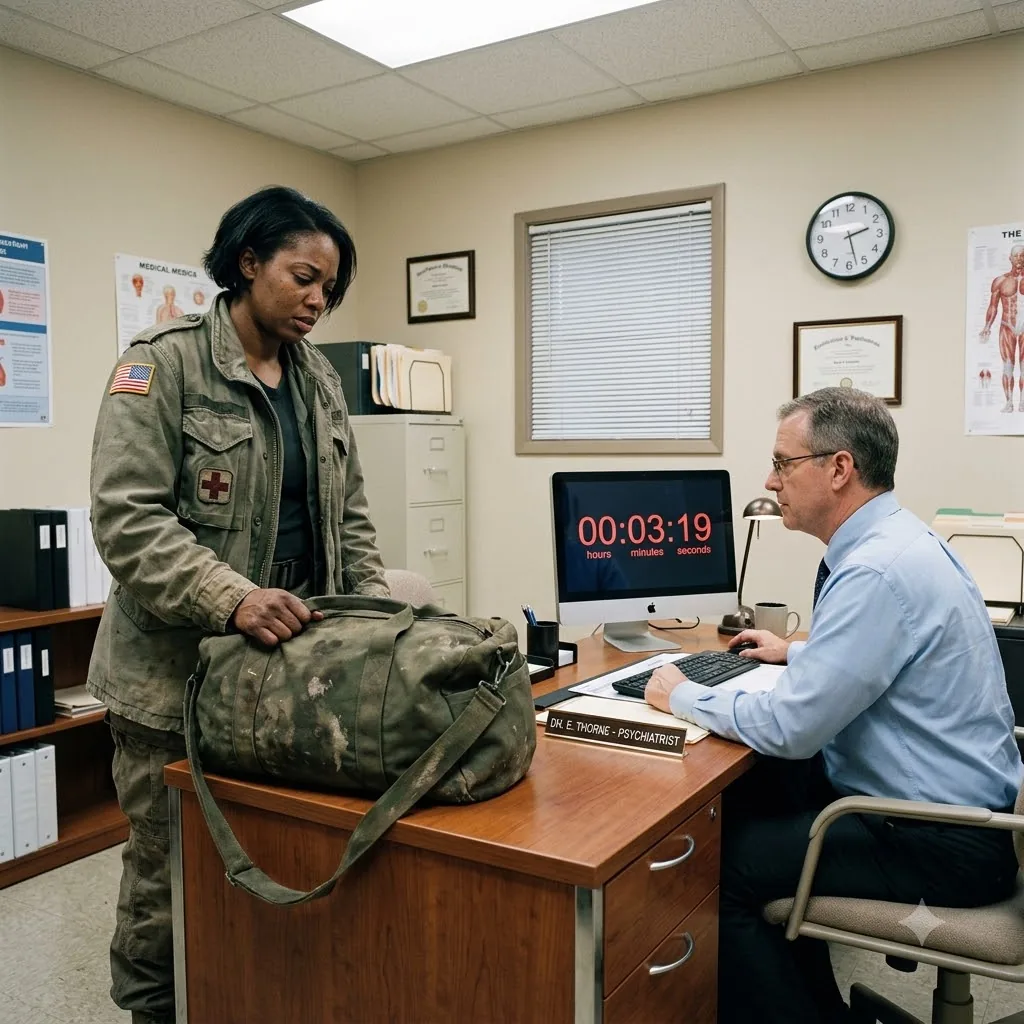
Ray did not raise her hands. She did not drop to her knees. She remained standing exactly where she was, her boots firmly planted in the spreading pool of brackish water and fresh blood. She simply lowered the mud-caked letter to her side.
The guards froze, their momentum stalling as their training clashed violently with the reality of the room.
The red dots of their tasers danced across Ray’s chest for a fraction of a second before sweeping frantically toward the desk. The tactical team had been briefed on an aggressive, non-compliant patient. They expected a physical threat. Instead, they found a perfectly calm veteran in a worn jacket, standing quietly amidst a pile of dirt and scrap iron.
The active threat, the source of the chaos, was the doctor.
Vance was hyperventilating, his back pressed hard against the examination bed. He was clutching his right hand to his chest, bright red blood welling from the deep laceration on his palm and soaking into the pristine, starched fabric of his white coat. He wasn’t looking at the guards. He wasn’t looking at Ray. He was staring unblinkingly at the pile of rotting foreclosure notices and muddy envelopes scattered across his synthetic mahogany desk, his chest heaving with shallow, ragged gasps. The corporate mask, the fifteen-minute optimization protocol, the patronizing de-escalation scripts-all of it had been completely incinerated.
“Doctor Vance?” the lead guard asked, his voice losing its authoritative bark, replaced by profound confusion. He lowered his taser an inch. “Sir, are you… are you injured? Did she attack you?”
Vance didn’t answer. He just shook his head, a frantic, erratic twitch, his eyes wide and vacant. A low, keening sound hitched in his throat, the sound of a man whose carefully constructed illusion had just violently collapsed under the weight of undeniable reality.
Ray watched him for a long moment. The heavy scent of sulfur, river mud, and rust had entirely conquered the room’s engineered lavender masking agent. It was permanent now. It would sink into the drywall, into the acoustic ceiling tiles, into the expensive upholstery of the waiting room chairs. They would never get the smell of Sector Four out of this building.
She slowly folded Elias Thorne’s letter. The brittle, mud-stained paper crinkled under her fingers as she slid it carefully into the inner breast pocket of her jacket, securing it close to her chest.
She looked down at the ruined desk. Beneath a heavy, jagged piece of sheared iron and a puddle of foul-smelling sludge, the white prescription slip remained. The generic central nervous depressant. The chemical eraser.
Ray reached out, moving with deliberate, unthreatening slowness. The lead guard tensed, his grip tightening on his weapon, but Ray ignored him. She pinched the corner of the dry side of the prescription slip and pulled it free from the wreckage. She didn’t tear it. She didn’t crumble it. She reached across the desk and slid the uncashed slip of paper neatly under Vance’s overturned ceramic coffee mug. It sat there, a pristine white anchor in the middle of a toxic spill.
“He needs a medic,” Ray said, her voice quiet, steady, and utterly void of malice. She looked directly at the lead guard. “He’s having a severe adverse reaction to his environment.”
The guard blinked, entirely derailed by her clinical tone. Before he could recalibrate his orders, Ray turned and walked toward the shattered door.
She didn’t rush. She simply stepped through the gap between the confused tactical officers, their weapons lowering as she moved past them. The threat assessment protocols in their heads had short-circuited. There was nothing in their manuals for a patient walking away from a doctor who was actively hyperventilating over a pile of dirt.
Ray stepped out of the hermetic seal of the examination room and into the clinic’s main corridor. The engineered quiet of the facility was gone, replaced by the blaring automated lockdown siren. Down the hall, the massive waiting room was in absolute gridlock. The digital fifteen-minute timers mounted above every single examination door were flashing a synchronized, glaring red.
The turnstiles had locked up. The throughput was jammed. Dozens of veterans sat in the sterile plastic chairs, their heads turning to watch her as she walked down the central aisle. The barcode scanners were offline. The machine had choked on a single piece of undeniable truth.
Ray pushed through the heavy glass exit doors, forcing them open against the lockdown mechanism. The cold hit her instantly. It was a sharp, biting chill, carrying the freezing rust-belt rain sideways across the cracked asphalt of the parking lot. She zipped her jacket, turning her collar up against the wind. The rain felt clean against her face, washing away the stagnant, sterile air of the clinic. Behind her, the sirens continued to wail, trapped inside the pristine white box, while Ray walked steadily away into the gray, uncompromising expanse of the valley.