Story code: ST-001256
Part 3: The Brutal Math
By Thursday morning, the flat-top grill was ice cold, and the diner smelled of industrial bleach instead of bacon. Frank sat at the copper-topped counter, a roll of white medical tape and a tube of burn cream sitting next to a mountain of unopened envelopes. He carefully wrapped the blistered skin on his left wrist, wincing as the adhesive pulled at the raw edges.
Twenty-four hours left.
He had spent the night pulling apart his filing cabinet, searching for some miraculous legal loophole in the mountain of paperwork that constituted his adult life. All he found was a terrifying, cascading ledger of debt. He arranged the red-stamped notices on the counter like a losing hand of solitaire: a final warning for $4,200 in municipal property taxes, a $1,800 commercial gas bill, and the terrifying quarterly statement for the small-business loan. The loan was collateralized by the equity in his three-bedroom starter home. If the fryers and the grill were seized by the landlord, the bank took the house.
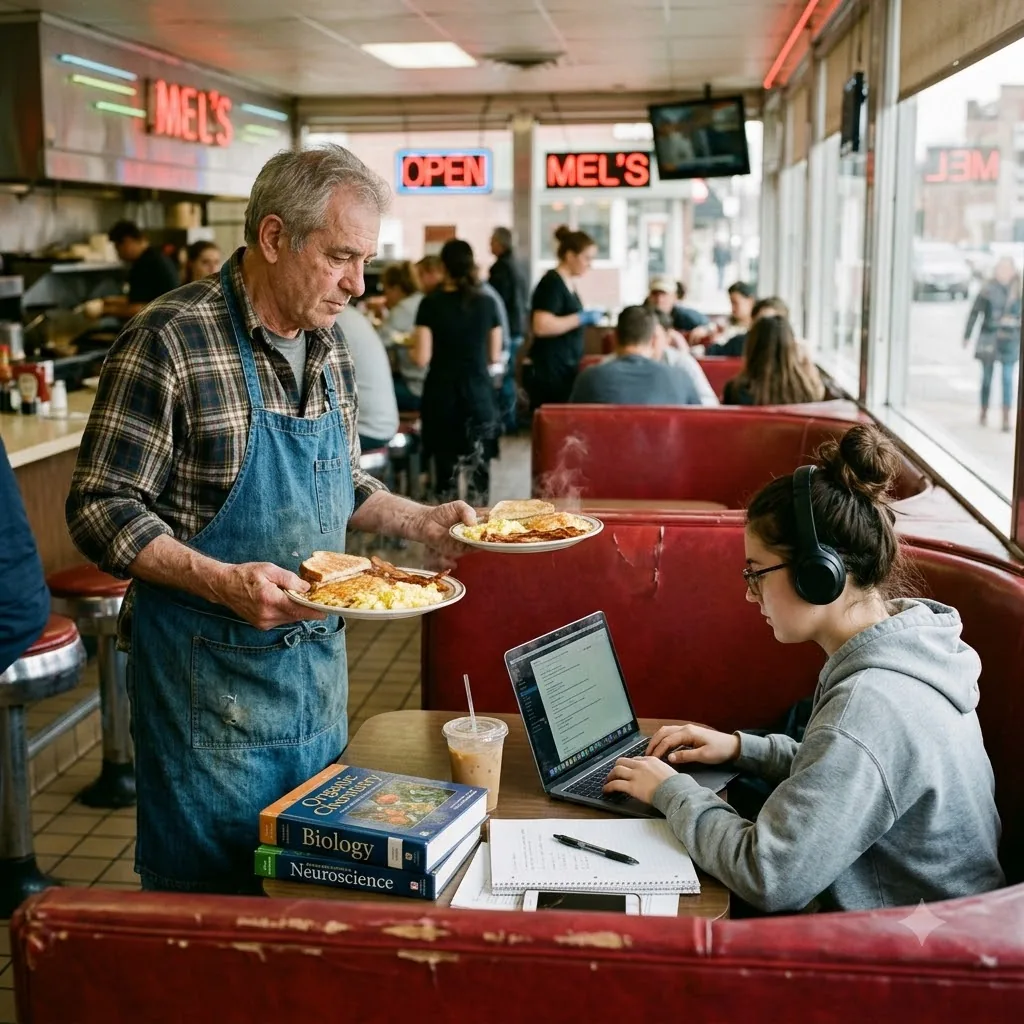
Across the quiet diner, Chloe occupied booth number four. She had returned at dawn, setting up her spiderweb of charging cables and opening a massive, hardcover textbook titled *The Sociology of Capitalist Decay*. She tapped away at her laptop, perfectly content in the silence of the ruined business.
Frank was reaching for a stack of unpaid invoices from his meat supplier when a black Mercedes sedan pulled up to the curb outside.
The brass bell above the door chimed. A man stepped inside, bringing the crisp scent of expensive cologne and dry-cleaned wool into the greasy air. He wore a tailored charcoal suit and rimless glasses, his polished leather shoes clicking sharply against the checkerboard linoleum. He didn’t look at Frank. His eyes swept the empty diner, locking immediately onto the only other person in the room.
Chloe looked up, her hand instinctively hovering toward her smartphone to record.
“Ms. Sterling?” the man asked, walking toward her barricade of canvas tote bags with an easy, practiced smile. “I’m David Vance. Regional Director for the Sterling-Vanguard Property Group. I handle the commercial acquisitions for this district.”
Chloe sat up straighter, her chin lifting. She didn’t touch her phone. “If you’re here to negotiate a buyback, you’re wasting your time. The Community Liberation Front holds the lease now. I hostilely acquired this space to sever it from your corporate portfolio, and I intend to keep it off your grid.”
Vance let out a soft, genuine chuckle. He slipped one hand into his tailored pocket. “Negotiate? Ms. Sterling, I drove out here to personally thank you. You triggered a buyout clause at a thirty percent premium above market rate. My board is absolutely thrilled. But frankly, the capital injection isn’t even the best part. I came to see the ‘indoor community garden’ you cited on the municipal transfer forms.”
Frank stopped taping his wrist. He turned on his stool, keeping his burning hands resting flat against the cool copper counter.
“We are reclaiming the concrete,” Chloe said, her voice dropping into its familiar, practiced lecture cadence. “It’s a localized eco-agricultural cooperative. We’re tearing out the commercial infrastructure to initiate blight removal via localized greening. I am subverting your traditional property paradigms by forcing a non-profit, green-space designation.”
Vance pulled a sleek tablet from his coat pocket, his smile widening into something wolfish and bright. “A localized eco-agricultural cooperative. Yes, that was the exact phrasing on the LLC filing. Brilliant.”
Chloe frowned, adjusting her wire-rimmed glasses. “You’re attempting to patronize me because you lost the property.”
“Ms. Sterling, do you know how long we have been trying to get the city planning commission to rezone this specific block for high-density luxury residential?” Vance asked, tapping his tablet. “Seven years. The city council kept blocking our demolition permits for the hardware store and the laundromat next door. They cited a district mandate requiring a thirty-percent eco-agricultural zoning ratio before any heavy commercial redevelopment could proceed.”
Chloe’s fingers froze over her laptop keyboard.
“We couldn’t knock down the diner or the hardware store without legally committing to replace one of them with a city-managed park, which completely ruins our square-footage yields for the condos,” Vance explained, his voice smooth and triumphant. “But you, acting as an independent LLC, just converted the largest footprint on the block to an eco-agricultural zone at your own personal expense.”
The silence in the diner was absolute. Frank felt a cold knot form in his stomach. He thought of Mike, who had run the hardware store for twenty years, and the elderly couple who owned the laundromat.
“You checked the city’s green-space box for us,” Vance said, pocketing his tablet. “The council approved our demolition permits for the rest of the block twenty minutes ago. We’re breaking ground on a fourteen-story luxury complex next month. So, on behalf of Sterling-Vanguard, thank you for your activism.”
Chloe’s mouth opened, but her practiced vocabulary vanished. A blotchy red flush crept up her neck. “That’s-no. No, I am filing an injunction. You can’t use my cooperative to gentrify the district! This is an anti-capitalist action center! I’m dismantling your infrastructure!”
“You *are* our infrastructure now,” Vance said mildly.
Frank slid off his stool. He picked up his mountain of paperwork-the final notices, the tax bills, the loan statements. He walked down the center aisle, stepping cleanly over her taut white power cord.
Chloe was stammering now, frantically clicking her trackpad. “I’ll change the zoning back. I’ll re-file the paperwork under a commercial designation-”
Frank stopped at the edge of booth four. He looked down at her heavy sociology textbook, open to a chapter on systemic oppression.
He dropped the thick stack of past-due bills right on top of the glossy pages.
The heavy *thwack* of the paper echoed in the empty diner. Chloe jumped, looking up at Frank’s exhausted, lined face.
“You can’t change it back, Chloe,” Frank said, his voice gravelly and quiet. He tapped a bandaged, blistered finger against the top notice. “Because you can’t afford to run it as a commercial space. Here is the math. Four thousand in property taxes. Eighteen hundred in municipal utilities. A thousand just to keep the grease traps compliant. That’s what it costs to stand in this building before you even buy an egg.”
Chloe stared at the red stamps and the bold, terrifying numbers glaring up at her from the textbook.
“You didn’t fight the system,” Frank said, staring down at her. “You just bought a VIP ticket to it with your trust fund. You paid them a premium to hand them the exact hammer they needed to smash my life, and everyone else’s on this street.”
Chloe stared at the brutal, unyielding numbers of Frank’s survival, the red ink bleeding across her academic theories, while Vance stood quietly by the door, smiling.