Story code: ST-001256
Part 4: The Tip
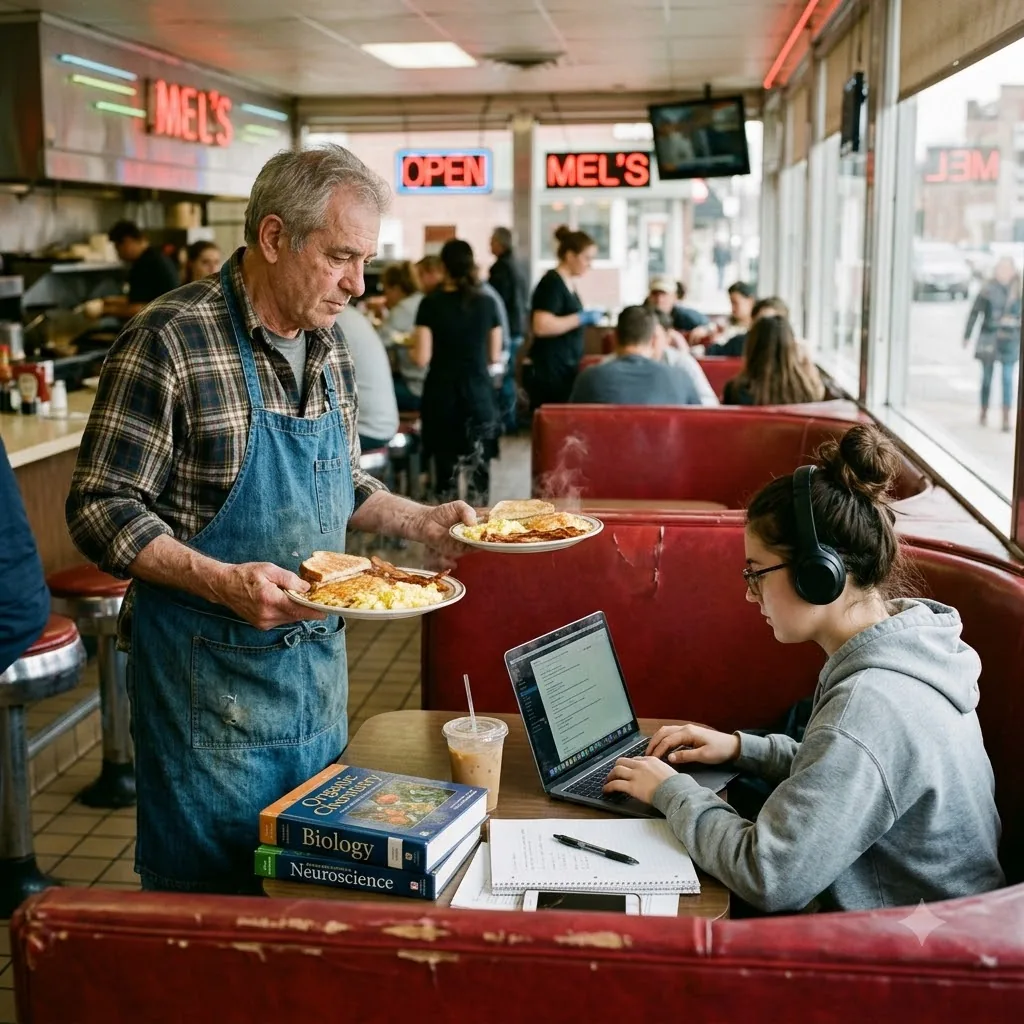
The silence in the diner stretched, thick and suffocating, broken only by the low hum of the commercial refrigerator that Frank couldn’t afford to restock. Frank watched the blood drain completely from Chloe’s face. She stared down at the stack of final notices, the bold red ink spelling out the exact cost of survival in the real world. Her eyes darted from the property tax statements to the loan documents, the numbers failing to compute within the margins of her sociology textbook.
She opened her mouth, her breath hitching. The practiced, rhythmic cadence of her academic lectures was entirely gone. “I didn’t… I wasn’t trying to…”
“Give them the neighborhood?” Frank finished for her, his voice devoid of anger, leaving only an exhausted, hollow rasp. “No. You were just playing a game. You thought you could buy a revolution with your parents’ money and go back to the dorms feeling like a hero. But this isn’t a classroom, Chloe. These are our lives.”
Chloe looked toward the front door. David Vance stood by the glass, adjusting the cuffs of his charcoal suit. He didn’t offer a lifeline. He didn’t offer an argument. He just watched her with the polite, detached amusement of an adult watching a toddler throw a tantrum in a sandbox.
“Ms. Sterling,” Vance said smoothly, checking his silver wristwatch. “I really must be getting back to the city. The demolition permits for the hardware store need to be filed before noon. We look forward to seeing your community garden flourish right next to our new lobby.”
The reality of it finally seemed to crush whatever performative armor Chloe had left. Her hands, previously so steady when holding her smartphone like a weapon, began to tremble. She reached out and grabbed her laptop, snapping it shut with a harsh, plastic clack. She didn’t look at Frank. She didn’t look at Vance.
She scrambled out of the sprawling booth, her vintage denim jacket catching on the edge of the Formica table. She started ripping her white charging cables from the wall outlet, no longer caring about neatly coiling them. She shoved the tangled wires and the thick sociology textbook into her canvas tote bag, heedlessly crumpling Frank’s past-due bills in the process. The hand-painted cardboard sign she had leaned against the napkin dispenser tipped over, falling face down onto the checkerboard linoleum.
“I have to go,” Chloe stammered, her voice high and thin, completely stripped of its former authority. She slung the heavy tote bag over her shoulder, nearly losing her balance. She stood in the aisle, looking down at the scuffed floor, completely unable to meet Frank’s gaze.
Then, driven by some bizarre, ingrained muscle memory of privilege and guilt, she reached into the pocket of her denim jacket. She pulled out her wallet, fumbled with the clasp, and extracted a crisp, green bill. She dropped it on the edge of the table.
A twenty-dollar tip.
Frank didn’t say a word as she turned and practically sprinted for the door. She shoved past Vance without acknowledging him, bursting out onto the sidewalk. The brass bell above the door chimed a cheerful, mocking tune as the glass swung shut behind her. Frank watched through the large front window as she hurried down the block, a shrinking figure retreating back to the safety of the campus, leaving the destruction of the entire commercial district in her wake.
Vance let out a soft sigh, stepping away from the door. He walked down the center aisle, his expensive leather shoes clicking rhythmically until he reached booth number four. He looked down at the twenty-dollar bill resting next to the crumpled edges of Frank’s financial ruin.
With a practiced, fluid motion, Vance reached into his breast pocket and produced a heavy, embossed business card. He set it down gently on the Formica, right next to the twenty.
“You were right, Frank,” Vance said, his tone entirely conversational. “She was just playing a game. It’s a shame you had to be the board.”
Frank kept his bandaged hands resting flat against the cool copper of the counter, ignoring the throbbing pain in his blistered skin. He didn’t look at Vance.
“If you need a reliable liquidation crew for the kitchen equipment, call the number on the back,” Vance added smoothly. “They work fast. You might be able to salvage enough scrap value to cover your moving truck. Good luck to you, Frank.”
Vance turned and walked out. The brass bell chimed one last time. The heavy glass door settled into its frame with a soft click, sealing the diner off from the morning traffic. Outside, the black Mercedes sedan pulled away from the curb, merging seamlessly into the flow of cars.
Frank was entirely alone.
He stood in the heavy silence, breathing in the sterile scent of industrial bleach that had replaced the rich, comforting aroma of coffee and grease. He walked slowly around the counter, his boots scuffing against the linoleum, until he reached the edge of booth number four.
He stared down at the table. The crumpled past-due notices. The crisp twenty-dollar bill. The embossed corporate business card.
He had won the argument. He had successfully broken through Chloe’s delusions, forcing her to see the brutal, hypocritical reality of her actions. He had stood his ground and defended his dignity to the very end.
Frank reached out with his good hand and picked up the twenty-dollar bill, rubbing the expensive paper between his thumb and forefinger. A bitter, agonizing realization settled heavy in his chest, colder than the ice-cold flat-top grill behind him.
He had won the moral victory, and it had cost him absolutely everything. The diner was gone. The bank would take his house next. The neighborhood was dead. He slipped the twenty dollars into his grease-stained apron, turned his back on the empty booths, and began the slow walk toward the kitchen to unplug the fryers.