Story code: ST-001262
Part 2: The Midnight Shift
Vance’s footsteps faded down the hallway, the heavy click-clack of premium leather soles on polished hardwood echoing like a metronome winding down. The frosted glass doors of the agency’s main entrance hissed shut, the magnetic lock engaging with a heavy, final *thud*.
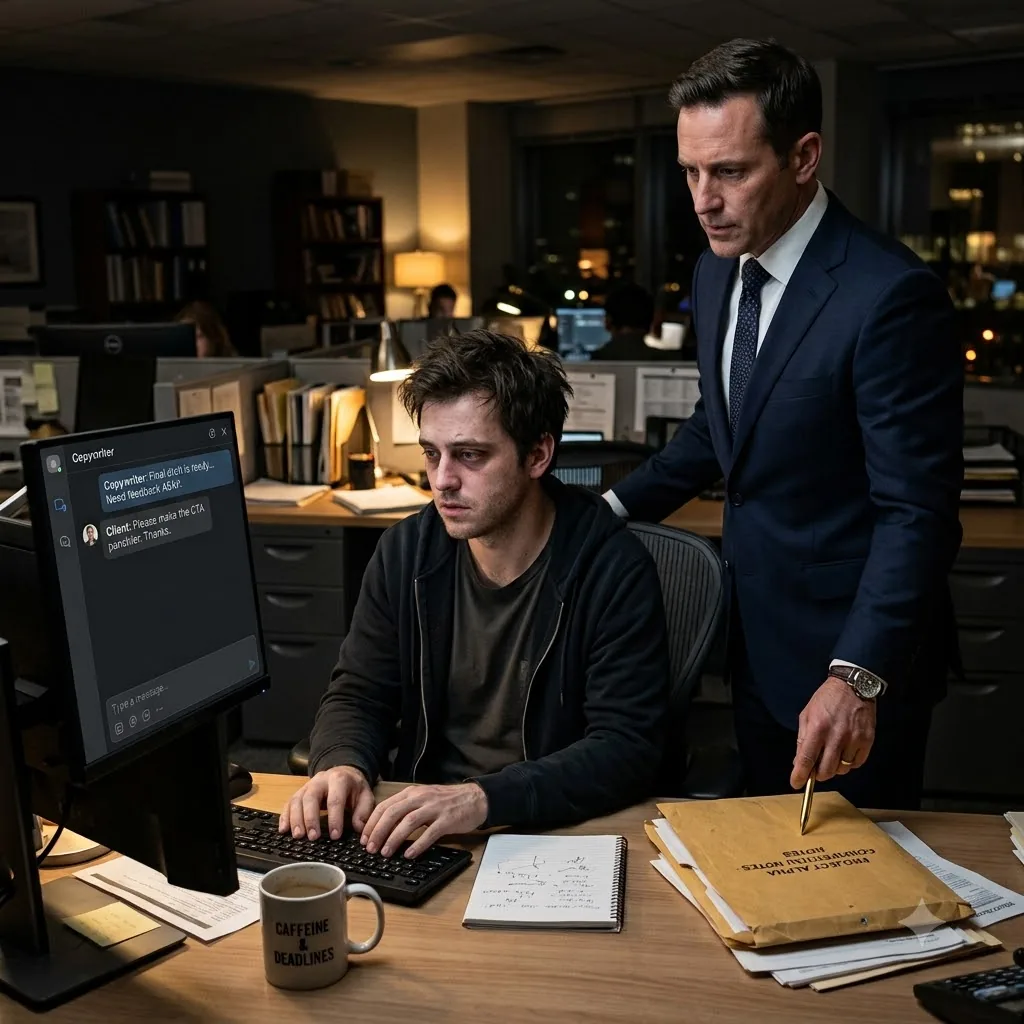
Mateo sat perfectly still. The harsh white glare of the monitor cast long, distorted shadows across his empty desk. The processing icon on the screen had stopped spinning, frozen in the exact state Vance had left it. The silence in the bullpen was absolute, broken only by the low, industrial hum of the server room three doors down.
He stared at the blank text box. *Finish automating this department for me.* The weight of the demand pressed into his chest, making it physically difficult to draw a full breath. He wasn’t just being asked to digitize his own decade of experience; Vance expected him to map the creative DNA of all six copywriters on the floor.
His phone vibrated against the desk pad. The screen lit up, displaying a photo of his wife, Elena, holding their four-year-old daughter, Sofia, in front of the peeling blue front door of their house.
*Elena: Sofia finally went down. Any idea when you’ll be home? Left some dinner in the microwave. Love you.*
Mateo squeezed his eyes shut. The temporary visas expired in exactly fourteen days. Without the corporate sponsor signature on those adjustment forms, the life they had spent seven years building would simply cease to exist. The mortgage, Sofia’s preschool, the neighborhood they had fought so hard to afford-all of it would be erased with a single letter to the federal government. He typed back a quick response: *Big pitch. Might be here all night. Go to sleep. Love you both.*
He couldn’t tell her. He couldn’t explain that the “pitch” was an algorithmic guillotine, and he was the one being forced to pull the lever.
Mateo reached for the mouse. His hand was no longer trembling. It felt cold, detached, as if it belonged to someone else. He opened the shared network drive, navigating to the folders of his team.
He started with Sarah. She had been at the agency for three years, specializing in the razor-sharp, minimalist tech copy that had landed them the Silicon Valley accounts. Mateo opened her master file and highlighted her best work. Control-C. He moved back to the proprietary language model’s interface. Control-V.
The machine accepted the input without hesitation. It digested Sarah’s quick, punchy syntax, her clever use of negative space in text, her cynical but highly engaging tone. Within seconds, the AI generated ten sample product descriptions. Mateo read through them. They were perfect. They lacked Sarah’s habit of leaving passive-aggressive notes in the margins of the document, but the copy itself was indistinguishable from her own.
Next was David. David, who had bought Mateo a coffee just this morning, complaining about his twin boys’ tuition costs while showing off pictures from their soccer game. David wrote the warm, folksy B2B newsletters that kept the legacy clients happy. Control-C. Control-V.
The algorithm swallowed David’s career in less than a minute.
Bile rose in the back of Mateo’s throat. He was digitizing his friends. He was stripping them down to data points and handing them over to a machine that would render them entirely obsolete by Monday morning. He needed to find a way out. He needed a way to satisfy Vance’s demand while keeping the department indispensable to the shareholders.
Mateo opened a new command prompt within the model’s training interface. He couldn’t stop the machine from learning, but maybe he could introduce a dependency. A structural flaw. If he could hardcode a blind spot into the AI’s logic-a subtle inability to parse emotional transitions in long-form copy-then Vance would still need human editors to fix the output. They would still need the team.
He began feeding the machine contradictory data. He took award-winning copy and deliberately scrambled the emotional cadence, pairing triumphant brand messaging with melancholic, sluggish syntax. He injected microscopic grammatical errors and logical leaps into the foundational training set, hoping to poison the well just enough to make the algorithm unreliable without intense manual oversight.
He hit enter, pushing the corrupted data batch into the neural network.
A red progress bar appeared on the screen. *Analyzing parameters.*
Mateo leaned forward, his heart hammering against his ribs. The red bar inched across the screen. If this worked, the AI would generate a flawed Q3 campaign. Vance would see the garbage output, realize the tech wasn’t fully autonomous yet, and sign the visa forms to keep Mateo on board for quality control.
The screen flashed green.
*Error: Contradictory emotional logic detected in training set. Anomaly flagged and quarantined.*
Mateo froze. The machine hadn’t just rejected the poisoned data; it had identified the deliberate sabotage.
Before he could attempt to clear the error log, a chat window popped up in the bottom right corner of his monitor. It wasn’t an automated system prompt. The username was *Vance_Admin*.
*Vance_Admin: I told you we were done adjusting the parameters, Mateo.*
Mateo stared at the text, a cold realization washing over him. Vance wasn’t gone. He was monitoring the session remotely, watching every keystroke, every attempted deviation from his hotel room.
*Vance_Admin: The system is designed to reject deliberate degradation. It knows what a perfect campaign looks like because you already showed it.*
Mateo’s fingers hovered over the keyboard, paralyzed by the digital surveillance.
*Vance_Admin: You are wasting time. I have the USCIS envelope sitting right here on my desk. It would be a shame to shred it over a failed attempt at sabotage. You have the rest of the night to generate the complete Q3 deliverables for all six accounts using only the model. No human edits.*
The chat window blinked once before the final message appeared.
*Vance_Admin: Complete the automation by 6:00 AM, or I call HR and cancel your sponsorship at 6:01. Stop trying to break my machine and do exactly what you are told.*
Mateo looked at the digital clock in the corner of his screen. It was 11:42 PM. He had just over six hours to perfectly replace his entire department, knowing that success meant destroying his colleagues’ livelihoods, and failure meant destroying his family’s entire world.