Story code: ST-001264
Part 4: The Appraisal
The screwdriver hit the floor tile with a sharp, metallic clatter. It echoed against the bare walls of the bathroom, amplifying the heavy silence that followed.
Sterling stared at Marcus, the blood completely drained from his face. For a long, suspended moment, the appraiser looked exactly like a man who had stepped blindly into oncoming traffic. But as Marcus watched, the raw panic in Sterling’s eyes hardened. The instinct for self-preservation kicked in, smoothing the shock into a mask of rigid, professional indignation.
Sterling reached down, snatched his screwdriver, and shoved it into his leather briefcase. “This is a fraudulent inspection,” he said, his voice tightening to a defensive, nasal pitch. “Misrepresenting occupancy is a direct violation of lender protocols.”
“You lowballed this property by eighty thousand dollars,” Marcus said, keeping his voice dangerously quiet. “A house with the exact same floor plan and square footage sold for eighty grand more just three doors down. Last month.”
“That property had broad market appeal,” Sterling snapped, locking the brass latches of his briefcase. “I am bound by Uniform Standards of Professional Appraisal Practice. I don’t set the market, I interpret it.”
Thomas stepped forward from the vanity, his hands still raised nervously. “Come on, Sterling. You didn’t even know he lived here. You were deducting value for custom cabinets you thought were cheap prefabs.”
“Because they lack verified permits, which makes them a liability,” Sterling fired back, moving quickly out of the bathroom and into the bedroom. He kept a wide berth around Marcus, his eyes fixed on the hallway. “This entire property suffers from functional obsolescence. The medical tub is a hyper-specific encumbrance. It severely limits the buyer pool. The hardwood flooring is a superadequacy-an over-improvement for this specific zip code that doesn’t yield a dollar-for-dollar return. My adjustments are based on paired sales analysis and curable depreciation, not… whatever stunt this is.”
Marcus leaned his weight into his crutch. He watched Sterling build a fortress out of syllables. The jargon was a shield, thick and impenetrable. Sterling wasn’t going to confess to bias; he didn’t even have to. The system had equipped him with a sprawling vocabulary designed specifically to make subjective prejudice sound like objective mathematics.
“You saw the neighborhood,” Marcus said, his voice carrying down the hall as Sterling practically jogged toward the front door. “You saw the name on the deed. And you ran the numbers backward to make them fit.”
“I am reporting this appointment as compromised,” Sterling called back over his shoulder.
The heavy front door opened, and a second later, it slammed shut. The concussion rattled the generic landscape print Thomas had hung on the living room wall.
Marcus closed his eyes. The adrenaline that had propelled him out of the closet evaporated, leaving behind a hollow, agonizing ache in his lower spine. He limped slowly out of the bedroom, the rubber tip of his crutch dragging heavily across the Brazilian cherry floors he had installed with his own bleeding hands.
Thomas was standing in the foyer, watching through the blinds as Sterling’s car reversed violently out of the gravel driveway.
“I’m sorry, Marcus,” Thomas said quietly. He rubbed the back of his neck, looking around the sterile, staged living room. “I thought… I really thought if we just proved he was playing a different game with me, we’d have him on the hook. I didn’t think he’d just double down.”
“They always double down,” Marcus murmured.
Thomas lingered for another ten minutes, offering to help unpack, but his discomfort was suffocating. He didn’t know how to exist in the heavy, defeated air of the room. Marcus eventually sent him home, claiming he needed to rest his leg.
When the deadbolt finally clicked shut behind Thomas, the house fell into absolute stillness.
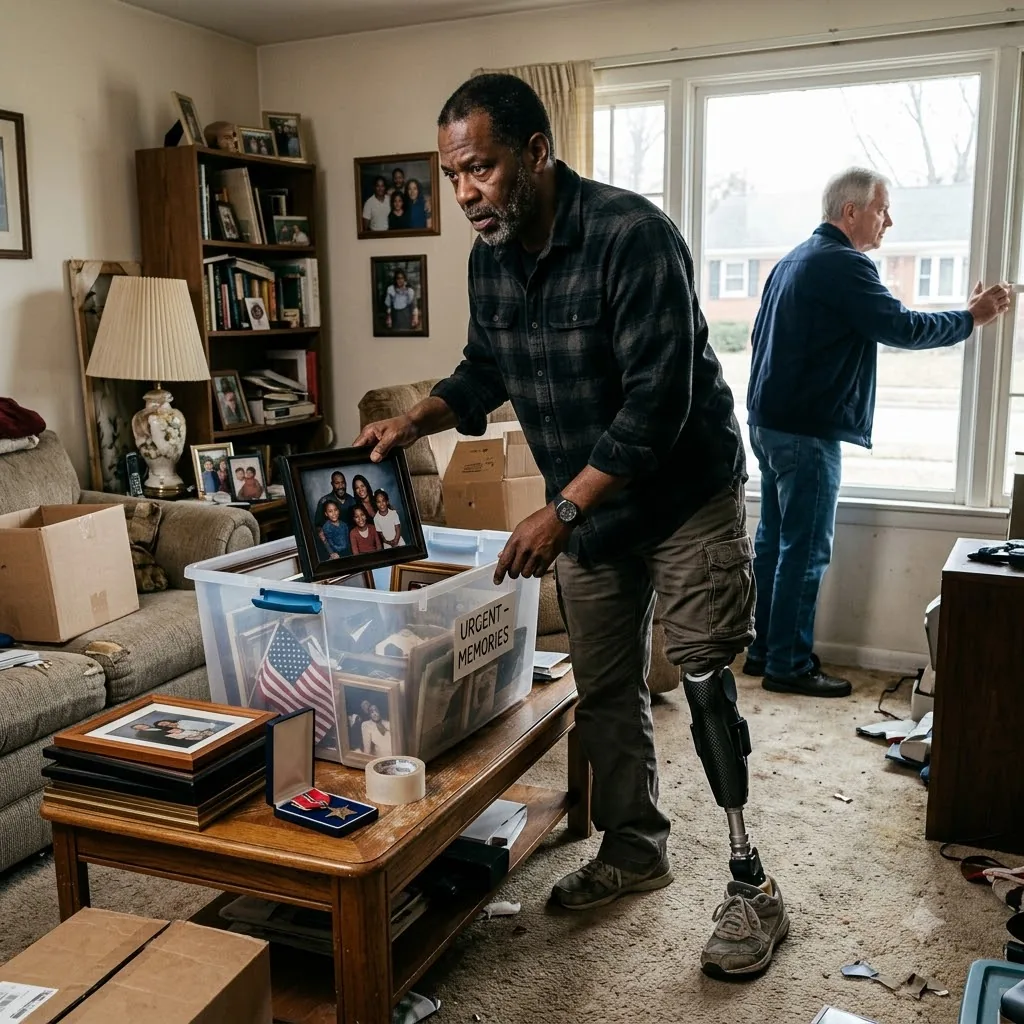
Marcus stood alone in the center of his whitewashed living room. The afternoon sun filtered through the blinds, casting pale, rigid stripes across the empty walls. He dragged himself to the hall closet and pulled the spare mop aside. He reached into the dark corner and gripped the handle of the heavy blue tote.
Every muscle in his back screamed as he hauled the plastic bin out into the hallway.
He opened the lid. The first thing he pulled out was the heavy shadow box. Through the glass, the Bronze Star gleamed in the dim light. A few miles away, his face was plastered on a highway billboard, forty feet high, wrapped in a flag, hailed as a hometown hero who had sacrificed his body for his country.
But standing in the house he was systematically being pushed out of, the medals felt like lead weights. The public patriotism was a performance. It was a comfortable, inspiring narrative for the morning commute. It did not translate to the equity in his home. It did not protect him from the polite, legally insulated theft executed with a clipboard and a laser measure.
Marcus carefully unwrapped the towel from the shadow box. He carried it back to the fireplace, ignoring the searing pain in his leg, and hung it precisely over the pale, rectangular ghost on the wall. He was going to have to fight the bank, and he was probably going to lose. But he was done erasing himself.