Story code: ST-001264
Part 2: The Valuation
“Sterling. Apex Valuation,” a brisk, nasal voice announced from the brightly lit foyer.
Marcus held his breath in the shadows of the hallway. He pressed his spine flat against the cool drywall, wrapping his large, calloused hand entirely around the rubber tip of his aluminum crutch to ensure it didn’t so much as graze the baseboards. From his vantage point in the gloom, he could just see the edge of the living room rug and the sharp, polished tips of the appraiser’s brown leather dress shoes.
“Thomas,” his friend replied, his voice projecting the exact right amount of casual, suburban confidence. “Thanks for coming out. Come on in. Can I get you some water or anything?”
“No, thank you. I have another property across town in forty-five minutes, so I’ll need to move efficiently,” Sterling said. The heavy front door clicked shut, sealing the three of them inside the house. A leather briefcase snapped open. “I’ll start with the interior measurements, check the finishes, and then walk the perimeter.”
Marcus closed his eyes, focusing on the slow, deliberate rhythm of his breathing. The sciatic nerve in his left leg was already pulsing with a toxic, electric heat from the hurried packing he had just finished. He shifted his weight marginally to his right, grinding his molars together to keep his jaw from trembling.
Footsteps moved into the center of the living room. A sharp, electronic beep echoed off the barren walls, followed by the faint red flicker of a laser measure dancing across the far baseboard.
“Good open concept,” Sterling noted, his voice flat and analytical. A pen scratched rapidly against a clipboard. “Are these original hardwoods?”
Marcus leaned his head back against the wall, silently willing Thomas to remember the index cards they had drilled over coffee that morning.
“Uh, yeah,” Thomas said smoothly. “Original. Refinished them last year.”
Marcus’s stomach plummeted. He squeezed his eyes shut in the dark. They were not original. The original floors had been heavily damaged, cheap pine from the late sixties. Marcus had spent three agonizing weeks on his hands and knees ripping them out and installing three-quarter-inch solid Brazilian cherry. It was a massive upgrade, a premium feature that justified a significant bump in the property’s comparable value.
“Hmm,” Sterling murmured. “I’ll note that. They’ve got some flex to them. Older subflooring usually does. I’ll have to grade the condition as average for their age.”
Thousands of dollars of equity instantly evaporated from the clipboard. Marcus’s chest tightened, the suffocating pressure returning. The entire point of this agonizing charade was to prove that the previous appraiser had lowballed him by eighty thousand dollars simply because of the Black family living inside. But by erasing himself from the house, Marcus had also erased the home’s passionate, knowledgeable caretaker. Thomas was a ghost haunting a shell, and his ignorance was bleeding Marcus dry just as effectively as the systemic bias had.
Their footsteps drifted toward the kitchen. Marcus tracked their location by the shifting shadows cast across the hallway floor.
“Granite countertops,” Sterling observed. More scratching. “Custom cabinetry?”
“Stock, actually, but high-end,” Thomas lied, attempting to sound humble.
Marcus bit the inside of his cheek hard enough to taste copper. He had built those cherry wood cabinets himself in the garage. They were entirely custom, dovetailed joints, soft-close hinges, designed specifically to maximize the awkward corner angles of the kitchen. Calling them stock meant they would be compared to big-box store prefabs.
“I see,” Sterling said, his tone growing faintly skeptical. “What about the plumbing for this farmhouse sink? Did you pull permits for the relocation? The county records I pulled this morning didn’t show anything recent.”
Silence hung in the air. Marcus could hear the refrigerator humming.
“I’d have to check my files,” Thomas stammered, the effortless confidence finally cracking. “The contractor handled all the paperwork. Might have been grouped under a general renovation permit.”
“I’ll need to see those invoices,” Sterling replied, the crisp professionalism sharpening into something more interrogative. “Without verified permits, I have to classify the plumbing as unpermitted DIY work. It’s a liability issue for the lender. It actually deducts from the total valuation.”
Marcus felt a cold sweat break out across his neck. The trap was backfiring catastrophically. He desperately needed this refinance to clear up the medical debt from his latest spine surgery and secure his daughters’ college funds. If this appraisal came in low-not because of race, but because of perceived shoddy, undocumented maintenance-the bank would deny the loan altogether. He would be forced to sell.
His left knee buckled slightly under the sustained strain. He hastily jammed his shoulder into the drywall to catch himself.
The floorboard beneath his right foot let out a sharp, piercing groan.
The scratching of the pen in the kitchen abruptly stopped.
“Is there someone else in the house?” Sterling asked. The appraiser’s footsteps moved away from the kitchen island, heading back toward the living room.
“No,” Thomas said quickly, though his voice sounded tight, pitched half an octave higher than normal. “Just the house settling. Old bones, you know?”
“Right,” Sterling said. The heavy leather shoes crossed the threshold from the kitchen tile back onto the living room wood. They were moving closer to the hallway. “Before I measure the bedrooms, I need to check the structural supports in the foundation. Is the crawlspace access in the hallway closet?”
Marcus’s eyes snapped open in the darkness.
“The access is outside,” Thomas said, stepping quickly into Sterling’s path. Marcus could see Thomas’s shadow intercepting the appraiser’s. “Around the back of the garage.”
“I’ll check that later, then,” Sterling said, undeterred. “I still need to calculate the interior storage volume. Standard procedure for this square footage tier.”
The shadows shifted as Sterling stepped around Thomas. The heavy, measured footsteps approached the mouth of the dark hallway. Marcus stopped breathing entirely. He pressed himself into the corner, his heart hammering against his ribs like a trapped bird.
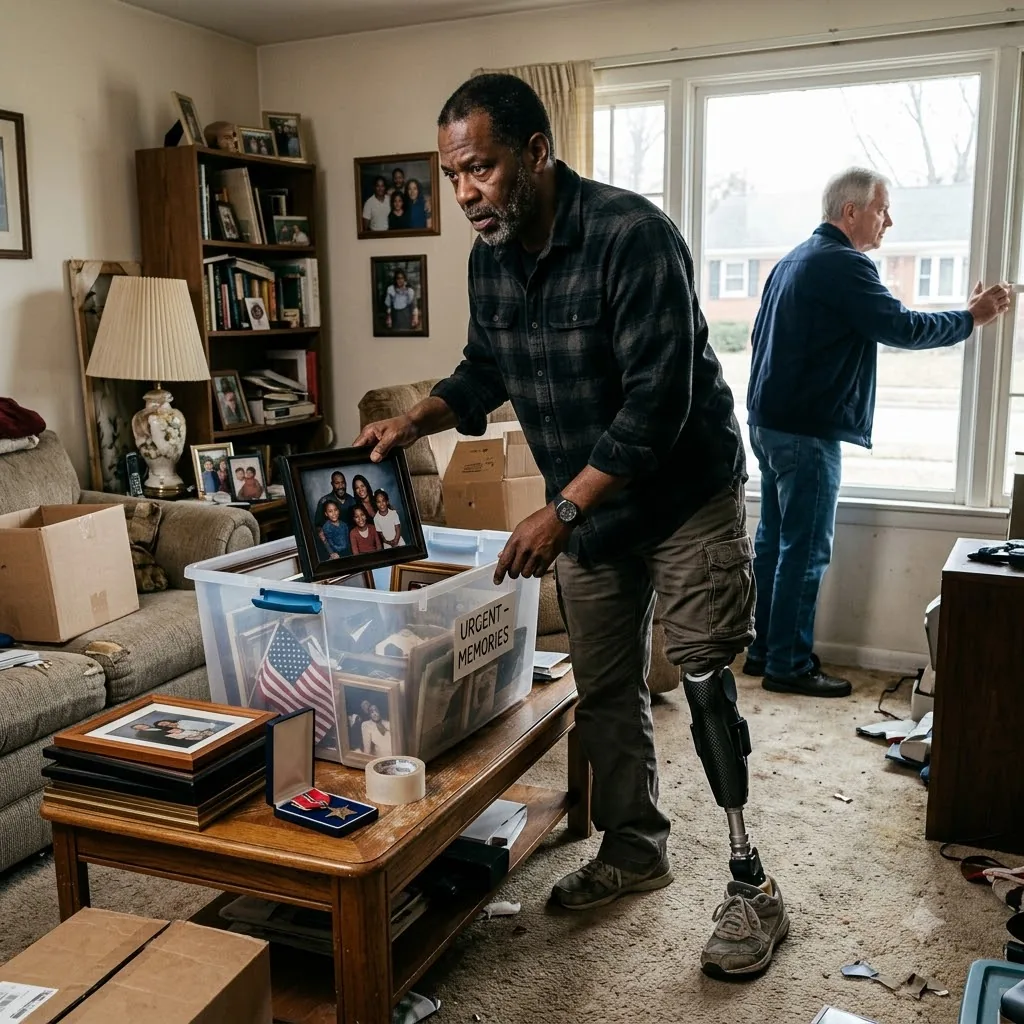
The coat closet was less than four feet away from him. It was where he had shoved the heavy blue plastic tote. The tote overflowing with his mail, his daughters’ framed photographs, the African American history books, and his bronze military medals.
Sterling’s shadow fell across the hallway floor. His hand reached out, closing firmly over the closet’s brass doorknob.