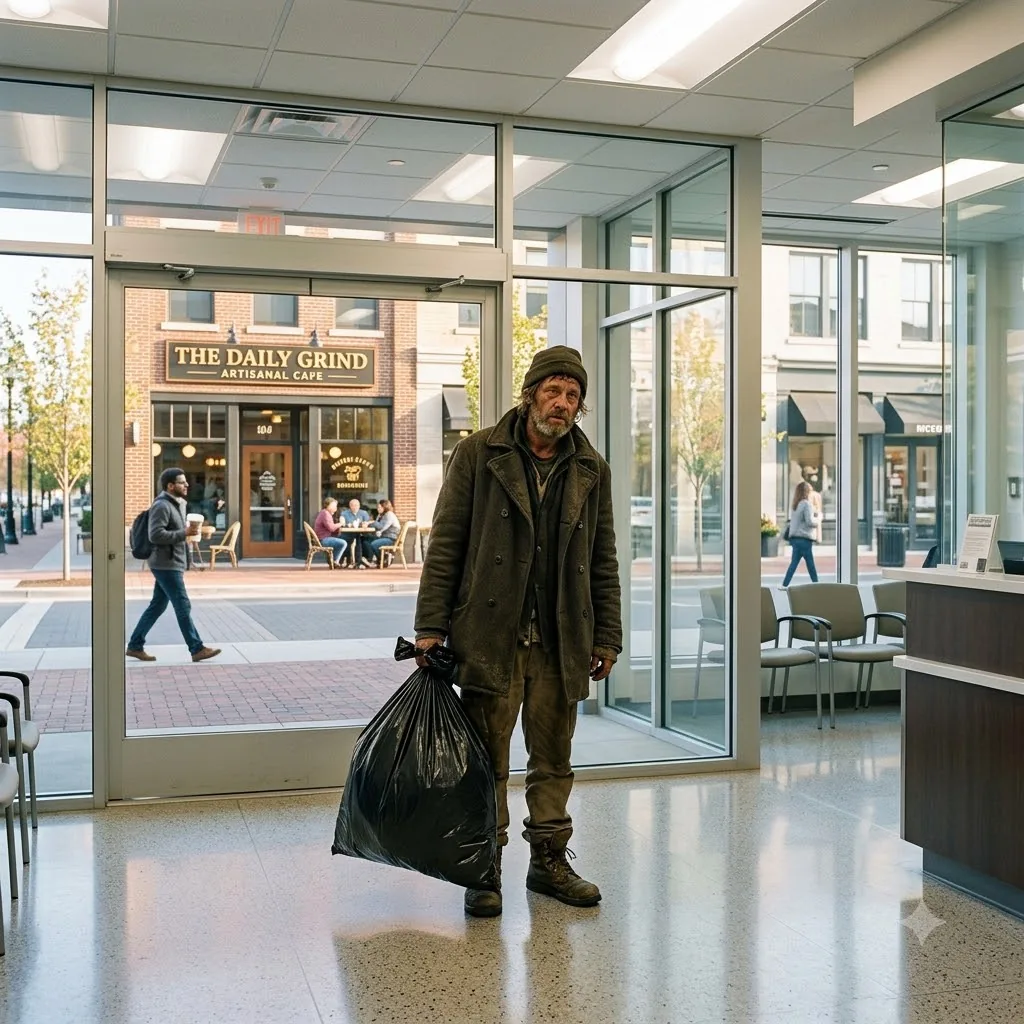
Story code: ST-001320
Part 2: Hostile Geometry
The concrete was freezing, a biting cold that seeped instantly through Sully’s worn denim jeans and into his aching, ruined knee. He kept his hands locked tight over the back of his neck, his face pressed hard against the decorative curb, waiting for the devastating shockwave. He braced for the spray of sand, the smell of cordite, and the deafening roar of shrapnel tearing through metal. Instead, the only sensation that washed over him was the damp, earthy smell of fresh pine bark mulch from the planter and the faint, sweet scent of roasted espresso.
His heart hammered a frantic, irregular rhythm against his ribs, vibrating through his chest into the pavement. The roar of the rotary engine faded, morphing back into the mundane rumble of a green delivery truck idling heavily at the intersection. Sully forced his eyes open, his breath hitching. The blinding, sun-bleached compound dissolved. In its place, the plate-glass window of the artisanal cafe swam back into sharp focus.
He wasn’t under fire. He was on the ground, curled in a desperate defensive posture, in the exact center of a bustling, affluent sidewalk.
A suffocating wave of heat flushed up his neck, burning his cheeks. Sully pushed himself up onto his good knee, his chest heaving as he tried to pull the crisp November air into his lungs. Less than ten feet away, a woman in a pristine, cream-colored trench coat had frozen in place, pulling the leash of her goldendoodle so tight the dog whined. She wasn’t looking at him with concern; her eyes were wide with naked, paralyzed terror. Behind the gleaming cafe window, a barista wearing a leather apron had a sleek silver smartphone pressed to his ear, his free hand pointing directly at Sully through the glass.
“I’m fine,” Sully rasped, the words scraping like dry sandpaper in his throat. “I’m fine.”
He reached blindly for his trash bag, his thick fingers finding the twisted plastic neck. He yanked it upward, desperate to get moving, to break the heavy, judging stares of the affluent morning crowd.
Riiiiiip.
The sound was impossibly loud, a jagged, tearing noise in the quiet morning air. The heavy heel of the combat boot inside, which had been threatening the thin material since he walked out of his room, finally sliced entirely through the bottom of the thirty-three-gallon bag. Gravity did the rest. The cheap plastic gave way, dumping the entirety of Sully’s meager life onto the newly power-washed concrete.
A pair of folded, faded jeans. Three worn, dog-eared paperbacks. A gray wool sweater unraveling at the cuff. Finally, a small tin box hit the pavement and popped open on impact, scattering a handful of loose brass screws, a spare bootlace, and a tarnished set of dog tags across the sidewalk.
Sully dropped back to both knees, ignoring the sharp, blinding spike of pain that radiated up his thigh. He scrambled to gather his things, his hands clumsy with cold and fading adrenaline. The woman in the trench coat stepped backward, her leather boots clicking sharply against the pavement, giving him a wide, paranoid berth. Nobody stepped forward to help. They just stared, a silent, disgusted audience watching a man try to shove his remaining dignity back into a torn garbage bag.
He shoved the jeans and the sweater into the surviving top half of the plastic, cradling it awkwardly against his chest like a wounded animal. He scooped up the tin box, snatched the dog tags from a puddle of condensation near a planter, and stuffed the cold metal into his coat pocket. He had to get off this block.
Limping heavily, Sully moved away from the cafe, aiming for the transit stop at the far corner. His breathing was still shallow, his pulse still roaring in his ears. He just needed five minutes to sit, to let the adrenaline crash pass, to figure out how to make fourteen dollars and twelve cents stretch until he could find a day-labor site.
He reached the bus stop and stopped dead, his bad knee buckling slightly.
Two years ago, there had been a wooden bench here, scored with graffiti and smelling of stale beer, but wide and flat. Now, a sleek, curved piece of brushed steel stood in its place. It was divided by three thick metal armrests, spaced exactly fourteen inches apart. The seat itself was slanted at a sharp downward angle. It wasn’t designed for sitting. It was designed for a brief, uncomfortable lean. It was a hostile geometric equation, engineered specifically to ensure men like him could never rest.
Sully stared at the anti-homeless architecture, the cold reality of his erasure settling over him like a suffocating blanket. He looked up at the low brick wall of the new luxury apartments behind the stop; iron spikes were bolted onto every flat surface. Even the subway heating grate on the sidewalk had been covered by a raised, jagged metal cage.
A sharp tap on glass drew his attention back down the block.
Through the reinforced window of the halfway house lobby, Sully saw Marcus. The manager wasn’t sitting behind his safe plexiglass desk anymore. He was standing near the front door, flanked by two men in impeccably tailored camel-hair overcoats. The men were pointing at the cracked plaster near the ceiling, then pointing out at the street, their faces masks of tight, impatient irritation. One of the men in the coats gestured aggressively toward Sully, who was standing down the block clutching his torn trash bag.
Even through the thick glass, Sully could see the heavy sheen of sweat on Marcus’s forehead. The manager’s usual bureaucratic indifference had completely evaporated. He nodded frantically, his shoulders hunched in the universal posture of a man desperately trying to save his own job. The developers weren’t just buying the neighborhood; they were demanding it be sanitized, scrubbed of any lingering human grime. And Marcus, desperate to prove his facility wasn’t a blight on their new investment, turned his glare entirely on Sully. Marcus slammed his hand flat against the glass, then violently jerked his thumb down the street, mouthing a clear, panicked directive. Move.
Before Sully could even process the betrayal of the institution that had anchored his life for two years, a flash of neon yellow caught his eye.
Rounding the corner by the artisanal cafe were two private security contractors. They wore high-visibility vests over black tactical gear, their utility belts heavy with thick plastic zip-ties. The barista in the leather apron was standing in the open doorway of the shop, pointing them straight toward the transit stop.
Sully’s chest tightened, the cold air suddenly feeling too thick to breathe. If those guards stopped him, if they ran his name and saw his fresh discharge, any confrontation could easily be framed as a parole violation. A violation meant a cage.
He clutched the torn bag tighter against his chest and turned the only way he could-into the narrow, shadowed alley between the halfway house and the new condo building. The moment he stepped into the gap, the wind caught him. The towering new structures had created a brutal, whistling wind tunnel, the freezing air biting straight through his thin coat, chilling the sweat on his neck to ice.
He limped faster, the cold sinking into his aching bones, aiming for the back street. But as the shadows deepened and he reached the end of the brick corridor, he stopped. At the end of the alley, completely blocking the exit, was a brand-new, ten-foot-high wrought-iron security gate, secured with a heavy electronic magnetic lock.
Behind him, the heavy, rhythmic crunch of tactical boots echoed at the mouth of the alley.