Story code: ST-001321
Part 4: The Mortality Rate
The VP broke first. The icy, commanding aura of the executive boardroom shattered as he scrambled backward, his expensive leather chair colliding hard with the acoustic glass wall. He looked at the scratched, empty insulin pump resting on the mahogany table as if it were a live grenade.
“You can’t do this,” the VP stammered, his voice climbing an octave. The polished corporate cadence was entirely gone, replaced by a raw, suffocating panic. “You can’t just come up here and… and die! Do you have any idea what kind of liability this is?”
Maya didn’t move. She didn’t blink. Inside her apron pocket, her thumb found the physical side button of her phone. She pressed it twice-the emergency shortcut that immediately began recording a voice memo. It was a reflex learned from hundreds of hostile delivery drop-offs, but this time, she wasn’t recording a customer complaining about cold food.
“Security!” a woman at the far end of the table shrieked, finally finding her voice.
“No, wait!” the VP yelled, his eyes darting frantically around the room. He patted his tailored suit jacket, plunging his shaking hands into his pockets. He pulled out a sleek silver money clip and began tearing off crisp hundred-dollar bills, throwing them onto the table next to the dead medical device. “Take it! Take the cash! Go buy your medicine!”
Maya stared at the scattered green paper. A few minutes ago, forty dollars would have saved her life. Now, the money just looked like trash.
“We didn’t know you would come here!” the VP babbled, his hands waving erratically in front of his chest. “The sweep is automated! We knew the extraction algorithm was aggressive, alright? We saw the beta projections! The risk-assessment team modeled for a three percent mortality rate among total-default accounts, but it was just data! Legal signed off on the collateral damage! You aren’t supposed to be in my boardroom!”
The heavy oak doors burst open behind Maya. Two security guards in dark suits rushed in, their hands resting on their utility belts. They slowed to a halt, taking in the bizarre scene: the towering, leaking catering boxes, the red financial data projecting across Maya’s back, and the VP practically hyperventilating against the glass.
“Get her out of here!” one of the executives yelled.
“Don’t touch her!” the VP screamed back, his face pale and shining with sweat. “If you put hands on her and she goes into a coma in the hallway, it’s a wrongful death suit! Just let her leave! Let her walk out!”
Maya looked at the VP one last time. She didn’t pick up the money. She didn’t pick up the empty pump. She just turned around and walked out. The security guards pressed themselves flat against the walnut-paneled walls, giving her a wide, terrified berth as she passed.
The elevator ride down to the lobby was entirely silent. The pressure popped in her ears. Her phone buzzed in her apron pocket, a sharp, double vibration. She pulled it out and looked at the cracked screen.
A bright red banner notification from the gig platform blocked her lock screen: *Your partnership has been deactivated. Reason: Severe Client Complaint / Security Breach at Drop-off.*
Maya swiped the notification away. It didn’t matter. She opened her financial portal. The $18,400 principal from her mother’s palliative care was still there, but now she clicked into the itemized breakdown. With the default triggers, collection fees, and the predatory compound interest the algorithm had automatically applied upon asset seizure, the final red number glaring at her was $84,320.
The elevator doors parted. She walked through the marble lobby, past the massive security desk, and pushed through the heavy glass doors into the blinding afternoon sun.
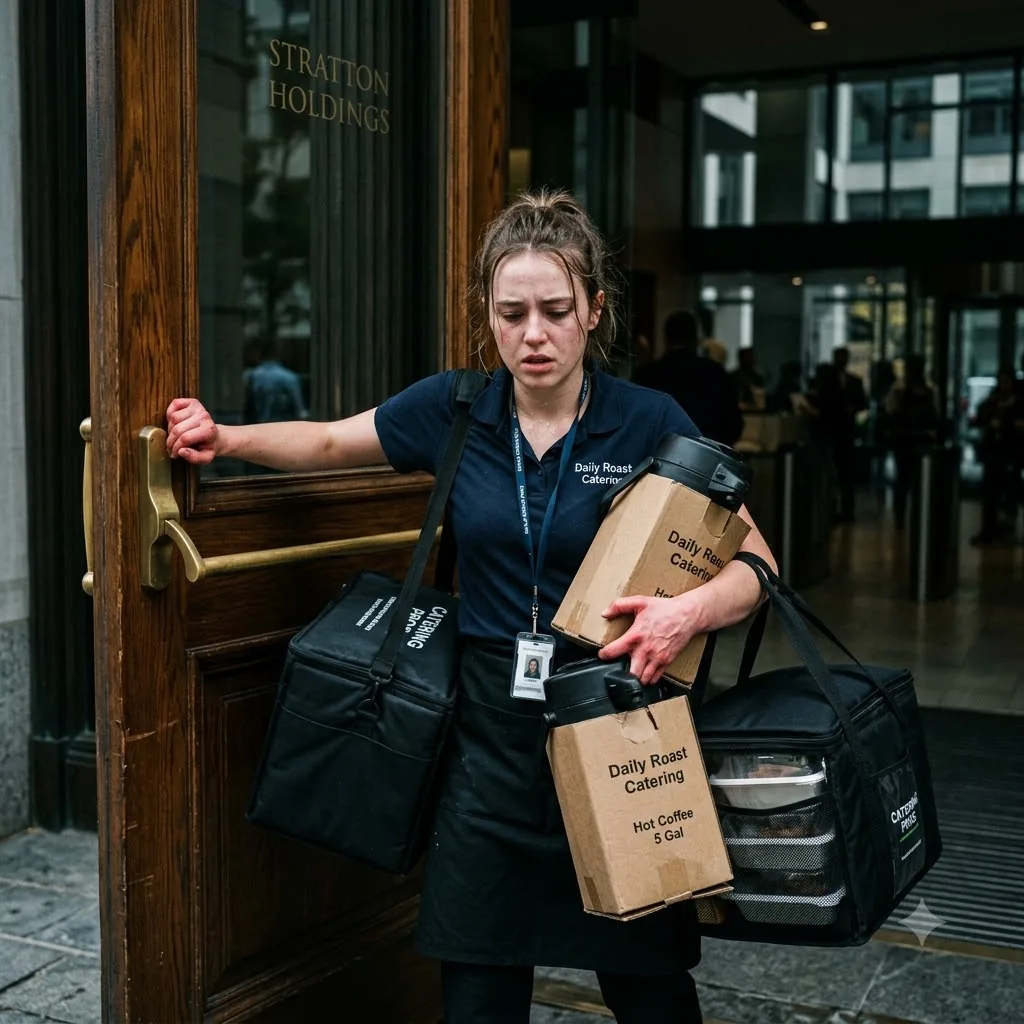
The city noise crashed over her-horns honking, subway grates rattling, sirens wailing in the distance. The physical toll of hauling thirty pounds up sixty floors suddenly caught up with her. Her knees buckled slightly. She stumbled to the edge of the sidewalk and sat down hard on the concrete curb, her breathing shallow and ragged.
Her hands shook violently as she reached into her pocket. Her fingers brushed past a crumpled receipt and found a foil-wrapped glucose tab. She peeled back the foil and put the chalky, synthetic grape tablet in her mouth, chewing it dry. It wouldn’t replace the insulin her body desperately needed. It wouldn’t fix the rising acid in her blood. But it was immediate, concentrated energy. It would keep her brain firing for the next hour.
Maya pulled her phone back out. She opened her voice memos and pressed play on the newest file.
*”We knew the extraction algorithm was aggressive, alright?”* the VP’s terrified voice played through the tiny speaker, perfectly clear over the background noise of traffic. *”The risk-assessment team modeled for a three percent mortality rate among total-default accounts, but it was just data! Legal signed off on the collateral damage!”*
Maya paused the audio. She looked at the $84,320 debt notification hovering in the background of her screen.
The hollow, cellular terror that had chased her for three days simply evaporated. The eighty-four thousand dollars was a fiction. The deactivation from the gig app was meaningless. The men in the glass tower had taken her money, her medication, and her mother’s dignity, assuming she would quietly fade away into a statistic.
She swallowed the last gritty remnants of the glucose tab. The crushing dread vanished, replaced by a cold, steady adrenaline. She looked up at the towering, sheer glass face of the corporate monolith, her thumb resting lightly on the audio file that was going to tear their world apart.