Story code: ST-001321
Part 2: Subject 44-A
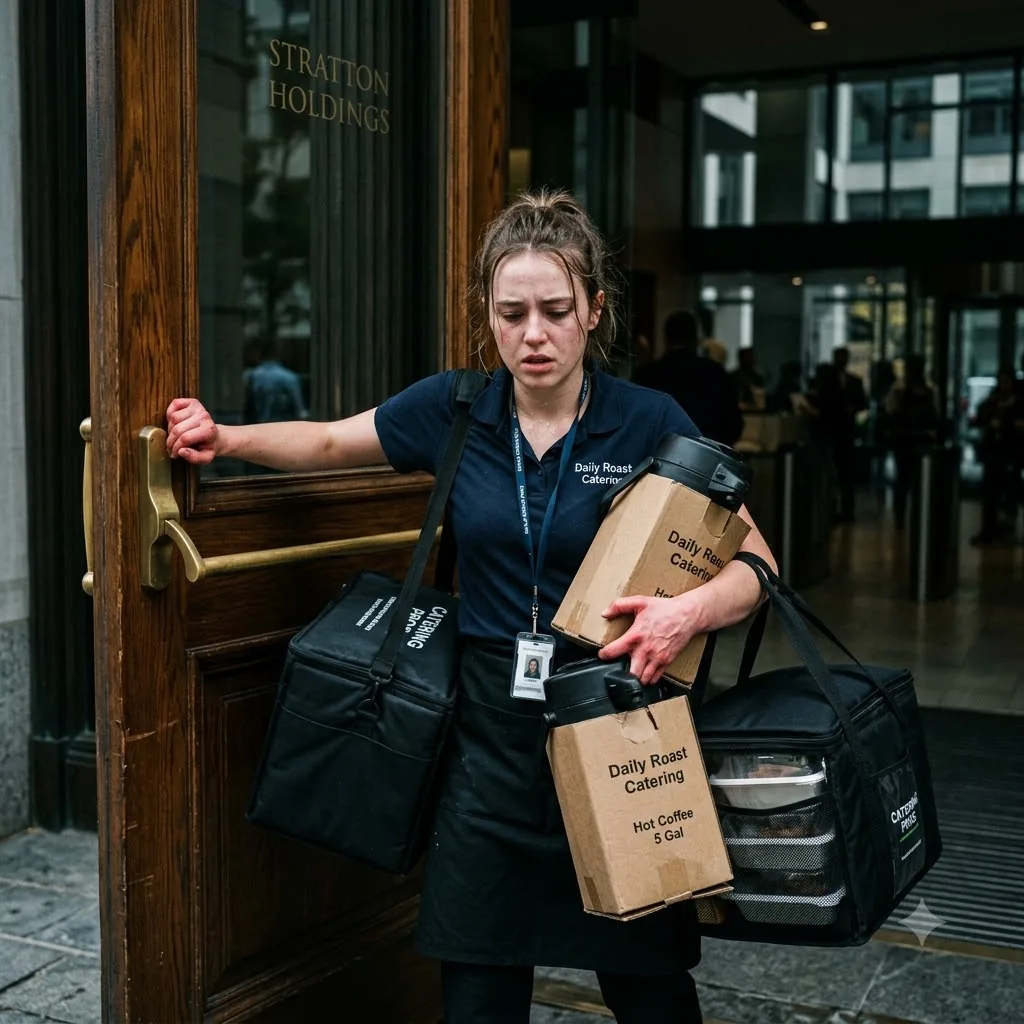
The cardboard carrier finally gave way. With a sickening rip, the wet bottom tore open, sending four heavy thermal carafes of scalding coffee plummeting toward the floor. Panic overrode Maya’s exhaustion. She dropped her knee, pinning the falling carafes against the heavy oak door, using her own body as a wedge. The impact bruised her thigh, and a splash of boiling dark roast shot across her wrist, but the containers didn’t shatter. The carpet was safe. She couldn’t afford a damage penalty. She had no choice. Ignoring the searing burn on her skin and the frantic hammering of her heart, she shoved the boardroom door open with her shoulder.
The air inside hit her like a physical wall of frost. The boardroom was cavernous, encased in floor-to-ceiling glass that overlooked the sprawling city grid. Around a massive mahogany table sat a dozen people in tailored suits, their glowing laptops forming a barrier between them and the rest of the world. At the head of the table stood a man in a slate-gray blazer, a silver laser pointer resting casually in his manicured hand. The conversation died the second Maya stumbled into the room, weighed down by the towering thermal bags and the precariously balanced coffee carafes.
“Finally,” the man at the head of the table sighed, his voice dripping with casual irritation. He pointed the laser at a long marble credenza against the far wall. “Set it up over there. Quietly. We’re in the middle of a quarterly review.”
Maya didn’t speak. She couldn’t. Her throat was a desert, the chronic, cellular thirst of her crashing blood sugar making it impossible to swallow. She kept her head down, her messy hair falling forward to shield her face, and hurried toward the credenza. Her arms shook violently as she lowered the thermal bags. Unzipping them, she began pulling out the heavy foil trays of scrambled eggs, bacon, and pastries. The smell of rich, greasy food hit her empty stomach, making her nauseous. Every movement felt sluggish, like she was submerged in molasses, the lack of insulin rapidly turning her blood acidic.
“As I was saying,” the man continued, turning his attention back to the massive OLED screen dominating the front wall. “Our new automated sweep algorithm is exceeding projections. We aren’t just waiting for the first of the month anymore. We are tracking micro-deposits in real-time and intercepting them before the debtor even knows the money has cleared.”
Maya lined up the carafes, her hands trembling so badly she could barely pop the lids open. She needed his signature on her delivery app. She needed him to select the twenty percent tip option. Or fifteen. Even ten percent would leave her a few dollars short, but maybe she could negotiate with the gray-market dealer in the alley. She pulled the reinforced company tablet from her apron pocket, the screen glowing with the $420.00 total and the blank signature box.
“Take this case file from this morning,” the man’s voice echoed off the glass walls. “Subject 44-A. Classic gig-economy profile. Unstable income, high medical debt. Eighteen thousand, four hundred dollars in arrears.”
Maya froze, the plastic tongs slipping from her fingers and clattering against the marble counter. Eighteen thousand, four hundred. That was the exact amount of her hospital bill from last year. The bill that had been sold to collections.
She turned her head, her breath hitching, and looked at the massive presentation screen. The slide was titled *Real-Time Asset Extraction*. There was a pie chart of a bank account. A timeline of deposits. And there, in the top right corner, was a blurred-out name, but the street address wasn’t blurred. It was her apartment building on 114th Street. The last four digits of the social security number on the screen were her digits.
“The algorithm caught a deposit of fifty-two dollars at 6:00 AM,” the executive boasted, pacing in front of the screen. “It swept the entire amount by 6:02 AM. We left the account at absolute zero. The beauty of this aggressive posture is that we force a cascading failure. Next week, they default on their vehicle, triggering our repossession clause.”
A wave of dizziness washed over Maya, the edges of her vision turning dark and static. The fifty-two dollars. That was the money she had scraped together yesterday, the money she had checked this morning only to find it vanished into a garnishment. The man standing ten feet away from her was the one who had taken her lifeblood. He was using her financial execution as a corporate bragging point.
*I need the tip,* her brain screamed through the fog of panic. *Nothing else matters. Get the tip. Get the insulin.*
Gripping the tablet like a shield, Maya forced her legs to move. She walked toward the head of the table, her scuffed sneakers silent on the thick carpet. She stopped beside the executive. Close up, he smelled of expensive cologne and peppermint.
“Excuse me,” Maya rasped out, her voice barely a whisper. “I just… I need a signature for the catering.”
The executive sighed loudly, clearly offended by the proximity of the sweating, trembling delivery worker. He lowered his laser pointer and snatched the tablet from her hand. “Four hundred and twenty dollars for breakfast,” he muttered, shaking his head. “Highway robbery.”
The tip screen populated. *15%. 20%. 25%. Custom.* Maya stared at his thumb, praying for it to hit the twenty. Her heart hammered against her ribs, a frantic bird trapped in a cage. Her vision blurred again, and she swayed slightly, catching herself on the edge of the mahogany table.
The executive’s thumb hovered over the screen. But he didn’t tap it. He paused. He turned his head and looked at Maya. Really looked at her. He took in her pale, sweating face, the dark bags under her eyes, the coffee stains on her shirt. Then, a click sounded from the presentation remote in his other hand. The slide on the massive screen behind him transitioned. It was a secondary profile page for Subject 44-A. And right in the center of the slide was an unredacted photograph-her driver’s license photo, blown up to five feet tall.
The executive looked at the giant face on the wall. Then he slowly turned his head back, his eyes locking onto the exhausted, desperate gig worker standing right in front of him, the tablet still hovering in his hand.