Story code: ST-001336
Part 2: The Vanguard Migration
The man clasping Tyler’s hand was unmistakable, even from the side angle. It was Richard Sterling, the CEO of Vanguard Systems. Vanguard was the exact monolithic enterprise they had spent the last two years mocking in their pitch decks-a dinosaur tech conglomerate notorious for buying out disruptive startups and burying their tech to protect its own outdated market share.
Tyler pulled Sterling into a one-armed embrace, projecting the image of old friends reuniting. The crowd murmured in surprise. Marcus gripped the edge of the velvet curtain, his knuckles turning white.
“Thank you, Richard,” Tyler said into his microphone, his voice echoing through the massive auditorium. “Ladies and gentlemen, we told you tonight we were looking for a Series A investment to scale our neural processing architecture. But over the last seventy-two hours, the roadmap evolved.”
Marcus stared at his co-founder. Seventy-two hours. Tyler had been negotiating with Vanguard behind his back for three days. While Marcus was pulling all-nighters optimizing the database shards, Tyler was selling them out.
“We aren’t here to ask for your money,” Tyler continued, turning to smile at the VIP section. “We’re here to announce an exclusive, tier-one acquisition and integration deal with Vanguard Systems.”
The crowd erupted into applause. Sterling waved to the audience. On the massive LED screen behind them, the flowchart shifted, Vanguard’s logo expanding to swallow the node that represented Marcus’s proprietary algorithm.
The lockout made complete, sickening sense now. Tyler hadn’t just changed passwords; he had executed a full migration. He had transferred the GitHub repositories, the AWS instances, and the DNS records to Vanguard’s enterprise servers. The original startup infrastructure didn’t exist anymore. Marcus wasn’t locked out of his house; the house had been bulldozed, and Tyler was currently handing over the deed to the empty lot.
“Excuse me,” a sharp voice whispered.
Marcus jumped. A stage manager in black clothing, wearing a heavy headset, stood beside him. She shone a small, red-filtered flashlight at his chest. “You can’t be in the wings. This is a restricted area.”
“I’m his co-founder,” Marcus hissed, pointing at Tyler. “That’s my company.”
The stage manager frowned and glanced at the glowing tablet strapped to her wrist. “I only have a Tyler Corfton listed for this block. Solo founder. You need to return to the green room or I’m calling security.”
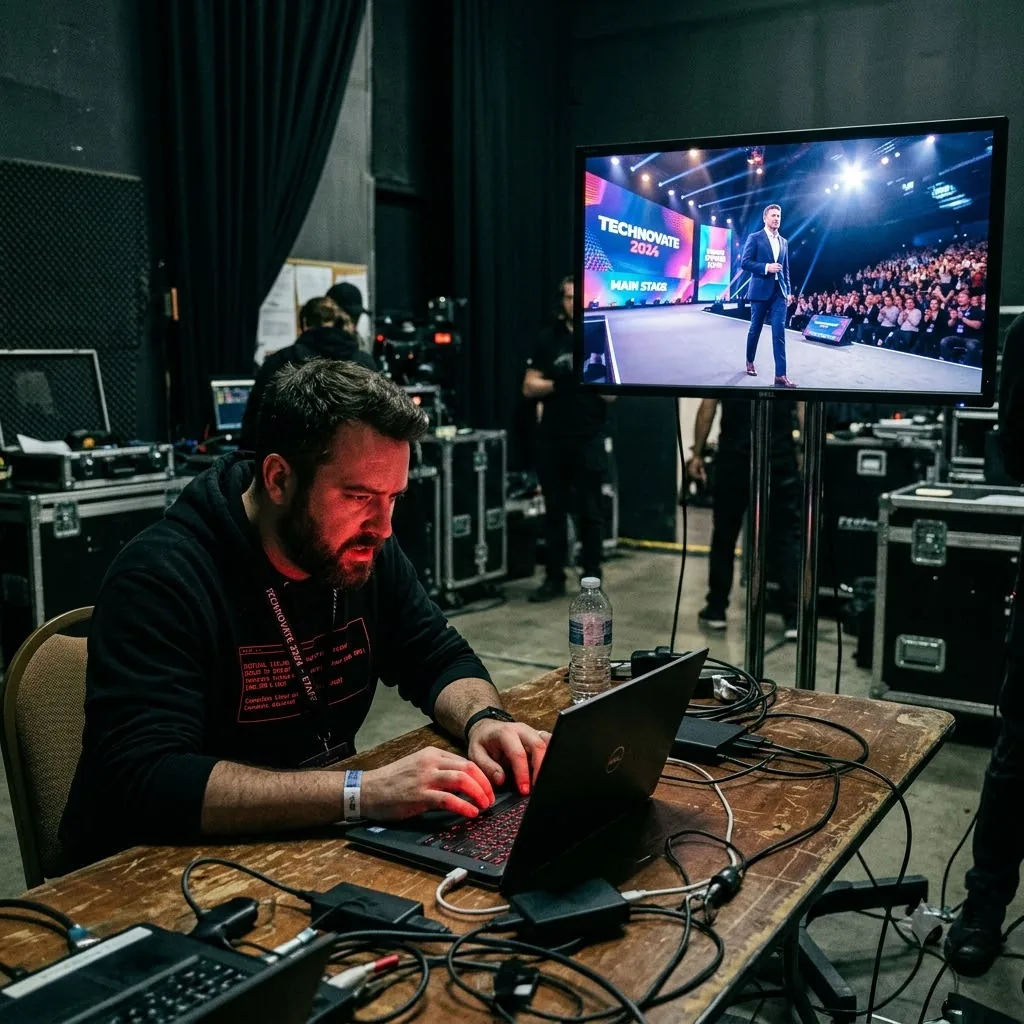
Solo founder. Marcus felt the air thin out in his lungs. He backed away from the stage manager, retreating deeper into the shadows of the wings but refusing to leave the backstage area entirely. He found a heavy, black production crate tucked behind a rack of stage lights and dropped his laptop onto it.
He flipped the screen open. The venue’s public Wi-Fi connected automatically. If Tyler had migrated the servers to Vanguard, they were behind a corporate firewall now. But Marcus knew the code better than he knew his own heartbeat. The V2 neural engine wasn’t a static piece of software you could just copy and paste. It required a live, continuously authenticating handshake with a master node to process the data weights.
Marcus brought up a raw terminal window. His hands were shaking so badly he mistyped his own home IP address twice. He finally connected via SSH to the Raspberry Pi sitting on his kitchen counter across town-a shadow server he used for compiling localized tests. It was completely independent of the startup’s official infrastructure.
He ran a rapid packet trace, pinging the unique identifier of the neural engine’s API.
The terminal flooded with incoming traffic.
Marcus blinked, leaning closer to the glowing screen in the dark. The engine wasn’t just online; it was highly active. On stage, Sterling was speaking now, his booming voice carrying over the monitors.
“To prove the power of this integration, Tyler and I aren’t just going to show you a slideshow,” Sterling announced. “We are going to run a live, real-time stress test of the neural net, right here, right now, ingesting the live financial data streams of the Asian markets.”
Marcus watched the terminal output. The data requests were firing at a massive rate, pulling from the Vanguard servers. But the Vanguard servers weren’t doing the processing.
The return pings were bouncing back to Marcus’s IP address.
Tyler hadn’t finished rewriting the authentication protocol for the Vanguard migration. He hadn’t known how. Instead, to make the live demo work tonight, Tyler had hardcoded the Vanguard application to securely tunnel back into Marcus’s personal, private network.
Marcus stared at the cascading lines of green text. Tyler was running the most critical demonstration of their lives, for a multi-million dollar acquisition, using Marcus’s personal hardware as the processing engine.
A notification popped up in the corner of Marcus’s screen. It was an email, sent to his personal account from Vanguard Systems Legal. The subject line read: *Notice of Termination and Transfer of Liability.*
He clicked it open. It was a digitally signed contract, backdated to yesterday, stating that Marcus had been terminated for cause due to “unauthorized handling of secure data,” and that he alone assumed all legal liability for any security breaches involving the neural engine’s open-source components.
On stage, Tyler clicked his remote. “Let’s initialize the data sync,” Tyler said, grinning at the crowd.
Marcus looked back at the terminal. Vanguard was piping terabytes of raw, heavily regulated financial data directly into Marcus’s unencrypted, unsecured home server. If the server crashed, Vanguard would blame the failure on a rogue former employee attempting to sabotage the event. If it succeeded, Vanguard took the credit, and Marcus had a legally binding document proving he was illegally hosting stolen corporate data on a personal device.
He had the terminal open. He could type `sudo killall` and terminate the process, crashing the demo instantly. But as his fingers hovered over the keys, the packet sniffer picked up a new, highly encrypted payload piggybacking on the Vanguard data stream-a payload that wasn’t supposed to be there, injecting itself directly into Marcus’s root directory.