Story code: ST-001375
Part 2: The Poison Pill
The iron head of the sledgehammer collided with the weakened steel casing with a deafening, bone-rattling crack.
Sarah flinched, throwing her hands over her ears as the sound wave physically hit her chest. A jagged black fissure ripped up the side of the main housing. For a fraction of a second, nothing else happened. Then, a massive, agonizing groan of straining metal echoed across the dead cornfields. The towering aluminum skeleton of the center-pivot system shuddered, dropping a few inches as the primary support column buckled inward.
“Are you insane?” Sarah shrieked, her carefully practiced corporate monotone entirely abandoned.
Elias ignored her. He stepped back, adjusted his grip on the hickory handle, and swung again.
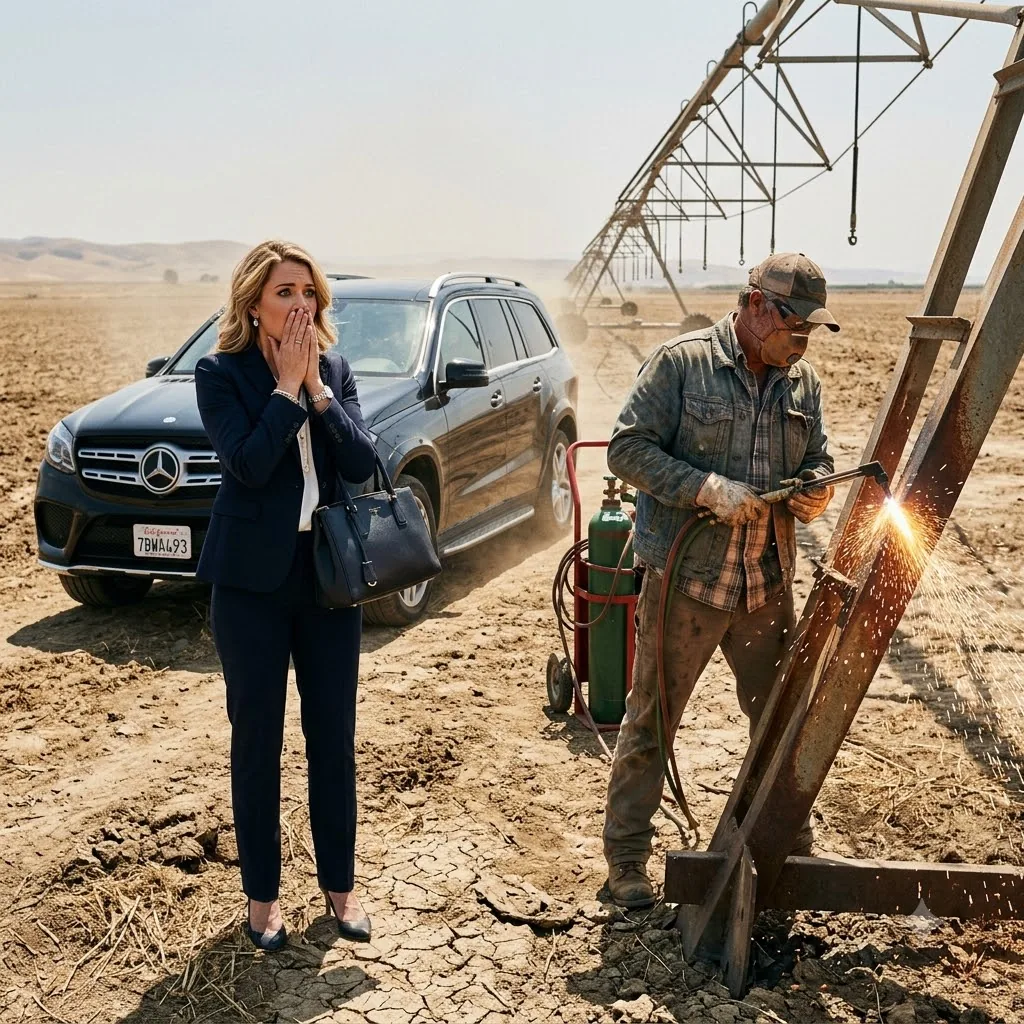
The second blow landed squarely on the fissure. The cast-iron housing shattered. Shrapnel the size of dinner plates exploded into the dirt. A violent hiss of trapped subterranean air escaped the cracked wellhead, blowing a cloud of red dust over Sarah’s tailored suit. She coughed, staggering backward, her eyes watering from the sudden blast of ancient, stale air rushing up from the aquifer.
“Stop!” she screamed, lunging forward before logic could catch up with her panic. She grabbed the handle of the sledgehammer just as Elias brought it down to his side.
The physical contact was a mistake. The hickory wood was hot and rough, and the sheer immovable mass of the man holding it sent a shock of terrifying vulnerability straight down her spine. Elias stopped, looking down at her manicured hands gripping his tool. He didn’t pull away, nor did he loosen his grip. He just looked at her with that same unnerving, tranquil expression.
“Let go of it,” Sarah commanded, her voice trembling. “If that pipe collapses, the borehole is compromised. The company won’t pay you a dime, Elias. They will sue you into oblivion. You’ll go to federal prison for defrauding a corporate entity. You will die in a cell.”
“I’m dying in a dust bowl, Sarah,” Elias said gently. He gave the hammer a slight tug. She held on, her knuckles white, her breath coming in shallow, frantic gasps. He didn’t force it. He simply let go of the handle with his left hand and gestured toward the horizon. “Look at it.”
“I don’t care about the crops!” she snapped, refusing to follow his gaze. “I care about the contract in my hand. The one that saves your life!”
“You care about the water,” he corrected, his voice a low, steady rumble over the hissing of the damaged wellhead. “And I read the terms. Page forty-two, subsection C. Maximum extraction yield.”
Sarah froze. The tight, ugly knot of jealousy in her chest twisted into cold dread. Most farmers never read past the financial settlement page. They saw the zeroes and signed. She had banked her entire promotion on Elias doing exactly that.
“That is standard agricultural zoning boilerplate,” she lied, the words tasting like ash in her dry mouth.
“It’s an industrial draining mandate,” Elias countered, shaking his head. “Your company isn’t going to farm this land. You’re going to run this pump twenty-four hours a day, pipeline it straight to the bottling plant in San Jose, and bleed the aquifer dry in two years. When you do, every well within fifty miles goes dry with it. The Miller family, the Hendersons. Their farms die.”
“That is not your problem!” Sarah yelled. “You are foreclosed! You have nothing! Why are you setting yourself on fire to keep people who didn’t even help you warm?”
“Because they’re my neighbors,” he said simply. He gently but firmly pried her fingers off the sledgehammer. She lacked the upper-body strength to resist. “And because I can.”
He turned his back on her, a profound display of dismissal that made Sarah want to scream. She dropped her leather portfolio into the dust. The pristine, sixty-page document that represented her entire future spilled out, its edges instantly curling in the brutal heat. She dug her phone out of her pocket, her thumb slipping frantically against the glass screen.
*No Service.*
She swore, waving the phone in the air, stepping over the scattered pages of the contract. “I will call the sheriff, Elias! I will drive up the ridge, get a signal, and have you arrested!”
Elias walked over to the bed of his rusted pickup truck, entirely unbothered by her threats. He unlatched the tailgate. It dropped with a heavy metallic clang. Sitting in the truck bed was a fifty-gallon steel drum, painted bright yellow with black hazardous-material warnings plastered across its sides.
Sarah recognized the logo. It was a rapid-set industrial epoxy, a dense, expanding chemical resin used to permanently cap abandoned oil wells deep underground. If it was introduced to the water table, it hardened into an impenetrable, toxic plug of artificial rock. It couldn’t be drilled through. It couldn’t be blasted. It would render the entire quadrant permanently inaccessible.
“Elias, no,” Sarah whispered, the blood draining from her face.
“By the time the sheriff gets out here, this resin will be two hundred feet down the shaft,” Elias said, hauling the heavy drum toward the edge of the tailgate. The truck’s suspension groaned as he shifted the weight. “Once it hits the water, it expands. Sets in three minutes. Plugs the borehole for good. Your company gets the dirt, but the water stays in the earth where it belongs.”
“They’ll fire me,” Sarah blurted out.
It was the most honest thing she had said all year. The words tumbled out unbidden, stripped of all corporate armor. If she returned to Chicago with a sabotaged well and a worthless patch of dirt, her career wasn’t just stalled; it was over. She would be the scapegoat for a multi-million-dollar blunder.
Elias paused, his hands gripping the rim of the yellow drum. He looked at her, his expression softening into something resembling pity. That pity stung worse than a slap.
“Then I guess we’re both out of a job,” he said softly.
He tipped the barrel. It slid down the tailgate and hit the earth with a heavy thud, kicking up a cloud of pulverized topsoil. He grabbed a crowbar from the truck bed and walked the barrel toward the cracked, hissing wellhead.
Sarah stared at the heavy iron sledgehammer resting in the dirt at her feet. She looked at Elias, slowly rolling the drum of resin toward the exposed shaft. The heat beat down on her shoulders, heavy and suffocating. Her phone was a useless brick in her hand. The silence of the dead farm pressed in from all sides, offering no help, no witnesses, and no way out.