Story code: ST-001420
Part 4: The Opt-Out
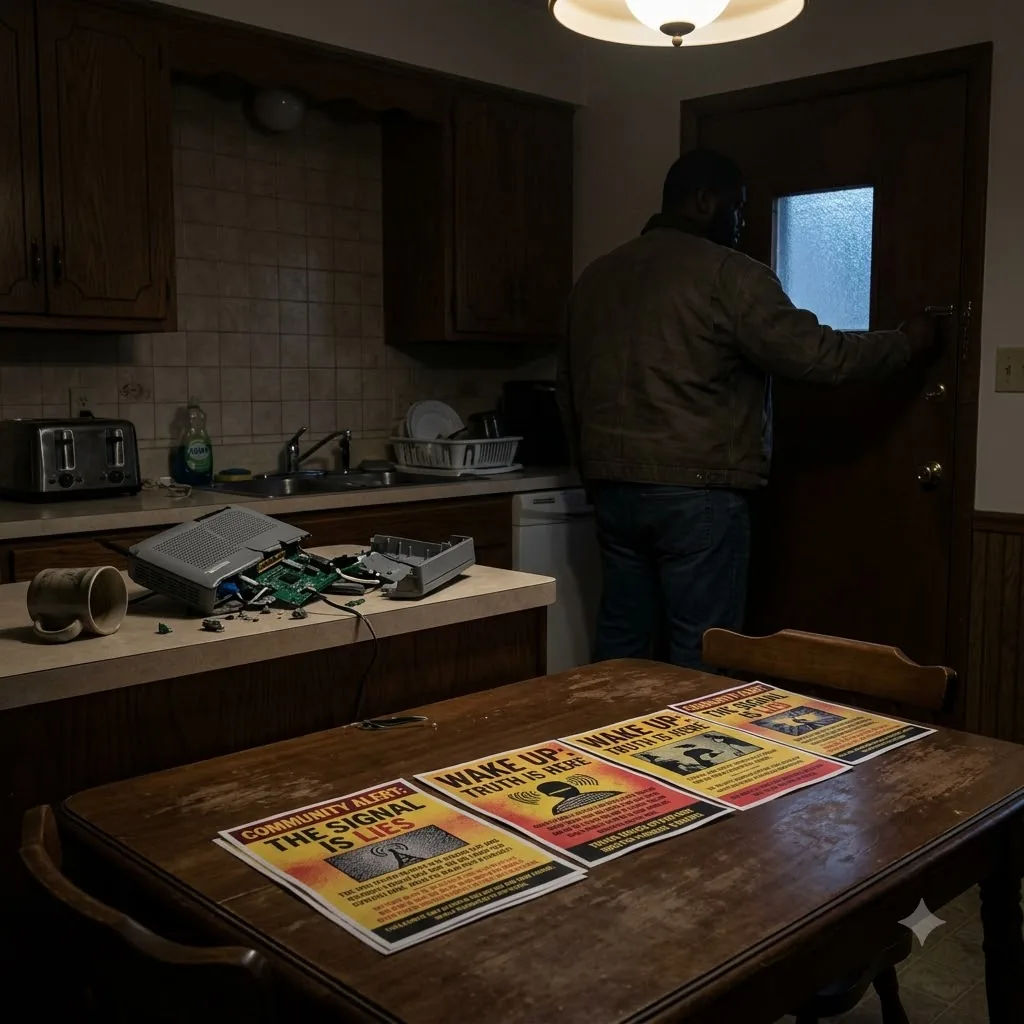
The standoff froze in the suffocating heat of the dining room. The voice of David, the Apex data broker, continued to bleed from the tiny speaker on the hardwood floor. “I have the billing address tied to the account! I’m connecting to the local precinct! Don’t touch him!” The polished, bored customer service drone was gone, replaced by a man hyperventilating, suddenly horrified by the blood pooling on his digital ledger.
Barrett’s thick fingers went slack. He backed away from Elias, holding his hands up at chest level as if the teenager had suddenly caught fire. The giant man looked nervously toward his partner.
Cole didn’t hesitate. He shoved the coiled plastic zip tie deep into his cargo pocket. His cold, mercenary professionalism evaporated into sheer panic. “We’re done,” Cole barked, stepping quickly around the dining table. “You said this was a clean, uncontested extraction, Vance. You didn’t say anything about live witnesses or federal dispatch.”
“Wait,” Pastor Miller stammered, his syrupy cadence breaking into a desperate croak. “You have a contract. We paid the retainer-”
“Keep it,” Cole snapped. He shoved past the pastor, grabbing Barrett’s shoulder. “If the cops find us dragging a minor into a van while a corporate executive is on the phone screaming about kidnapping, we go to prison. We aren’t taking the fall because you idiots couldn’t control your own household data.”
The two transport men didn’t look back. Their heavy boots thundered down the hallway, shaking the floorboards. The front door ripped open, letting in a brief gust of warm evening air, and slammed shut. Seconds later, the diesel engine roared to life, tires squealing in reverse down the gravel driveway.
Silence crashed back into the house, but the architecture of power had fundamentally fractured.
Pastor Miller dropped to his knees, his hands trembling violently as he snatched his phone off the floor. He jabbed at the red button, cutting off David’s frantic shouts, plunging the room into quiet once more. Miller stared at the black screen, his chest heaving. The righteous veneer was entirely stripped away, leaving only a terrified, sweaty man sitting on the floor of a ruined dining room.
Elias’s father stood frozen by the sliding glass patio door. The absolute authority that had locked the deadbolt and smashed the router was gone, shattered by the realization that the outside world was now looking in. The sterile, isolated courtroom of their home had been breached.
“You called the police on your own family,” his father whispered, the anger in his voice hollowed out by disbelief.
Elias rubbed his bruised wrist. He looked at his mother. She was staring at the grid of glossy, targeted advertisements on the oak table. The printed pages didn’t look like righteous proof anymore; they looked like a crime scene. She covered her mouth with both hands, a muffled sob escaping her throat as she realized the algorithmic crusade had just cost her her son.
Elias knew what would happen when the police arrived. He was seventeen. The officers would take statements, Miller would smooth his suit and lie about the transport team, and his father would invoke his parental rights. They wouldn’t take Elias away; they would leave him trapped in this house, indefinitely, until his father found a quieter, darker way to send him off.
He couldn’t stay. The system wouldn’t protect him.
Elias stepped away from the patio door. He walked past his father. The older man twitched, his hands balling into fists, but he didn’t reach out. The phantom threat of the approaching sirens paralyzed him.
Elias moved into the hallway and picked up his abandoned backpack. He reached into his pocket, pulled out his own smartphone, and dropped it onto the entryway table. The glass screen clattered loudly against the wood. It was the device that had sold him out, the invisible tether that had broadcast his deepest secrets to the highest bidder. He was done with it.
He grabbed the heavy brass knob, unlocked the deadbolt, and stepped out into the twilight.
The air was cooling rapidly, the shadows of the suburban street stretching long and dark across the manicured lawns. Elias walked down the driveway, his sneakers crunching on the loose gravel. He didn’t know where he was going. He had thirty dollars in his wallet, no phone, and the crushing realization that he could never return to the house behind him. The looming reality of the streets-the cold, the hunger, the absolute vulnerability-pressed down heavily on his shoulders. It was a terrifying, jagged future.
But as he turned the corner, walking fast against the coming night, he thought of David’s panicked, hyperventilating voice on the speakerphone. Elias realized he wasn’t the only one whose life had shattered today. Somewhere in a sterile corporate park, a data broker was staring at a screen, permanently haunted by the violent human reality behind a single row of sold coordinates. The illusion of harmless data was dead for both of them, leaving Elias to disappear into the dark, entirely unseen.