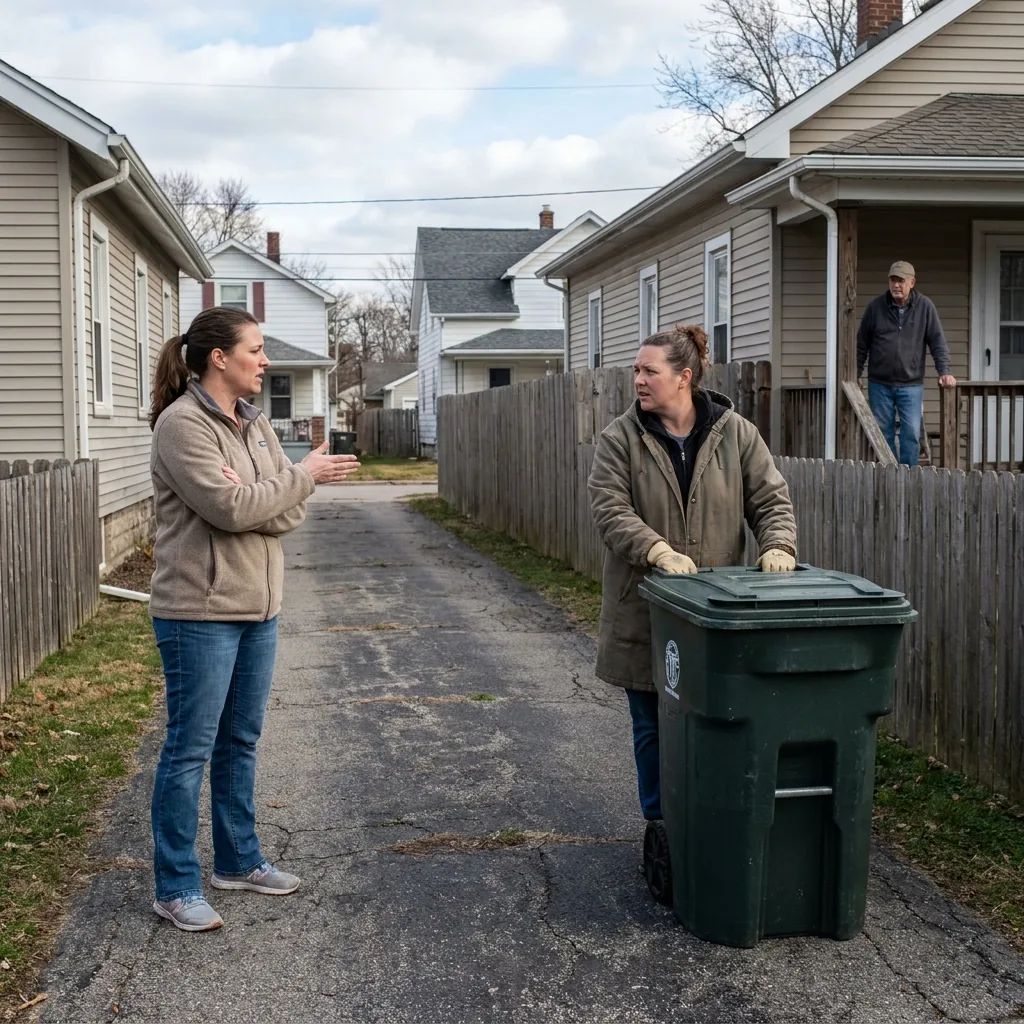
Story code: ST-000281
Part 2: The Wheel Did Not Match
Leah said Dana had swapped the whole bin before anyone came outside, but the wheel still carried a chalky rim of pale gravel dust from the strip beside Dana Miller’s fence gate. Tina Reed saw it when Dana saw it, and once that detail entered the driveway, Leah’s story had to fight something concrete instead of just people. The ugly part was that even then, the first accusation did not die cleanly.
Tina pointed without stepping over the boundary seam.
“Look at the wheel,” she said.
Mr. Alvarez bent enough to see it. The dust sat in the grooves near the outer edge, not like something blown on by the wind, but packed into the tread where the bin had rolled over rough stone and then onto concrete.
Leah glanced down and answered before anyone else could.
“There was gravel in the alley last month.”
There was no alley behind Maple Drive. The houses backed to short fenced yards and a drainage strip. Nobody corrected her immediately, which somehow made the moment sharper. Dana stood with both hands at her sides and let the silence hold a beat longer than Leah seemed to expect.
Then Dana said, “There is gravel by my gate.”
It was a plain sentence, not a dramatic one. Tina turned and looked toward the side yard. From the driveway, the narrow strip beside Dana’s fence was visible through the open gate: two stepping stones, a row of planters, and a broken line of pale gravel that had spilled wide near the latch post.
Mr. Alvarez looked from the gate back to the wheel.
Leah crossed her arms tighter. “So she rolled it there after taking it.”
Dana answered, “Then the tag should help you.”
That was the part Leah kept trying to skip. The pickup tag hung where the molded plastic dipped inward near the axle. It was not a decorative tag or something from a store. It was the city kind, printed on stiff stock, with a service line, a date box, and a handwritten address that matched Dana’s house number.
Tina stepped closer, careful not to touch the bin.
“The writing looks old enough to have been out here since Monday,” she said.
“Old enough” was not proof by itself, but it was another small thing that did not help Leah. The plastic tie had left a rubbed mark where it had shifted against the black handle during two days of moving. The corner of the tag had softened from dew. None of it looked newly attached.
Leah reached down suddenly and grabbed the tag between two fingers.
Dana did not move. Neither did Tina.
“Read it out loud,” Dana said.
Leah gave the tag a short jerk, as if she meant to twist it around without fully committing to it. The plastic tie tightened and snapped the card flat again against the bin.
Mr. Alvarez said, “Just read it.”
Leah looked up at him first, then back at the card. Her mouth set hard. She did not read the handwritten line. Instead she tapped the printed service code and said, “This doesn’t prove whose bin it is. It proves someone called for service.”
“On what address?” Tina asked.
Leah did not answer Tina. She lifted her chin toward Dana and went back to the original accusation.
“She drags bins around all the time. That’s the point.”
It was the same claim again, only broader now. The scene had shifted from one bin to Dana’s reputation, which was exactly why the first accusation had bite. If Leah could keep it general, she could avoid the tag, the wheel, and the front sticker long enough to leave a stain anyway.
Dana finally stepped forward again and turned the bin a little more. The city sticker on the front caught the light. Under it, the white address numbers showed older paint pooled into the texture of the plastic.
“You said the label was on the front and got peeled off,” Dana said. “Where?”
Leah stared at the front panel. There was no scraped rectangle, no adhesive shadow, no cleaner patch where something had been removed. The scuffs and sun-fade ran evenly across the surface except where Dana’s sticker sat.
Mr. Alvarez straightened slowly. “If a sticker came off, you’d see it.”
Leah put one hand on the lid. “Not if she cleaned it.”
“With what?” Tina asked. “Because the dirt line’s still here under the rim.”
That stopped Leah for another beat. Tina was right. A dark line of settled dust still traced the lip under the lid hinge, the kind that builds up from ordinary use and misses any place someone recently scrubbed. Dana watched Leah’s fingers tighten on the lid edge.
“Open it,” Dana said.
Leah looked at her. “Why?”
“Because you keep saying it’s yours.”
Nobody raised a voice after that. A car rolled past the end of the street. Somewhere farther down Maple Drive, another bin lid banged shut. In the shared driveway, the four of them stood around one black can like it had become the only object in the neighborhood.
Leah kept her hand on the lid but did not lift it.
Tina spoke first. “If it’s yours, tell us what’s inside the lid pocket.”
Dana said nothing. She only watched Leah’s hand stay where it was.
Most city bins did not have much inside the molded lid, but Dana’s had one very ordinary thing tucked there after Monday’s service visit, and Leah was close enough now to either expose the truth or make the wrong move in front of everyone. The only question was which one she would choose.