Story code: ST-000281
Part 4: The Note Took the Bin Away
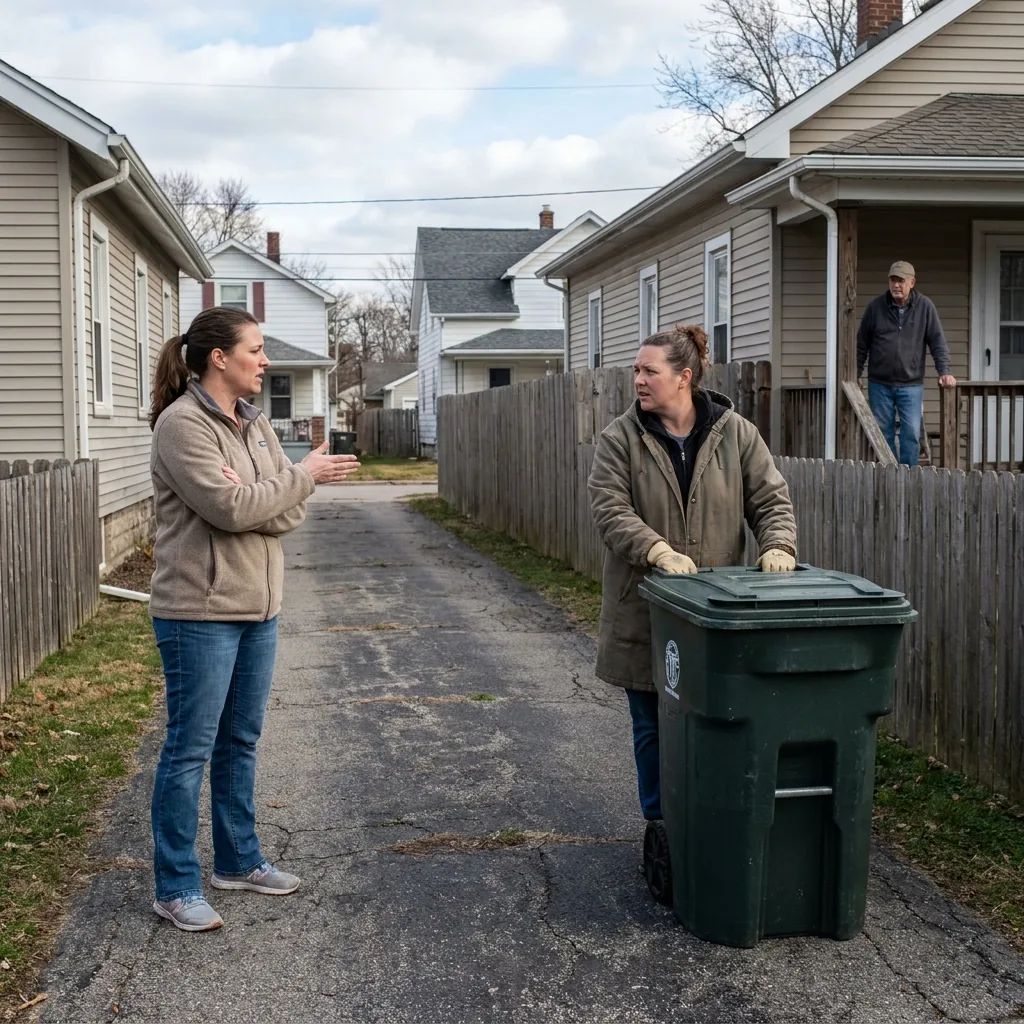
Leah Brooks kept the bin open after the route note came into view. That was the part no one could miss: she had been the one to lift the lid, the one to hold it high, and now the folded slip sat in plain sight under the inside pocket while the outside tag, the painted address, and the dusty wheel all lined up in the morning light. The shared driveway had gone very still around the movement of her hand.
Dana Miller did not reach for the bin. She did not repeat the accusation or call for anyone’s help. She only stood where she could see the paper, the tag, and Leah’s fingers still braced on the lid edge.
Tina Reed spoke first. “That’s a city note.”
Mr. Alvarez bent once more, enough to read the visible line without touching anything. “Relocation approved,” he said.
Leah snapped, “It’s not supposed to be there.”
That was the wrong sentence to say in a driveway where three people had already seen the tag, the wheel, and the address. Tina straightened and looked at Leah with her phone still down at her side, not recording, just present. Mr. Alvarez shifted his weight back toward his car.
Dana said, “It came with the bin.”
Leah tried once more to pull the slip from the lid pocket. The tape held the paper firm. She tugged hard enough that the lid bounced against her wrist. The paper tore at the corner and stayed in place. A thin white strip of torn fiber showed where her fingers had scraped it.
Tina said, “Stop pulling on it.”
Leah let go, then reached for the outside tag instead, as if she could still redirect the scene. The tag on the wheel swung once and settled. The service number and Dana’s address remained visible.
Mr. Alvarez glanced toward the curb lane. “If the rear access was blocked, why was it out here?”
Dana did not answer for Leah. She only turned her head toward the side gate again, and the reason sat in open view: the narrow gate path, the broken gravel, the tight space by the fence post. The city note inside the lid was not a mystery now. It was process. The bin had been marked for the curb because the rear route could not take it. Whoever had touched it had tried to turn that ordinary service detail into a theft accusation.
Leah looked from the paper to the three faces around her and then made the only move left to her. She shut the lid with both hands and began dragging the bin toward the street, hard enough that the wheel rattled on the seam between driveway and sidewalk edge. The motion was clumsy, but it was also visible. She was the one moving the bin now, the one completing the exact action her own accusation had tried to describe as Dana’s wrongdoing.
Tina said, very steady, “You just moved it back after saying she stole it.”
Leah kept dragging it anyway, past the driveway seam and toward the curb lane, where the pickup trucks would see it first thing. Mr. Alvarez watched without speaking. Dana stayed where she was and let Leah finish the distance herself.
The bin reached the curb. Leah left it there with the lid closed and the route note still folded under the lip where she had exposed it. She stood over it for one beat, then looked toward the row of houses as if checking who had seen what.
More than one neighbor had. That was plain from the half-open doors and the people who were no longer pretending not to watch.
A minute later, the street got its answer in the ugliest ordinary way possible. A city truck rolled up slow, the driver glanced at the note tucked in the lid pocket, and then he did not unload the bin where Leah had placed it. He set a yellow notice on the handle, snapped a photo, and rolled on to the next house without touching the can again.
Mr. Alvarez saw the notice first. “What’s that mean?”
Tina read the top line aloud. “Moved from approved access point. Not serviced today.”
Leah took one step toward the curb and stopped. The truck had already gone. The bin sat there with the yellow notice bright against the black plastic, and the message was plain enough for the whole driveway to understand. The process had closed around the lie instead of around Dana. The bin would not be picked up from that spot now, and the city would not come back to treat it as if nothing had happened.
Dana looked at the notice, then at Leah, then at the row of neighbors who had witnessed the whole thing. She did not raise her voice.
“That’s your call now,” she said.
Leah did not answer. She walked back toward her house with her empty hand at her side, while the bin stayed at the curb with the yellow notice on it and no service coming for the one that had been dragged into the wrong story.
Coldly, the driveway had become smaller for her than it was an hour before. The bin was no longer available to her as a claim, and the route note had taken away the only version of events she could still stand on in public.