Story code: ST-001463
Part 4: The Cost of Calibration
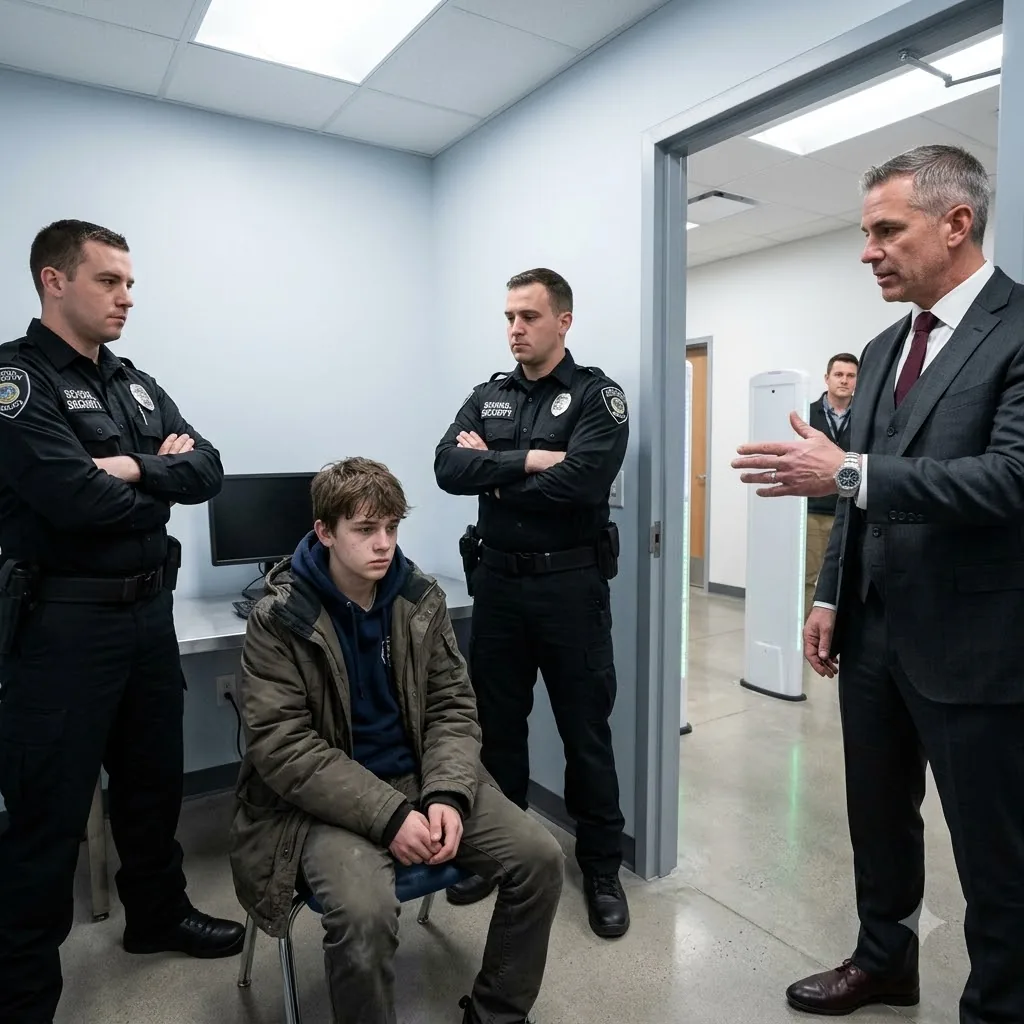
The automated lockdown siren ripped through the sterile administrative holding room, bouncing violently off the acoustically dampened walls. The red LED ring on the Sentinel pillars strobed like a frantic heartbeat, casting jagged, bloody shadows across the gleaming epoxy floor.
Principal Davies cracked.
The polished, untouchable facade of the gentrified school administrator dissolved in an instant. He lunged away from the wall, his polished leather shoes slipping awkwardly on the spotless floor as he scrambled past the two police officers. He rushed the security podium, his manicured fingers stabbing uselessly at the diagnostic interface. The touchscreen was locked out, demanding an administrative override code he clearly didn’t possess in his panic.
“Turn it off!” Davies shrieked at the private security contractor, his voice cracking over the blaring siren.
The guard just stood there, bewildered, his massive hands hovering near his tactical belt.
Davies didn’t wait for him to figure it out. He dropped to his knees in his tailored suit, uncaring as the hard floor scuffed the expensive wool. He crawled behind the sleek podium, desperately clawing at the thick bundle of power cables snaking into the wall socket. With a guttural sound of pure, unadulterated panic, he seized the main conduit in both fists and yanked backward with all his weight.
The heavy black cable ripped free from the wall. The violent tension transferred straight up the cord, catching the edge of the diagnostic monitor. The screen tore off its magnetic mount and slammed face-first into the linoleum. The tempered glass shattered with a deafening crash, spraying a wave of glittering shards across the floor.
The siren cut out instantly. The strobing red lights died.
The sudden silence in the room was heavier than the noise. The only sound left was Davies’s ragged, uneven breathing as he knelt in the debris of the million-dollar technology, clutching the dead power cable to his chest.
The lead police officer stared down at the principal, then slowly turned his gaze to Elena. He let out a long, exhausted exhale. The officer reached down to his utility belt, secured the metal clasp over his handcuffs, and snapped it shut with a definitive, ringing click.
“There’s no weapon,” the officer said, his voice flat and completely drained of all previous aggression. He looked at the teenage boy trembling in the corner. “Pick up your coat, kid. You aren’t under arrest.”
Without another word to the administration, the two officers turned on their heels. Their heavy tactical boots crunched through the scattered glass as they pushed open the frosted administrative doors and walked out into the bright, opulent lobby, leaving the school to deal with the fallout of its own catastrophic mess.
Leo scrambled forward. He grabbed his frayed navy blue jacket off the floor, clutching the clumped synthetic fabric to his chest as if it were a shield, and pressed himself against Elena’s side.
Davies slowly climbed to his feet. He brushed a dusting of broken glass from his slacks, his eyes darting frantically around the room before finally landing on Elena. The smug arrogance was entirely gone, replaced by a calculating, desperate panic. He knew exactly what she had just uncovered. If the public defender’s office leaked that the Sentinel AI was flagging kids based on the density of cheap discount clothing, the luxury condo parents would riot. The civil rights lawsuits would bankrupt the district. The massive technology grant money would vanish overnight.
“Elena,” Davies started, his voice adopting a sickeningly smooth, placating tone. He stepped carefully over the shattered monitor, moving toward his leather briefcase resting on the counter. “Counselor. Let us not be hasty. There are always teething issues with bleeding-edge technology. The algorithm merely needs… recalibration.”
“It doesn’t need recalibration,” Elena said, her voice dropping to an icy chill. “It’s working exactly as you intended. It’s keeping the poor kids out of sight so your new donors don’t have to look at them.”
Davies unclasped his briefcase. He pulled out a thick, cream-colored document, the heavy cardstock crisp and official.
“The PTA maintains a discretionary fund for independent security audits,” Davies said, holding the document out to her with a trembling hand. “We could offer you a consulting contract. A very generous retainer, effective immediately. You could personally oversee the software patches. Ensure equitable outcomes. All subject to standard non-disclosure agreements regarding the preliminary testing phase, of course.”
Elena stared at the piece of paper. It was a bribe, wrapped neatly in the sanitized, corporate language of administrative procedure. They were offering to buy her silence to protect the legal shield the machine provided.
She didn’t shout. She didn’t argue. Elena reached out and took the thick contract from Davies’s manicured hand.
For a fraction of a second, relief washed over the principal’s pale face.
Elena stepped forward. She looked down at the dead diagnostic monitor, its shattered screen reflecting the sterile fluorescent lights in a hundred fractured angles. She opened her fingers and let the contract fall. The heavy paper fluttered down, landing perfectly amidst the jagged glass and the tangled, lifeless power cords.
“Keep your money,” Elena whispered, her eyes locking onto Davies with a cold, absolute certainty. “I’m going to take this machine apart, piece by piece, in open court. And when I’m done, I’m coming for the man who plugged it in.”
She turned her back on him. She placed a gentle hand on Leo’s shoulder, guiding the terrified teenager away from the silent white pillars. Together, they walked out through the frosted glass doors, leaving the principal standing alone in the ruins of his flawless algorithm, surrounded by the shattered evidence of his own intent.