Story code: ST-001470
Part 4: The Weight of Paper
The echo of Toby Mercer’s hyperventilating sobs faded, replaced by the suffocating, humid silence of the dead bakery. Elias blinked, the memory of that sterile conference room receding as David Sterling’s polished wingtips came back into sharp focus. The lawyer was still standing by the stainless steel prep island, completely unbothered by the stifling heat, checking his gold watch.
“Your twelve minutes are up, Elias,” Sterling said, his voice flat and businesslike. He nudged the certified check for one hundred thousand dollars across the metal surface. “Sign the release.”
Elias looked at the check. He remembered the look of absolute terror on the teenager’s face, the way Vanguard’s immaculate, corporate facade had violently cracked under the weight of the truth. He had fought for two brutal years, bankrupting himself to expose them on the public record. He wasn’t going to sell that victory back to them for pennies. He wasn’t going to let them buy their way out of what they had done to his life.
“No,” Elias said. His voice was raw, his throat burning from severe dehydration. He picked up his heavy claw hammer in one hand and the two-and-a-half-million-dollar court judgment in the other. “I broke your lie, Sterling. I’ll take my chances.”
Sterling didn’t look angry. He just looked pitying, like an accountant closing a tedious spreadsheet. “Pride is an exceptionally expensive luxury for a bankrupt man.”
The lawyer picked up the check, slid it back into the unmarked manila envelope, and walked to the front door. He turned the deadbolt and tapped the glass twice. Out on the street, the men with the heavy tools didn’t hesitate. The piercing shriek of a reciprocating saw tore through the evening air as they bypassed the front door and went straight for the side loading bay. Elias didn’t stay to watch them butcher his deck ovens. He walked out the front door, the heavy official court document rolled tight in his fist, his pockets heavy with the hundred and twenty dollars in scrap money.
Over the next fourteen months, Elias learned that the justice system did not care about the moral victory of a broken teenager crying in a deposition room. The appellate courts operated entirely on a cold, frictionless plane of corporate structuring.
Sterling had kept his promise. Vanguard Logistics unleashed a swarm of appellate lawyers who meticulously dismantled the trial verdict. They didn’t dispute the damages, and they didn’t dispute that Toby Mercer had orchestrated the digital swarm that ruined Elias’s business. Instead, they weaponized the boy. Vanguard’s attorneys successfully argued that Toby had grossly exceeded the parameters of his independent contractor agreement. Then, in a masterstroke of corporate evasion, Vanguard dissolved the dummy subsidiary that had contracted the teenager in the first place, declaring it entirely insolvent.
When the appellate judge finally struck the gavel, Elias won. The court affirmed the two-and-a-half-million-dollar judgment. But they affirmed it solely against Toby Mercer.
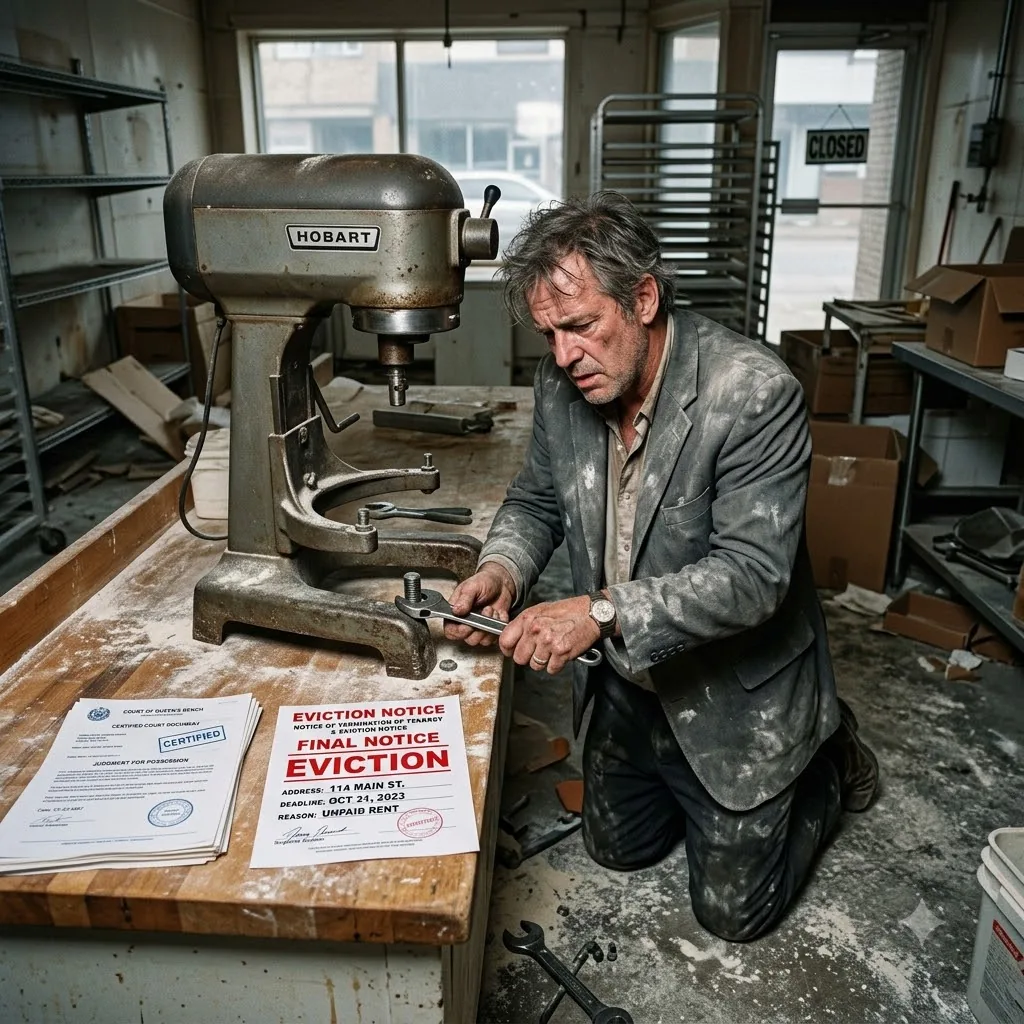
Elias was left holding a legally binding document entitling him to millions of dollars from a nineteen-year-old whose only assets were a custom-built gaming PC and a collection of obscure cryptocurrency that had collapsed in value a year prior. Toby was entirely, irrevocably judgment-proof. The boy couldn’t have paid for Elias’s stolen Hobart mixer, let alone two million dollars in punitive damages.
On a rainy Tuesday afternoon, Elias sat in the cramped office of his pro-bono attorney. The lawyer who had fought beside him for years looked completely exhausted, surrounded by mountains of useless Vanguard case files.
“We can’t squeeze blood from a stone, Elias,” the lawyer said softly, sliding a final, single-page invoice across the desk. “We can hire a collections agency to hound the kid for the rest of his life, but they’ll take sixty percent of absolutely nothing. I need to officially close the file.”
The invoice was for administrative closing costs and court filing fees. It was exactly three hundred and forty dollars. Elias opened his wallet. He took out the crumpled twenties he had gotten from Ray the scrapper, combined them with the last pathetic dregs of his checking account, and handed over his final liquid cash.
By November, Elias was living in a dark studio apartment on the industrial edge of the city limits. The radiator hissed in the corner, leaking a damp, metallic smell into the unventilated room. The only illumination came from the yellow streetlamp bleeding through the single, unwashed window.
Elias sat alone at a rickety particle-board table. There was no flour dust here. There was no smell of yeast rising in the early hours of the morning, no comforting hum of proofing cabinets. There was only a plastic bag resting on the faux-wood laminate, its brightly colored logo glaring under the dim street light.
He reached out and untwisted the wire tie. He pulled out a slice of mass-produced supermarket bread. It felt deeply unnatural in his grasp-a spongy, perfectly square, chemical-laced imitation of the craft he had dedicated his life to. It yielded instantly under the slight pressure of his thumbs, devoid of any crust, structure, or character.
Elias looked down at his own hands holding the cheap slice of bread. For six years, his palms had been a rugged landscape of minor burn scars, rigid calluses, and constantly cracked skin from endless exposure to industrial heat and friction. Now, in the pale yellow light of the cramped apartment, the skin was completely smooth. The burns had healed long ago. The hardened, protective ridges on his fingers had faded away entirely. His hands were soft, unblemished, and completely empty.