Story code: ST-001488
Part 3: Vital Public Service
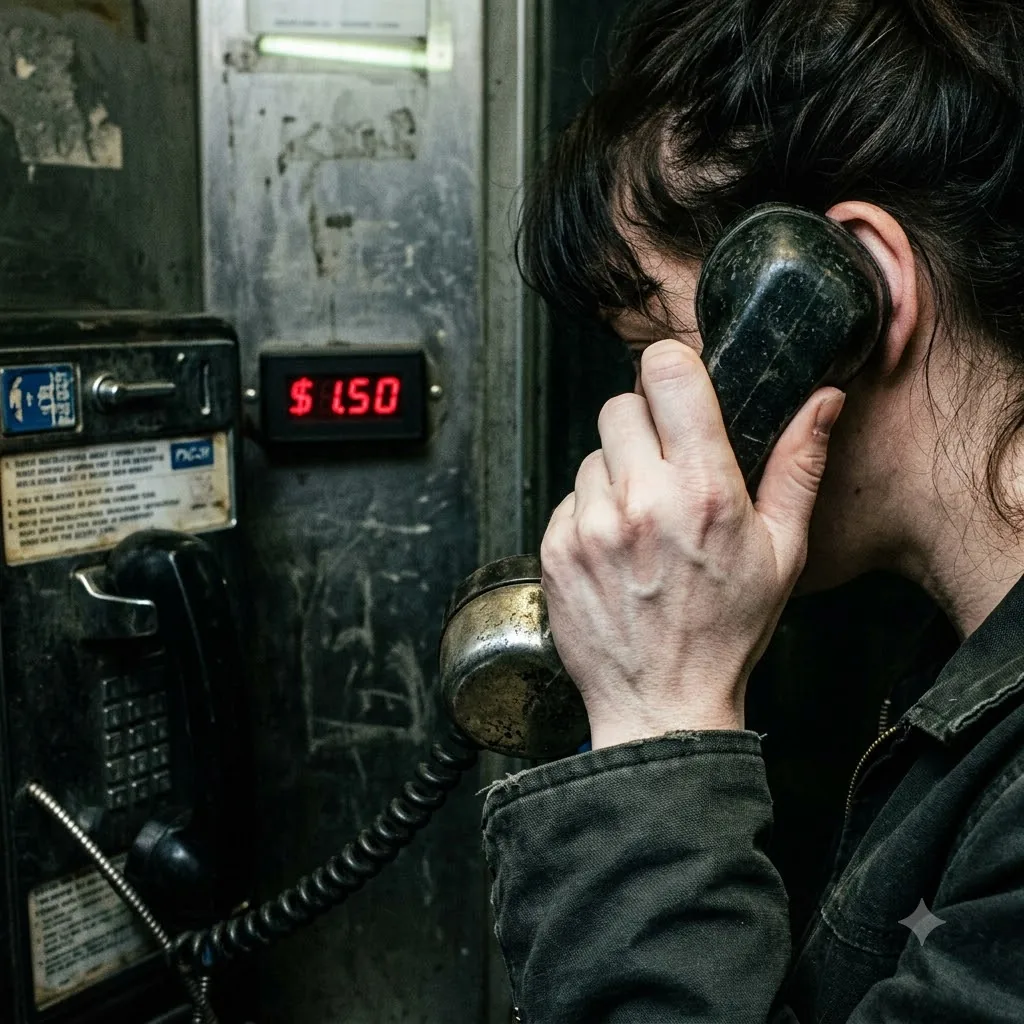
“Break a window!” Maria screamed into the metal mouthpiece, the rigid plastic cutting deep into her cheekbone. Her free hand gripped the coiled steel cord so hard her knuckles turned white. “Get a hammer, Mrs. Gable! You have to break the door!”
“I’ll run to the maintenance closet,” the older woman stammered over the line, her voice tight with a paralyzing, breathless panic. “Hold on, Maria, I’m putting the phone in my pocket. I’m going to try to bust the knob-”
A flat, universal dial tone severed the line.
It wasn’t the synthetic corporate woman warning of depleted funds or a peak-pricing surge. It was an immediate, system-wide override. The connection hadn’t run out of money. It had been killed from the source.
Maria slammed the switchhook down, screaming into the dead receiver. Nothing but dead air echoed back. Overhead, the harsh fluorescent lights of the dayroom flickered twice in rapid succession. The heavy PA system crackled to life, Officer Reynolds’ voice echoing off the concrete walls with mechanical, unyielding authority.
“Attention all inmates. Secure all activities. Terminals are offline. Stand to the wall. I repeat, all inmates on the wall for a facility VIP inspection. Anyone out of place goes straight to segregation.”
Maria stood frozen at the phone bank, the heavy receiver dangling from her limp fingers. Her physical body was inside the penitentiary, but her mind remained three hundred miles away, trapped in a narrow apartment hallway with the muffled sound of her nine-year-old son suffocating on the carpet. She couldn’t breathe. The air in her own lungs felt like ground glass.
“Maya,” Jackson hissed, grabbing Maria by the shoulder of her issued gray sweatshirt. It was the callsign Maria had brought with her from her old Army unit, the only name the women on this block used for her. “Maya, you have to drop the phone. You’re going to get us locked down. Move.”
Jackson dragged her backward by sheer force. Maria stumbled, her bad hip-a permanent, aching gift from a roadside IED during her second tour in Kandahar-flaring with sudden, sharp agony. She pressed her spine against the freezing cinderblock wall alongside sixty other women. Her chest heaved, her vision tunneling into a dark, panicked blur. She needed to get back on the line. She needed to know if Mrs. Gable had broken the lock.
The heavy steel double doors at the front of the dayroom clanged open with a deafening metallic screech. The Warden stepped through, his uniform pressed to a razor-sharp crease. He wasn’t alone. A small entourage trailed behind him: two deputy wardens with their hands resting on their utility belts, a local news cameraman hoisting a heavy shoulder rig, and a man in a pristine, charcoal-gray tailored suit who looked violently out of place in the grim, industrial misery of a women’s penitentiary.
Maria recognized the man instantly.
His artificially tanned face was printed on the glossy, self-congratulatory brochures stacked in the commissary window. His signature was stamped at the bottom of the extortionate fee schedules bolted to the cinderblock right next to the phone bank. Richard Sterling. The billionaire CEO of OmniLink Telecommunications.
“And here, Mr. Sterling, is our primary dayroom,” the Warden projected, his voice booming over the forced, tense silence of the inmates lined up against the walls. He gestured expansively toward the row of dead metal phones. “As you can see, the OmniLink terminals are fully integrated and heavily utilized by our population.”
Sterling stepped forward, turning slightly to ensure the cameraman had a clear, flattering angle of his profile. He offered a warm, practiced smile that completely failed to reach his cold eyes.
“It’s all about rehabilitation, Warden,” Sterling said, his voice smooth and heavily polished for the evening news broadcast. “Keeping these women connected to their families, their children. It reduces recidivism. OmniLink is incredibly proud to bridge that gap. We view it as a vital public service, regardless of the heavy operating costs.”
Maria’s blood turned to ice. *The operating costs.* The arbitrary peak pricing. The automated voice actively drowning out her son’s dying breaths just to demand another seventy-nine cents.
Before Jackson could grab her arm again, Maria stepped off the wall.
It was a massive, immediate violation of strict security protocol. Across the room, Officer Reynolds bolted upright inside the glass control bubble. The two deputy wardens instantly unsnapped the holsters of their pepper spray.
“Inmate 4490, step back against the wall!” the Warden barked, his PR-friendly demeanor evaporating in a split second.
Maria ignored him entirely. She ignored the throbbing in her hip, squaring her shoulders with a rigid, terrifying stillness. She locked her eyes directly onto the billionaire. Then, she snapped her right arm up, her fingertips grazing her temple in a razor-sharp, flawless military salute.
“Sir!” Maria shouted.
The sheer volume of her voice, honed by years as a non-commissioned officer commanding troops over the roar of diesel engines, echoed like a gunshot in the cavernous room. It stopped the guards dead in their tracks. It made the cameraman instinctively pivot his lens toward her, drawn by the sudden, dramatic spectacle of an inmate holding a perfect salute for a corporate executive.
Sterling, caught off guard by the military protocol and the blinking red light of the camera pointed at his face, offered a hesitant, reflexive smile. “Uh… thank you for your service.”
Maria didn’t drop the salute. She stared through him, her voice projecting with absolute, devastating clarity.
“Sergeant Maria ‘Maya’ Torres. Discharged with full honors and a sixty percent combat disability rating,” she announced, her words clipping the stale air. “My monthly VA disability stipend, issued for permanent nerve damage sustained in a combat zone, is exactly eight hundred and forty-two dollars.”
The Warden took a threatening step forward, but Sterling frantically held up a hand. Trapped by the camera’s unblinking gaze, he had to play the benevolent, listening executive. He nodded tightly for her to continue.
“Since my arrival at this facility ten months ago,” Maria recited, her voice rising in pitch and intensity, ringing off the steel doors, “your monopoly has skimmed exactly four thousand, eight hundred and ninety-one dollars and fifty-two cents from my account in connection fees, unannounced peak-pricing surges, and arbitrary deposit tariffs.”
Sterling’s polished smile died instantly. His eyes darted nervously toward the camera lens, the PR disaster dawning on him.
“That is one hundred percent of my combat compensation, sir,” Maria barked, taking one deliberate step closer to the entourage. “Routed directly out of my government ledger and into your corporate revenue.”
Sterling opened his mouth to speak, but Maria cut him down.
“Thirty minutes ago, my nine-year-old son went into severe respiratory failure,” Maria continued, her voice vibrating with a raw, barely contained ferocity that commanded the entire room. “I was guiding him to his medication when your system initiated an unannounced peak-pricing surge and terminated the connection mid-sentence. My son is suffocating behind a locked door right now, sir, because my blood money couldn’t buy a fourth minute of your vital public service.”
A suffocating silence slammed down on the dayroom. The PR mask fell entirely off Sterling’s face, leaving only a pale, terrified slackness. The cameraman slowly lowered his rig, staring at Maria in sheer horror. The Warden and his guards stood frozen, their hands hovering over their weapons, caught helplessly in the crossfire of the media and completely paralyzed by the unanswerable, crushing weight of the truth.