Story code: ST-001488
Part 4: Severed Connection
The silence in the dayroom shattered the moment the cameraman lowered his rig.
The Warden moved with sudden, brutal efficiency, stepping squarely in front of the lens. His broad back completely eclipsed Richard Sterling’s pale, panicked face, shielding the billionaire from the glass eye of the camera.
“Restrain her,” the Warden hissed, the command aimed at his deputies. His voice was entirely stripped of its earlier PR-friendly polish.
They didn’t use the pepper spray. They couldn’t, not with the local news crew still standing there in shock. Instead, Officer Reynolds and a second guard lunged across the polished concrete, seizing Maria by both arms. They spun her around with violent force, slamming her chest against the cold, painted cinderblock. The impact drove the breath from her lungs in a sharp, ragged rush.
“Stop resisting,” Reynolds grunted, shoving his forearm against her shoulder blades.
Maria hadn’t moved a muscle. She simply let her forehead rest against the wall, her eyes sliding shut. She felt the heavy plastic zip-ties bite into her wrists, binding her hands tight behind her back.
“Move,” the second guard ordered, jerking her backward by the collar of her issued sweatshirt.
Her bad hip flared instantly. The familiar, jagged lightning of her Kandahar injury shot down her leg, making her stumble. She limped, practically dragged by the two guards through the heavy steel double doors, leaving the dead metal phones and the shocked murmurs of the dayroom behind.
They marched her down the long, echoing corridor. The chaotic noises of the prison population faded, replaced by the sterile, rhythmic thud of combat boots on tile. She was marched through the security vestibule, subjected to the humiliating, freezing reality of a strip search on a bare concrete floor, and issued a stiff, bright orange jumpsuit-the universal marker for disciplinary lockdown.
Then came the final walk down the narrow, windowless hallway of the Secure Housing Unit.
Cell 114.
The guard shoved her inside. Maria stumbled, her bare feet slipping on the slick floor, catching herself on the edge of the steel sink combo. Behind her, the heavy metal door swung shut. The locking mechanism engaged with a sequence of deafening, metallic clanks. The heavy deadbolt slid home. The electronic strike locked.
Then, the single overhead light clicked off.
Maria stood in the pitch black. The silence was absolute, heavier than the cinderblock walls pressing in around her. The air in the cell was stagnant, smelling faintly of institutional bleach and the stale, anxious sweat of whoever had occupied this concrete box before her.
She sank to the floor, her back sliding against the freezing wall until she hit the thin, plastic-wrapped mattress resting directly on the ground. She pulled her knees to her chest, wrapping her arms tightly around her legs. The adrenaline that had propelled her to break rank, to stand at attention and humiliate a billionaire, was rapidly evaporating. In its place, a cold, hollow terror began to pool in her stomach.
The image of the cameraman lowering his rig replayed in the dark.
He had stopped recording.
The realization hit her like a physical blow, stealing the breath from her lungs just as surely as the asthma was stealing Leo’s. It was a local news crew. They were there for a sanitized puff piece, invited by the Warden to capture a ribbon-cutting moment for a corporate donor. The Warden controlled the facility. Sterling controlled the narrative. They would never let that footage leave the building. The camera’s memory card was probably already sitting in the Warden’s desk, slated for deletion before Sterling’s tailored suit even reached the visitor parking lot.
No broadcast. No public reckoning. No sudden investigation into the extortionate fees draining her government disability pay.
She had screamed the truth into a void.
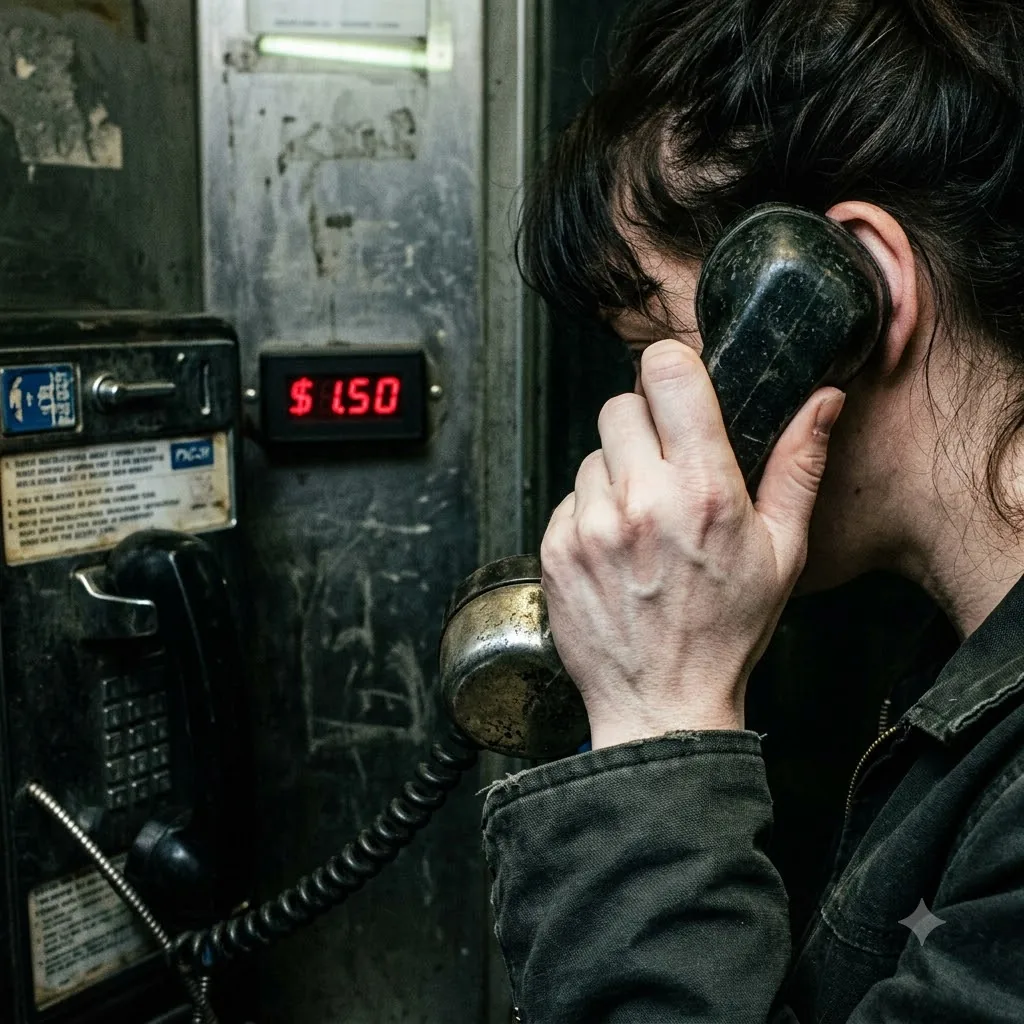
And the cost of that scream was everything. Segregation meant twenty-three hours a day locked in this pitch-black box. It meant the immediate revocation of all privileges. No commissary. No yard time. And, most devastatingly, no phone access. For a minimum of thirty days, her PIN would be permanently disabled.
“Mrs. Gable,” Maria whispered into the dark, her voice cracking, sounding terribly small in the tomb-like cell.
She squeezed her eyes shut, but the darkness behind her eyelids was identical to the darkness of the room. Instead of the cell, she saw the narrow hallway of her apartment building. She heard the ragged wheezing. She heard her neighbor fumbling with the doorknob, desperately trying to break the deadbolt.
Did she get the door open? Did Mrs. Gable manage to shatter the window in time? Did the paramedics arrive, push a nebulizer mask over Leo’s face, and force the oxygen back into his struggling lungs?
Or did the wheezing stop? Did the silence in her apartment match the suffocating silence of this concrete box?
Maria pressed the heels of her hands into her eye sockets until bursts of static color flared in the blackness. The not knowing was a living, breathing thing, a monster clawing at the inside of her ribcage. If Leo had survived, he would be waking up in a hospital bed, entirely alone, terrified, wondering why his mother wasn’t answering the phone. If he hadn’t… if the asthma had won… she wouldn’t even know. The prison chaplain would be the one to tell her, whenever the bureaucratic machinery finally bothered to process the paperwork.
She had traded her only lifeline to her son for a protest that would be erased by men who viewed her entirely as a revenue stream.
Maria buried her face in her knees. In the absolute, crushing isolation of solitary confinement, there was no automated corporate voice to interrupt her, no peak-pricing surge to calculate. There was only the dark, the throbbing pain in her hip, and the endless, unanswered silence of a severed connection.