Story code: ST-001506
Part 2: The Oxygen Ledger
“Mr. Vance?” Marcus leaned closer to his microphone, the plastic edge of his headset pressing sharply into his cheek.
The metallic crash reverberated in his earpiece, followed by a hollow, resonant clatter-the distinct sound of a heavy, metal cylinder striking a hard floor and rolling away. Then, nothing but a dense, ambient static.
“Elias, are you there? Can you hear me?” Marcus stripped the practiced, corporate cadence from his voice. He glanced at his secondary monitor. The call timer ticked past forty-five seconds. Company protocol dictated a strict procedure for dead air: state your name, advise the debtor you are disconnecting, and end the call to preserve the Average Handle Time metrics.
Marcus didn’t touch the disconnect button. The raw, desperate wheeze he had just heard defied every script in his training manual.
He listened intently to the open line. Beneath the white noise of the connection, a faint, rhythmic hiss emerged, accompanied by a high-pitched, repetitive electronic chirp. It sounded like a failing machine alarm.
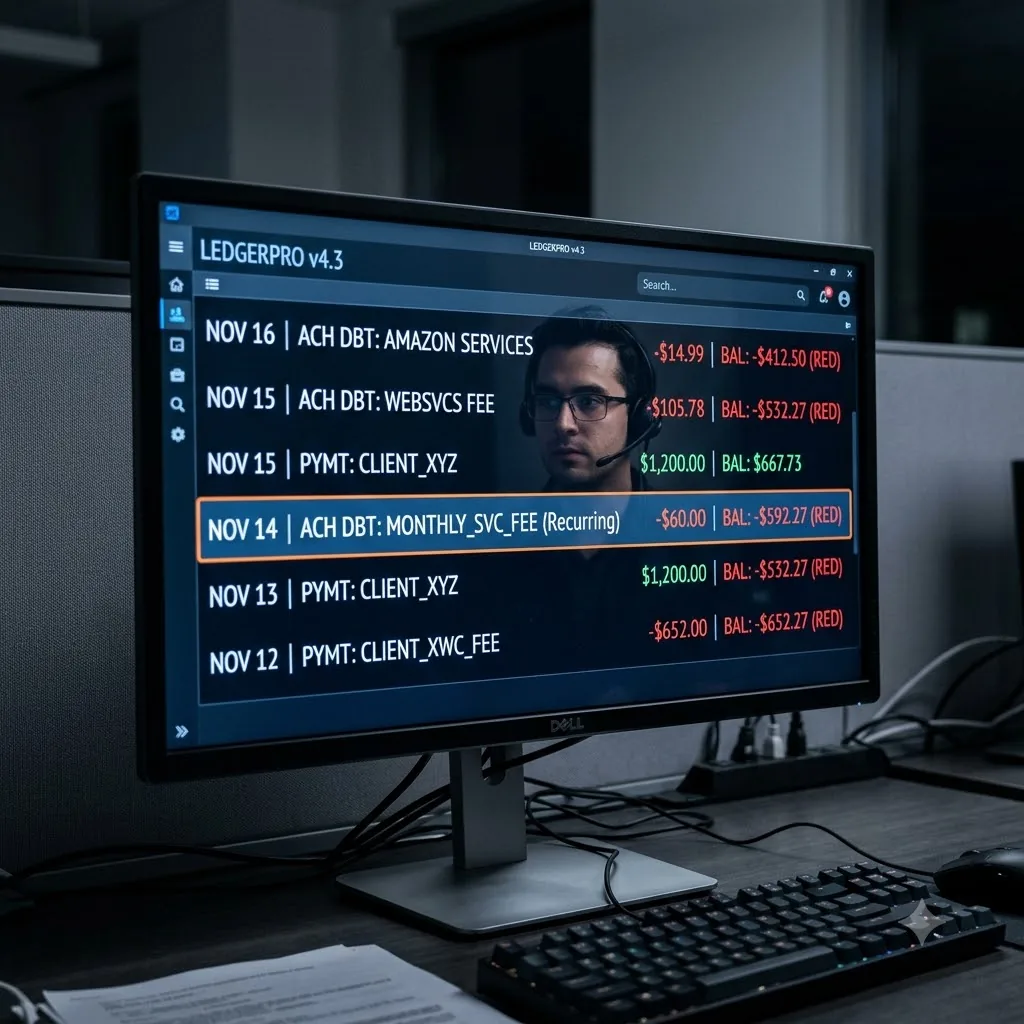
Panic, cold and sharp, prickled the back of Marcus’s neck. He dragged his mouse across the mousepad, maximizing the Vance file until it filled the primary monitor. The red deficit-forty thousand dollars-glared back at him, but the numbers no longer felt like a simple administrative puzzle. They felt like a crime scene.
Marcus bypassed the main ledger and opened the advanced skip-tracing module, an interface reserved for deep-dive asset recovery. He needed to know where the call was coming from. The caller ID displayed a generic wireless prefix, a prepaid burner phone routed through a dozen cell towers. It was untraceable from his terminal.
“Come on,” Marcus muttered, his fingers flying across the keyboard. If he couldn’t trace the phone, he had to trace the money.
He pulled up the exact ATM terminal ID where Elias made his bi-weekly sixty-dollar deposits. Terminal 4992-B. Marcus copied the alphanumeric string and pasted it into a web browser on his tertiary monitor, matching the ID to a physical address. The map dropped a red pin on the city’s dilapidated south side, highlighting a standalone convenience store in a crumbling strip mall.
Marcus zoomed in on the satellite view, his eyes scanning the adjacent storefronts. A laundromat, a pawn shop, and a sprawling, windowless brick building labeled *Apex Plasma Center*.
The realization hit him like a physical blow in the chest. Elias Vance wasn’t working an under-the-table hustle. He wasn’t mowing lawns or scraping metal. He was selling his blood plasma. Every two weeks, he traded bits of his own failing body for sixty dollars in cash, walking directly from the clinic to the convenience store ATM to keep his checking account on life support.
But why? If the account balance perpetually hovered near zero, the sixty dollars was immediately going somewhere else.
Marcus switched back to the banking ledger. He adjusted the filters, stripping away the incoming deposits to look exclusively at the outgoing automated clearing house transfers. For the past six months, the pattern was absolute. Two days after every sixty-dollar deposit, a digital withdrawal of fifty-eight dollars and fifty cents cleared the account.
Marcus highlighted the merchant ID attached to the withdrawal. It was masked behind a third-party billing processor. He clicked through three sub-menus in the collections software, forcing the system to unmask the vendor.
*Breathe-Rite Respiratory Solutions.*
A medical supply company.
Marcus stopped breathing. His eyes darted to the top right corner of his screen. The overnight action report. His administrative freeze had locked the account at midnight.
He hammered the F5 key, refreshing the live transaction feed for Elias’s frozen account. The screen flickered, querying the bank’s servers in real-time. A new line of data populated at the very top of the ledger, glowing in a harsh, cautionary yellow.
*DECLINED – INSUFFICIENT FUNDS / ACCOUNT FROZEN.*
*MERCHANT: Breathe-Rite Respiratory Solutions.*
*AMOUNT: $58.50.*
*TIME: 10:12 AM.*
Elias had called at 10:14 AM.
The sixty dollars wasn’t just money. It was the recurring rental fee for a portable oxygen concentrator. Or worse, the delivery fee for compressed oxygen tanks. The heavy, metallic crash on the phone line suddenly made a horrifying kind of sense. It was the sound of an empty tank hitting the floor, a tank Elias couldn’t afford to refill because Marcus had intercepted the blood money meant to pay for it.
“Elias!” Marcus shouted into the headset, uncaring if his supervisor heard him. “Listen to me, I’m releasing the freeze. I’m reversing it right now. Pick up the phone!”
Only the steady, rhythmic chirp of the machine alarm answered him.
Marcus frantically tabbed over to the administrative portal. He needed his supervisor’s digital fingerprint to unfreeze an account on the same day a levy was placed. He grabbed his desk phone to call her extension, but stopped. Unfreezing the account wouldn’t magically push the declined payment through, and it certainly wouldn’t dispatch an emergency medical technician to Elias’s location.
He needed an address.
Marcus stared at the demographic information in the file. All three listed addresses were flagged as invalid, mail returned to sender over two years ago. Elias was unhoused, or transient, living completely off the grid.
But Breathe-Rite Respiratory Solutions knew where he was. They had to deliver the tanks, or at least service the machine.
Marcus typed the medical supply company’s customer service number into his dialer, keeping the dead-air call with Elias active on line one. The phone rang twice before a cheery automated voice answered, thanking him for calling Breathe-Rite.
“Representative,” Marcus demanded, hitting zero repeatedly.
A click, and then a bored voice answered. “Breathe-Rite, this is Sarah.”
“I need the delivery address for an Elias Vance,” Marcus said, his voice tight. “This is a medical emergency.”
“I’m sorry, sir, but due to HIPAA regulations, I cannot disclose patient information without authorization. Are you a family member?”
“I’m his collections agent,” Marcus blurted out, instantly regretting the truth. “Listen to me, his account was frozen, his payment bounced, and he’s unresponsive on the other line. You have to send an ambulance to his service address.”
“Sir, I can’t verify that,” the representative said, her tone icing over. “If you believe there is a medical emergency, you need to contact 911. We do not dispatch emergency services.”
“I can’t call 911 because I don’t know where he is! You have his address!”
“Have a good day, sir.” The line went dead.
Marcus slammed his fist onto the desk. He switched back to line one. The chirping alarm had grown faster, more frantic. And beneath it, a new sound emerged-a slow, wet gurgle, the sound of lungs desperately fighting for air that wasn’t there.
He was listening to a man drown on dry land, anchored by a forty-thousand-dollar debt, and Marcus was the one who had just cut his air supply.
The call timer ticked past three minutes. Marcus had the power to seize assets with a keystroke, but he was utterly powerless to save the life attached to them. He stared at the blinking red line, realizing the true horror of his job wasn’t finding people. It was what happened when he actually caught them.