Story code: ST-001519
Part 3: The Shell Game
Arthur’s hand trembled violently as his fingers brushed the polished silver barrel of the pen. Marcus’s vision tunneled. The heavy, grinding squeal of the tow truck’s air brakes echoed down the county highway, the sound vibrating through the loose windowpanes of the old farmhouse.
Before Arthur could close his grip on the pen, Marcus lunged. He didn’t just slap the instrument away; he drove his shoulder gently but firmly into his uncle, bumping the older man back against the peeling white siding of the house. In the same fluid motion, Marcus snatched the metal clipboard directly out of Arthur’s hands.
The silver pen clattered loudly onto the wooden floorboards, rolled rapidly toward the edge, and dropped into the overgrown, thorny azalea bushes below the porch.
“Marcus!” Arthur gasped, clutching his chest as he caught his breath against the wall.
“Time is up, Mr. Vance,” the stranger said. The smooth, practiced customer-service cadence instantly vanished from his voice. The mechanical flatness was gone, replaced by a sharp, icy irritation. “The recovery unit is here. That settlement document was a professional courtesy to save you both from bankruptcy. Now, the electronic injunction proceeds. I will freeze the accounts myself.”
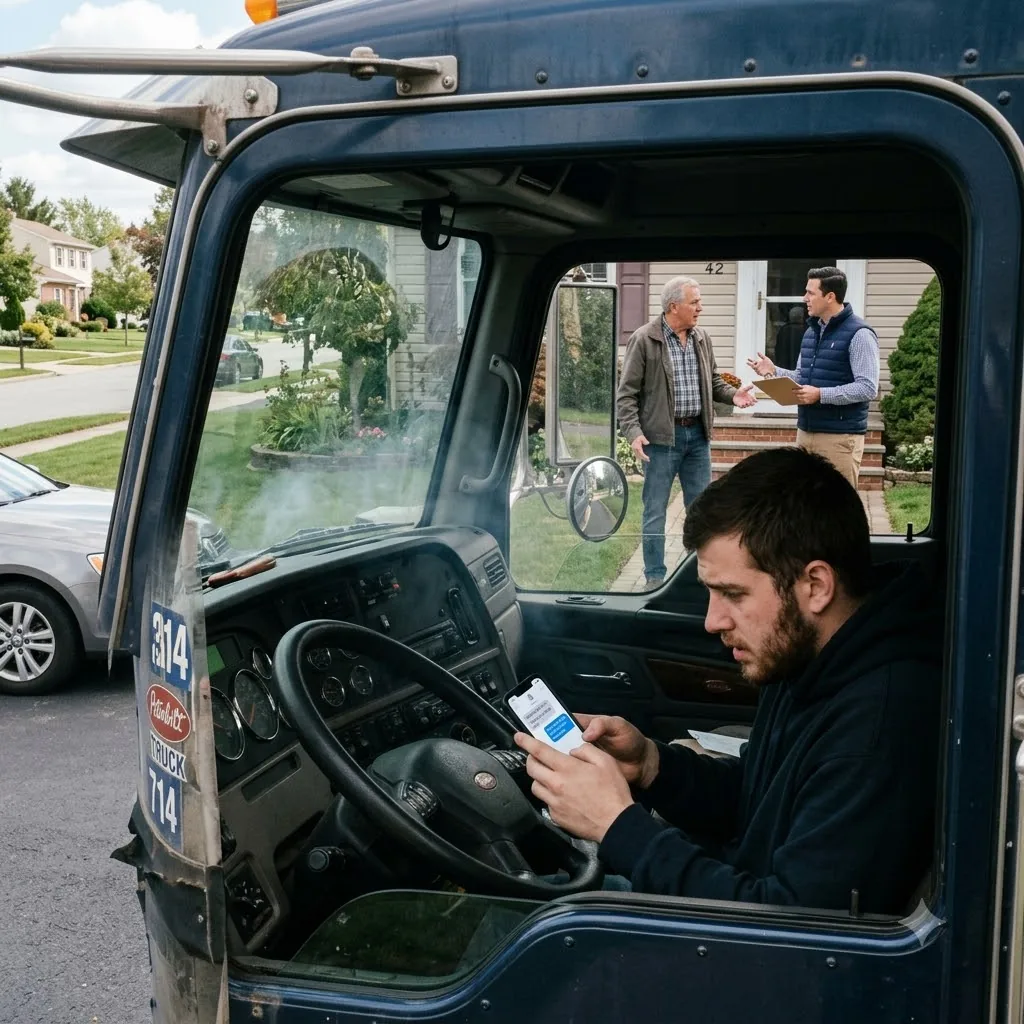
Marcus ignored the threat. He gripped the cold metal edges of the clipboard, staring down at the dense block of legal text. Behind the stranger, a massive, heavy-duty wrecker painted matte black turned off the rural highway. It ground its way up the dirt driveway, kicking up a thick cloud of dry dust that coated the chrome grill of Marcus’s dead freight rig.
Marcus scanned the header on the settlement document. *Horizon Asset Management.* It looked incredibly official, complete with a sophisticated corporate watermark and a barcode at the top. But as Marcus’s eyes tracked down to the third paragraph-into the dense, microscopic font detailing the exact transfer mechanism of the eighty-four-thousand-dollar deficit-he spotted the routing information for the long-term payment plan.
“Make all certified checks payable to…” Marcus muttered out loud, his eyes narrowing as he read the tiny print. “Payable to *Nexus Freight Innovations*.”
Marcus stopped breathing for a second. He blinked, the tiny black letters swimming against the stark white paper. Nexus Freight Innovations. That wasn’t a bank. That wasn’t a lending institution or an independent collection agency. That was the parent company of the logistics startup he drove for. The exact same tech startup whose human resources algorithm had terminated his contract fifteen minutes ago.
“Give me the clipboard,” the stranger demanded, stepping up the stairs and closing the distance between them. He reached for the metal board, his manicured hands suddenly looking tense, grasping, and overtly aggressive.
Marcus yanked it back out of reach. He pulled his smartphone from his pocket with his free hand, thumbing open the automated termination email that was still glowing in the background. He scrolled aggressively past the brutal algorithmic breakdown of his route efficiency, past the smart-contract nullification clauses, all the way down to the tiny corporate footer at the bottom of the screen.
*Nexus Freight Innovations, LLC. Incorporated in Delaware.*
Marcus looked up, his heart hammering a violent, erratic rhythm against his ribs. The black wrecker parked directly in front of Marcus’s immobilized rig. The driver’s side door swung open, and a man in grease-stained coveralls hopped out, carrying a thick stack of printed work orders attached to his own plastic clipboard.
“You don’t work for the bank,” Marcus said, his voice dropping to a dangerously low register. “The bank didn’t dispatch you.”
“I am a contracted liquidation agent,” the stranger said, extending his hand again, his jaw muscles flexing. “I represent the lienholder. Hand over the paperwork, Mr. Vance, or the local sheriff will be dispatched to remove you from the premises for interfering with a lawful repossession.”
“The lienholder is a credit union in Ohio!” Marcus shouted, stepping right into the stranger’s personal space. He shoved the clipboard toward the man’s chest, tapping the tiny print with his thick, calloused index finger. “This contract says the debt transfers to Nexus. You’re buying the debt from the bank. You work for the same damn startup that just fired me.”
The wrecker driver walked up to the base of the porch steps, completely oblivious to the escalating tension. He held out his stack of papers to the man in the puffer vest. “Got the morning manifest, Mr. Sterling. That makes fourteen rigs we’ve bricked in this county since six this morning. We’re gonna need a bigger overflow lot. I’ve got six more to hook up before noon.”
Marcus’s head snapped toward the wrecker driver. “Fourteen?”
The driver looked at Marcus, then at the furious expression on Sterling’s face, suddenly realizing he had walked directly into a landmine. He shut his mouth audibly and took a slow step back down into the crushed gravel.
Marcus looked back at the man in the vest. The scattered, illogical puzzle pieces of the morning violently snapped together, forming a picture so deeply predatory it made Marcus physically sick to his stomach.
“It wasn’t a three percent drop in efficiency,” Marcus said, his voice rising, carrying easily over the loud, rumbling idle of the heavy wrecker. “It wasn’t the black ice in the mountain pass last week. You fired everybody.”
Sterling’s jaw tightened. The sleek, infuriating smile had completely vanished from his face, leaving only a cold, panicked hostility.
“You triggered a mass firing,” Marcus said, the sheer scale of the realization hitting him like a physical blow. “If you fire us without cause, you owe us severance. You have to buy out the contracts. But if your algorithm flags us for ‘critical efficiency failure,’ it nullifies the deal. It triggers the immediate forfeiture clause.”
Arthur pushed himself off the peeling siding of the house, his pale face suddenly flushing with comprehension. “They’re tanking the loans,” Arthur whispered, staring at Sterling in absolute horror.
“You’re forcing the defaults,” Marcus said, stepping closer to Sterling, forcing the corporate agent to retreat a half-step toward the edge of the wooden porch. “You fire us, remotely brick the trucks so we can’t hide them, and send guys like you to scare the drivers and their families into signing over the rigs right here in the driveways. The banks panic because the commercial loans are instantly underwater. So your little shell company swoops in, buys the distressed debt for pennies on the dollar, and you get a hundred-and-twenty-thousand-dollar piece of machinery for absolutely nothing.”
Sterling stood rigidly near the top step. He didn’t adjust his high collar. He didn’t brush any invisible dust off his pristine navy vest. He just glared at Marcus, his eyes darting toward the wrecker driver and back, realizing that his carefully constructed illusion of corporate inevitability had just been completely shattered.
“The transfer paperwork is legally binding, regardless of corporate structure,” Sterling said, his voice dropping into a harsh, defensive hiss. But he didn’t reach for the clipboard again.
“It’s not a repossession,” Marcus snarled, raising the metal clipboard between them like a weapon. “It’s a manufactured default.”