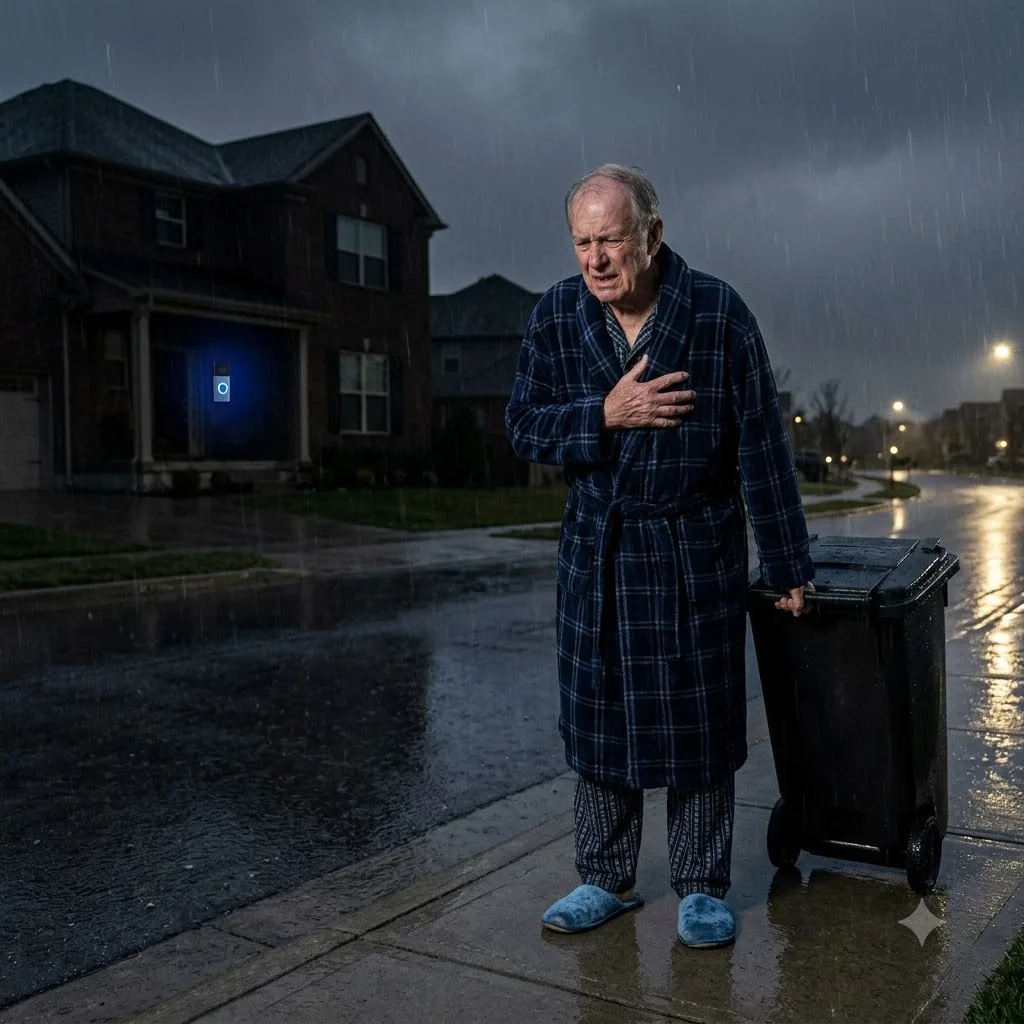
Story code: ST-001522
Part 4: Network Offline
The rhythmic, mechanical pulse of the hospital’s intravenous pump was a clinical, soulless sound, but to Arthur, it lacked a countdown timer. That made it the most beautiful thing he had heard in years.
He blinked against the soft, fluorescent lighting of the cardiac recovery ward. The ceiling tiles were pristine white, unmarked by glowing red camera lenses or amber warning lights. His left arm was taped with IV lines, delivering a steady, cool rush of fluids and proper, unrationed medication directly into his bloodstream. The crushing weight on his chest had receded, replaced by a dull, aching soreness that felt entirely survivable.
He turned his head against the stiff pillow.
David Miller sat in a vinyl visitor’s chair by the window. He wasn’t wearing his pressed office attire, nor was he hiding behind drawn blinds. He wore a faded t-shirt and jeans, casually swiping through his smartphone with a faint, incredulous smile playing on his lips.
“You’re awake,” Miller said, immediately leaning forward and setting the phone on his knee. “Don’t try to sit up. The doctor said you need to stay flat for at least another twelve hours. You had a massive heart attack, Arthur. The heatstroke pushed you right over the edge.”
Arthur swallowed, his throat dry and scratchy. “The… the ambulance…”
“They got you here in time,” Miller said softly.
Arthur’s heart rate hitched, the monitor beside the bed giving a rapid, warning flutter. “The fee. The transport fee. Eight hundred and fifty dollars. The automatic withdrawal-” He tried to push himself up with his good arm, panic instantly overriding the painkillers. “It’ll bounce, David. They’ll put a lien on the house.”
Miller reached out, pressing a firm, gentle hand against Arthur’s shoulder. “Arthur, stop. Breathe. Look at me.”
Arthur froze, his chest heaving.
Miller picked up his phone and tapped the screen a few times. He turned the device so Arthur could see it. It wasn’t the menacing red and black interface of the Oakridge Homeowners Association compliance portal. It was a simple, digital ledger from a local credit union.
At the top, in bright green text, was a balance of zero. Beneath it was a long list of deposits.
“The ambulance fee is paid,” Miller said, his voice thick with an emotion Arthur couldn’t quite place. “Your hospital co-pay is covered, too. And the next six months of your beta-blockers.”
Arthur stared at the screen, his aging eyes struggling to focus on the numbers. “How? I didn’t…”
“I knocked on doors,” Miller explained, scrolling slowly down the list. “After the ambulance took you, I walked up and down the street. I started with Mrs. Gable. Then the Jenkins family. I told them what happened. I told them what Todd tried to do.” Miller paused, his jaw tightening. “I told them what I almost let happen back in January because I was too scared of a fifty-dollar fine to help you in the freezing rain.”
Arthur saw names next to the deposits. Gable: $100. Jenkins: $200. Patel: $50. It was a cascade of tiny rebellions, a pooling of money from people who had spent the last five years living in silent terror of each other.
“We paid it,” Miller said. “All of it.”
Arthur fell back against the pillows, a hot tear slipping out of the corner of his eye and tracking through the deep wrinkles on his cheek. The suffocating dread that had lived in his stomach for years began to loosen, dissolving into the cool, sterile air of the hospital room.
“What about Todd?” Arthur whispered, suddenly remembering the sharp crack of flesh against plastic, the hollow splash of the tablet falling into the storm drain. “The block captain…”
Miller’s smile returned, wider this time, carrying a sharp edge of vindication. He swiped to a video in his photo gallery and hit play.
Arthur watched through the small screen. It was a shaky, hand-held recording of their street, taken at dusk. The automated drone patrol was nowhere in sight. Instead, a dozen neighbors were out on the pavement. Mr. Jenkins was standing on a heavy aluminum stepladder, wielding a standard-issue baseball bat. With one massive swing, Jenkins shattered the blue-pulsing camera dome mounted above his own garage. The lens sparked, died, and rained plastic down onto the driveway.
The crowd in the video cheered. In the background, Arthur saw someone else throwing a heavy tarp over the community streetlight sensors, permanently blinding the motion detectors. They were tearing down the nodes, dismantling the unblinking eyes that had kept them captive in their own homes.
“The network is completely down,” Miller said, taking the phone back. “The central server in the clubhouse relies on those nodes to mesh. With half of them smashed, the algorithm can’t process a single compliance scan. It’s totally blind.”
“And Todd?”
“He ran inside the second his tablet went down the drain,” Miller said, his tone dropping into a flat, pitying register. “He’s been locked in there for two days. Mrs. Gable’s nephew checked the network traffic logs before the main server crashed. Todd’s router has been pinging the system thousands of times an hour. He’s sitting in his perfectly measured house, frantically refreshing an empty admin dashboard. Nobody is answering his commands. Nobody is taking his calls.”
Arthur closed his eyes. He pictured Todd sitting alone in the glow of a dead monitor, surrounded by perfectly aligned trash bins and flawless grass, entirely powerless without the machine to back him up.
“The HOA board from the parent company is sending a regional manager next week to assess the damage,” Miller added, leaning back in his chair. “But Jenkins already hired a lawyer. We’re filing for immediate dissolution of the charter. They can’t fine us if we don’t recognize their authority.”
Arthur listened to the steady, rhythmic beep of his heart monitor. It was a slow, calm sound. He realized, with a profound sense of exhaustion, that he didn’t care about the regional manager. He didn’t care about the charter or the broken cameras.
He opened his eyes and looked out the hospital window at the bright, blue summer sky. For the first time since his wife had passed, Arthur wasn’t afraid of the time on his watch. He took a long, deep, painless breath, and simply let it out.