Story code: ST-001531
Part 1: The Addendum
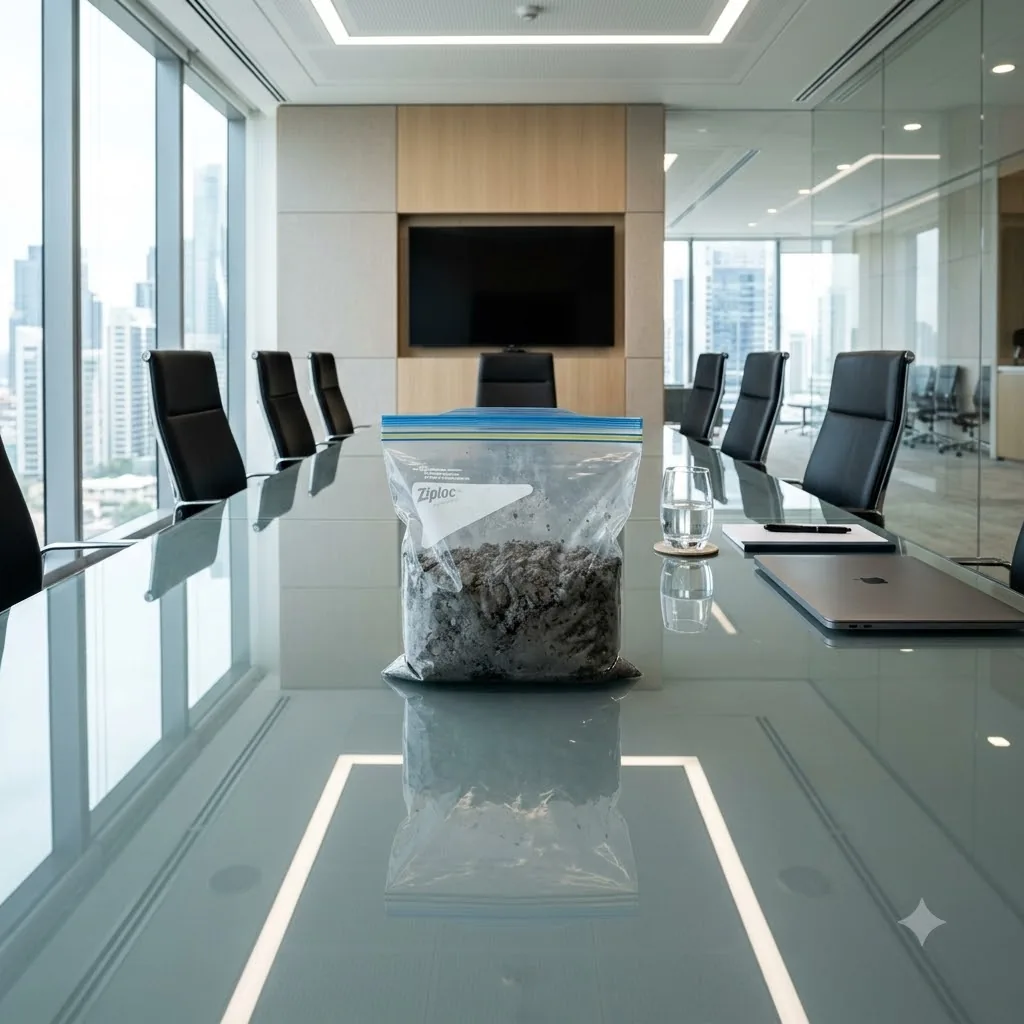
The gallon-sized Ziploc bag sat exactly in the center of the frosted glass conference table, looking like a piece of evidence awaiting processing. Inside it, a dense mound of wet ash clumped against the plastic, condensation beading near the seal. The sterile, soundproofed walls of Conference Room 4B offered absolute silence, but the faint, acrid smell of a burned-down living room still managed to seep through the closed zipper.
Kiran stared at the bag. It was supposed to be a standard physical addendum for an HR catastrophic loss claim, neatly categorized under code 402-B. The form required tangible proof of residence destruction for the corporate relief fund, and the ash was all that remained of the heritage property.
Across the glass table, Brody tugged at the zipper of his navy-blue Patagonia fleece vest. The metal tab clinked against his collarbone. He leaned back in the ergonomic mesh chair, lacing his fingers together behind his head, entirely ignoring the charred remains of a home resting inches from his elbow.
“It all comes down to strategic alignment, Kiran,” Brody said, his voice carrying the practiced cadence of a TED Talk delivered to an empty room. “We need to ensure that the machine learning models are fully synergistic with our Q3 revenue targets. I want us speaking the same language when I stand in front of the executive board next week.”
Kiran kept their eyes on the condensation inside the bag. The ash was getting muddy at the bottom.
“Synergistic,” Kiran repeated, the word tasting like chalk.
“Exactly,” Brody said, dropping his hands to the table and leaning forward. He tapped a manicured fingernail against the glass, narrowly missing the plastic bag. “The board needs a clean narrative. They want to see how the new predictive algorithm drives user retention. I know you have been doing the heavy lifting in the sandbox, but now that I am steering the ship, we need to polish the presentation.”
Brody had been in the building for exactly eleven days. His desk remained mostly empty, save for a framed photograph of a golden retriever and a stress ball shaped like a bitcoin. He had not written a single line of code since his undergraduate degree, a fact he frequently masked with broad, sweeping directives about architectural vision.
The relief fund application had been sitting in Brody’s approval queue for a week. The automated system required VP sign-off for any disbursement over five thousand dollars. Kiran had brought the physical proof, as requested by the automated HR portal, placing it on the table at the start of their one-on-one. Brody had glanced at it once, frowned slightly as if someone had left a half-eaten sandwich on his desk, and instantly pivoted to the quarterly deliverables.
“I need you to walk me through the backend logic,” Brody continued, swiping his iPad awake. “Just the high-level stuff. The granular data is your domain, obviously. But I need to understand the weights you assigned to the behavioral triggers. If I am going to own this product launch, I have to be able to field questions from the CEO.”
Kiran shifted in the chair. The algorithm was not just a side project. It was fourteen months of late nights, endless debugging, and a complete rewrite of the company’s legacy matching system. It was the exact deliverable that had been promised to secure Kiran’s elevation to the director level. The same elevation that had quietly evaporated when the external hire announcement hit the department-wide email list last Tuesday.
“The weights are dynamic,” Kiran said, keeping the tone flat, professional. “They adjust based on real-time user latency. If a user hesitates on a targeted prompt, the model decreases the priority of that specific product category.”
Brody nodded slowly, narrowing his eyes in an approximation of deep thought. He typed something on his iPad using only his index fingers.
“Right, dynamic,” Brody said. “But we can hardcode an override. Just to boost the premium tier offerings during the demo.”
“Hardcoding an override breaks the foundational logic of the system,” Kiran said.
“Nothing is unbreakable, Kiran.” Brody smiled, a tight, practiced expression that did not reach his eyes. “That is why we iterate. I want you to pull up the repository on the main screen. Show me exactly where the primary routing loops happen. I need to be able to explain how I built the new efficiency matrix.”
The words hung in the soundproofed air. How I built.
Kiran looked away from Brody and back to the Ziploc bag. The wet ash was dark, heavy, and silent. It represented seventy years of family history, a collection of photo albums, antique furniture, and the wooden porch where Kiran had learned to walk, all reduced to a chemical paste by a wildfire that had burned for three weeks.
The HR policy clearly stated that emergency relief funds were distributed at the discretion of the departmental Vice President, contingent on a review of the employee’s current performance and team contribution. It was a subjective clause buried on page forty-two of the employee handbook.
Brody drummed his fingers on the table again. “Let us get the code up on the screen, Kiran. I have a hard stop at eleven, and I need to be completely fluent in your architecture by the time I have my lunch meeting with the big boss.”
Kiran slowly reached out, placing a hand flat on the cool glass next to the plastic bag. The smell of the burned wood seemed to grow stronger, overwhelming the filtered, climate-controlled air of the corporate suite. The laptop sat closed.
“You want me to train you on the architecture,” Kiran said, ensuring the statement remained entirely flat, devoid of any upward inflection.
“I want you to empower me to champion our team,” Brody corrected smoothly, adjusting his fleece vest one more time. “And after we nail down this presentation, we can circle back to whatever that is.” He gestured vaguely toward the bag of ash. “I am sure HR has a digital form you can fill out instead of bringing physical debris into the workspace.”
Brody pushed his chair closer to the table, clapping his hands together once, the sharp sound bouncing off the acoustic panels.
“Pop the hood, Kiran,” Brody said, staring expectantly at the dark monitor. “Show me everything you did so I can make it mine.”
Kiran kept a hand resting beside the heavy, wet ash, staring at the blank screen of the closed laptop as Brody waited for the system to boot.
The gallon-sized Ziploc bag sat exactly in the center of the frosted glass conference table, looking like a piece of evidence awaiting processing. Inside it, a dense mound of wet ash clumped against the plastic, condensation beading near the seal. The sterile, soundproofed walls of Conference Room 4B offered absolute silence, but the faint, acrid smell of a burned-down living room still managed to seep through the closed zipper.
Kiran stared at the bag. It was supposed to be a standard physical addendum for an HR catastrophic loss claim, neatly categorized under code 402-B. The form required tangible proof of residence destruction for the corporate relief fund, and the ash was all that remained of the heritage property.
Across the glass table, Brody tugged at the zipper of his navy-blue Patagonia fleece vest. The metal tab clinked against his collarbone. He leaned back in the ergonomic mesh chair, lacing his fingers together behind his head, entirely ignoring the charred remains of a home resting inches from his elbow.
“It all comes down to strategic alignment, Kiran,” Brody said, his voice carrying the practiced cadence of a TED Talk delivered to an empty room. “We need to ensure that the machine learning models are fully synergistic with our Q3 revenue targets. I want us speaking the same language when I stand in front of the executive board next week.”
Kiran kept their eyes on the condensation inside the bag. The ash was getting muddy at the bottom.
“Synergistic,” Kiran repeated, the word tasting like chalk.
“Exactly,” Brody said, dropping his hands to the table and leaning forward. He tapped a manicured fingernail against the glass, narrowly missing the plastic bag. “The board needs a clean narrative. They want to see how the new predictive algorithm drives user retention. I know you have been doing the heavy lifting in the sandbox, but now that I am steering the ship, we need to polish the presentation.”
Brody had been in the building for exactly eleven days. His desk remained mostly empty, save for a framed photograph of a golden retriever and a stress ball shaped like a bitcoin. He had not written a single line of code since his undergraduate degree, a fact he frequently masked with broad, sweeping directives about architectural vision.
The relief fund application had been sitting in Brody’s approval queue for a week. The automated system required VP sign-off for any disbursement over five thousand dollars. Kiran had brought the physical proof, as requested by the automated HR portal, placing it on the table at the start of their one-on-one. Brody had glanced at it once, frowned slightly as if someone had left a half-eaten sandwich on his desk, and instantly pivoted to the quarterly deliverables.
“I need you to walk me through the backend logic,” Brody continued, swiping his iPad awake. “Just the high-level stuff. The granular data is your domain, obviously. But I need to understand the weights you assigned to the behavioral triggers. If I am going to own this product launch, I have to be able to field questions from the CEO.”
Kiran shifted in the chair. The algorithm was not just a side project. It was fourteen months of late nights, endless debugging, and a complete rewrite of the company’s legacy matching system. It was the exact deliverable that had been promised to secure Kiran’s elevation to the director level. The same elevation that had quietly evaporated when the external hire announcement hit the department-wide email list last Tuesday.
“The weights are dynamic,” Kiran said, keeping the tone flat, professional. “They adjust based on real-time user latency. If a user hesitates on a targeted prompt, the model decreases the priority of that specific product category.”
Brody nodded slowly, narrowing his eyes in an approximation of deep thought. He typed something on his iPad using only his index fingers.
“Right, dynamic,” Brody said. “But we can hardcode an override. Just to boost the premium tier offerings during the demo.”
“Hardcoding an override breaks the foundational logic of the system,” Kiran said.
“Nothing is unbreakable, Kiran.” Brody smiled, a tight, practiced expression that did not reach his eyes. “That is why we iterate. I want you to pull up the repository on the main screen. Show me exactly where the primary routing loops happen. I need to be able to explain how I built the new efficiency matrix.”
The words hung in the soundproofed air. How I built.
Kiran looked away from Brody and back to the Ziploc bag. The wet ash was dark, heavy, and silent. It represented seventy years of family history, a collection of photo albums, antique furniture, and the wooden porch where Kiran had learned to walk, all reduced to a chemical paste by a wildfire that had burned for three weeks.
The HR policy clearly stated that emergency relief funds were distributed at the discretion of the departmental Vice President, contingent on a review of the employee’s current performance and team contribution. It was a subjective clause buried on page forty-two of the employee handbook.
Brody drummed his fingers on the table again. “Let us get the code up on the screen, Kiran. I have a hard stop at eleven, and I need to be completely fluent in your architecture by the time I have my lunch meeting with the big boss.”
Kiran slowly reached out, placing a hand flat on the cool glass next to the plastic bag. The smell of the burned wood seemed to grow stronger, overwhelming the filtered, climate-controlled air of the corporate suite. The laptop sat closed.
“You want me to train you on the architecture,” Kiran said, ensuring the statement remained entirely flat, devoid of any upward inflection.
“I want you to empower me to champion our team,” Brody corrected smoothly, adjusting his fleece vest one more time. “And after we nail down this presentation, we can circle back to whatever that is.” He gestured vaguely toward the bag of ash. “I am sure HR has a digital form you can fill out instead of bringing physical debris into the workspace.”
Brody pushed his chair closer to the table, clapping his hands together once, the sharp sound bouncing off the acoustic panels.
“Pop the hood, Kiran,” Brody said, staring expectantly at the dark monitor. “Show me everything you did so I can make it mine.”
Kiran kept a hand resting beside the heavy, wet ash, staring at the blank screen of the closed laptop as Brody waited for the system to boot.