Story code: ST-001531
Part 3: The Raw Data
The executive boardroom on the forty-second floor smelled of lemon polish and expensive leather, a sharp contrast to the phantom scent of wet ash that had permanently settled in the back of Kiran’s throat. A panoramic wall of floor-to-ceiling glass overlooked the city skyline, but the fifteen board members seated around the massive mahogany table were focused entirely on the eighty-inch monitor dominating the far wall.
Brody stood at the head of the room, completely in his element. He had swapped his navy fleece vest for a tailored charcoal blazer, moving with the energetic, restless confidence of a man who implicitly believed his own pitch.
“For the past fourteen months, we have been saddled with a legacy matching system that left money on the table,” Brody said, projecting his voice to reach the furthest leather chair. “It was too cautious. But as I took the helm of the department, I realized we needed a paradigm shift in our behavioral routing matrix. I needed to build a system that doesn’t just suggest our Premium Platinum tier, but actively drives our highest-net-worth users toward it.”
Kiran sat off to the side at a sleek administrative console, hands resting lightly on the closed lid of the laptop. The HDMI cord snaked from the wall into the machine. Kiran’s role, according to Brody’s hushed, frantic instructions five minutes earlier, was to sit quietly, press nothing, and let the newly minted executive override shine.
“To achieve this, I engineered a direct bypass,” Brody continued, pacing a few steps to his left. He gestured to the architectural diagram displayed on the screen. “An efficiency matrix that cuts through the algorithmic hesitation and prioritizes top-tier conversion. But rather than just show you slides, I want to run a live simulation.”
At the opposite end of the table, the CEO, a man named Sterling whose silver hair perfectly matched his titanium wristwatch, leaned forward. “A live simulation, Brody? Using the production environment?”
“With my personal VP authorization token, yes,” Brody said smoothly. “I want to demonstrate exactly how the new matrix handles premium data. In fact, Mr. Sterling, let’s use your property. Montecito, correct? Zip code 93108. And perhaps yours, Eleanor?” He pointed to the CFO. “Calabasas? 91302.”
Brody tapped his iPad. The screen on the wall shifted from the diagram to the sleek, minimalist interface of the company’s internal client portal.
“I am going to force the system to route Premium Platinum comprehensive coverage to these specific executive zip codes,” Brody announced. “Watch the latency. Watch the immediate conversion.”
Kiran watched Brody’s manicured finger hover over the iPad.
In the code, the bypass was a brute-force injection. It was instructed to grab the highest-priced insurance tier and slam it into the users’ feeds, completely ignoring the dynamic environmental weights Kiran had painstakingly built into the learning loop.
Brody pressed the button.
On Kiran’s terminal, out of sight of the board, the script executed. *Merge successful. Authorized by B. Vance, VP of Product.*
The eighty-inch monitor on the wall flashed green for a fraction of a second. The system attempted to load the Platinum Tier marketing package. But underneath the user interface, the manual override had severed the error-correction nodes. The algorithm, blinded to nuance, immediately collided with the underlying geospatial climate data-the exact data Kiran had calibrated based on real-time soil aridity, wind vectors, and municipal fire response rates.
The memory cache bypassed. The local buffer began flooding with unverified requests. The conflict between Brody’s hardcoded command and the mathematical reality of the terrain spiked the processor.
The sleek client portal froze.
Brody smiled, his eyes darting to the paused screen. “Just a slight network latency. The matrix is pulling the premium assets.”
It was not latency. It was a fatal server cascade.
The user interface shattered. The corporate branding vanished, replaced instantly by the stark, unformatted diagnostic terminal. Line after line of raw, unfiltered backend data spilled down the eighty-inch screen in bright, glaring red text.
`QUERY: 93108 (MONTECITO) – PLATINUM COMPREHENSIVE`
`FATAL CONFLICT: LATENCY OVERFLOW.`
`ENVIRONMENTAL RISK INDEX: 99.8%`
`STATUS: CATASTROPHIC FIRE LIABILITY.`
`RESOLUTION: ASSET UNINSURABLE. DEFAULT TO REJECTION.`
`QUERY: 91302 (CALABASAS) – PLATINUM COMPREHENSIVE`
`FATAL CONFLICT: LATENCY OVERFLOW.`
`ENVIRONMENTAL RISK INDEX: 97.4%`
`STATUS: CATASTROPHIC FIRE LIABILITY.`
`RESOLUTION: ASSET UNINSURABLE. DEFAULT TO REJECTION.`
The boardroom fell deathly silent. Sterling’s titanium watch clinked sharply against the mahogany table as he slowly lowered his hands. He stared at the red text declaring his ten-million-dollar estate a catastrophic liability.
Brody’s tailored blazer suddenly looked too tight. He tapped his iPad again, his finger jabbing at the glass. Nothing happened. The terminal was locked in the overflow loop, continuing to spit out the raw risk assessments for every wealthy enclave in the state.
“Kiran,” Brody hissed, his voice dropping the practiced cadence, tight with panic. He leaned toward the side console. “Toggle it off. Use the override.”
Kiran did not touch the laptop. The HR notification from yesterday was still active in Kiran’s mind: *Catastrophic Loss Claim 402-B. Auto-cancellation in four hours.*
“There is no toggle,” Kiran said, the words carrying clearly across the silent boardroom. “If you manually inject a static weight into a dynamic learning loop, the model perceives it as an anomaly.”
Brody’s face flushed a deep, mottled crimson. “Fix it right now.”
Kiran pushed the laptop back and stood up. The silence in the room was absolute, save for the hum of the processor rendering the brutal, unvarnished math on the wall. Kiran walked slowly past Brody, stepping up to the edge of the mahogany table, directly in the eyeline of the CEO.
“Mr. Sterling,” Kiran said, keeping the tone flat, professional, and entirely devoid of apology. “The legacy system hid the environmental reality to preserve short-term premium revenue. The new architecture does not. When Mr. Vance used his executive token to bypass the marketing filters, he stripped away the UI and exposed the raw climate model.”
Kiran gestured to the glaring red text on the wall.
“The algorithm isn’t broken. It is evaluating real-world variables. The soil moisture in 93108 has dropped below the critical threshold. The wind vectors in Calabasas have shifted permanently.”
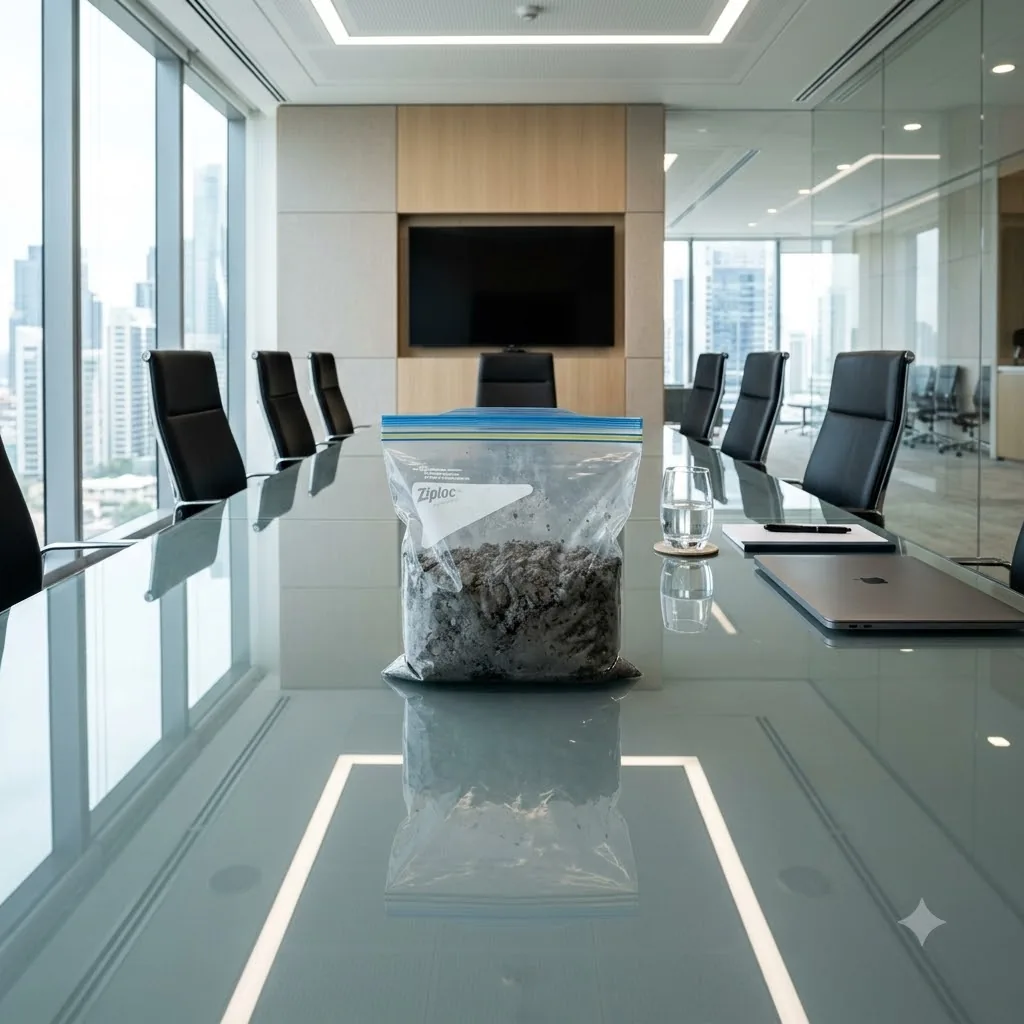
Kiran thought of the gallon-sized Ziploc bag sitting on Brody’s desk. The heavy, muddy paste of seventy years of family history. The undeniable, physical weight of a fire that had already happened.
“The math is correct,” Kiran continued, holding Sterling’s gaze. “Mr. Vance demanded an unvarnished efficiency matrix, and he has successfully deployed one. The system is calculating the exact trajectory of the current wildfire season against your property lines.”
Kiran looked at Brody, whose finger was still hovering over his useless iPad, and then turned back to the board.
“Your estates are mathematical anomalies. They are going to burn. And this company cannot afford to insure the ash.”
Sterling stared at the screen, the silence stretching until it threatened to snap.