Story code: ST-001531
Part 2: The Executive Override
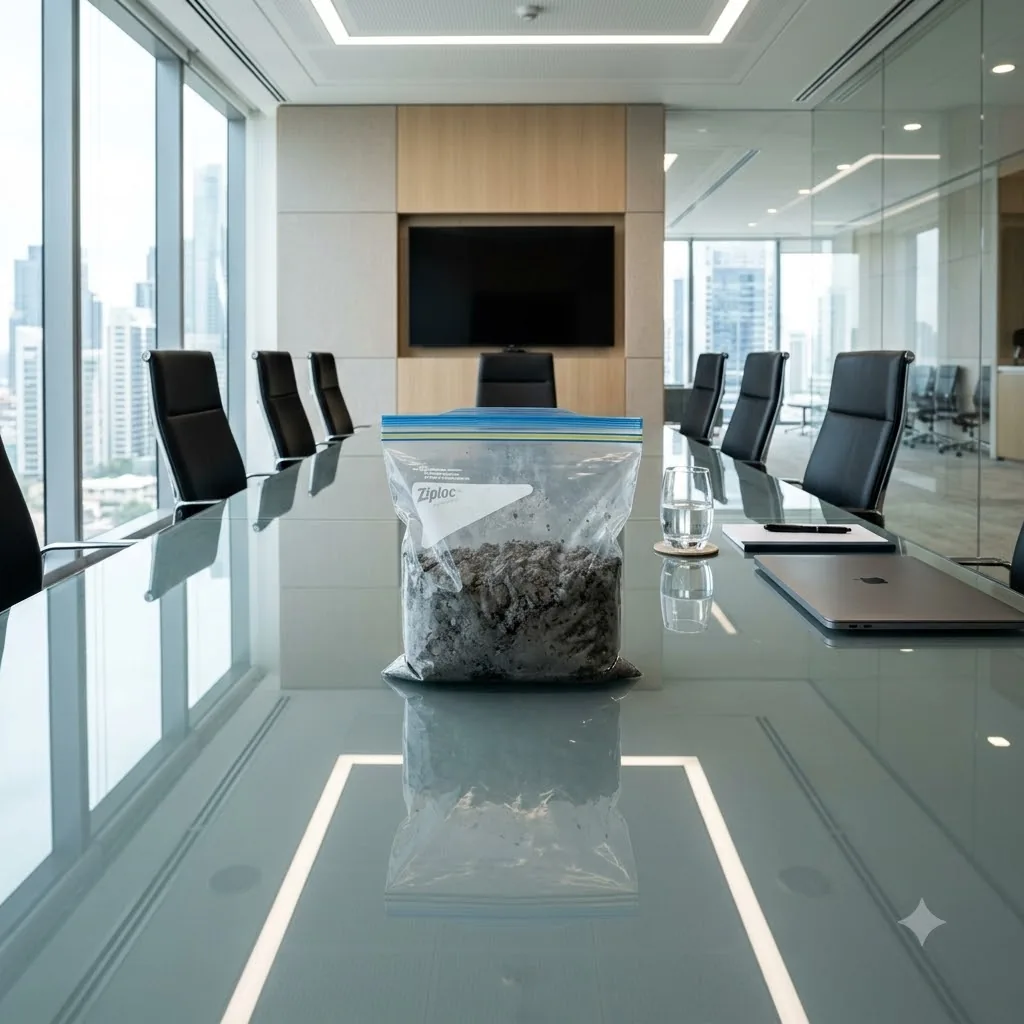
The laptop hinge offered stiff resistance. Kiran pushed the screen back, the cold glow of the monitor washing over the dark ash inside the plastic bag. The quiet hum of the processor joined the heavy silence of the room.
Kiran plugged in the HDMI cable. A second later, eighty inches of high-definition display lit up the wall of Conference Room 4B, projecting Kiran’s desktop.
“Excellent,” Brody said, scooting his chair forward. The wheels groaned against the industrial carpet. “Let’s pull up the engine block.”
Kiran opened the integrated development environment. A dark-themed window filled the wall, populated by thousands of lines of color-coded logic. This was the behavioral routing matrix. It was a living, breathing neural net, designed to quietly observe user hesitation, mouse velocity, and scroll depth, adjusting the product pipeline in milliseconds without the user ever realizing they were being guided.
“Scroll down,” Brody commanded. He crossed his arms over his fleece vest. “Where are the conversion toggles?”
“There are no toggles,” Kiran said, fingers resting lightly on the trackpad. “The matrix doesn’t use static if/then statements. It evaluates historical latency against active session data. It builds a unique route for every single user.”
“Right, but I need to show the CEO a toggle,” Brody said, his tone adopting the patient, rhythmic cadence of someone explaining a very simple concept to a very slow child. “Tomorrow morning, when the executive committee is watching, I need to click a button and force the algorithm to push our premium subscriptions to the top of the feed.”
“You cannot force it,” Kiran said, watching the cursor pulse at the end of a variable declaration. “If you manually inject a static weight into a dynamic learning loop, the model will perceive the forced data as an anomaly. It will immediately try to correct it.”
“Then tell it not to correct it.”
“That requires disabling the error-correction nodes.” Kiran turned away from the screen, looking at Brody. “If you disable those, the system stops learning. It just becomes a static page. It defeats the entire purpose of the fourteen-month rewrite.”
Brody sighed, pinching the bridge of his nose. He dropped his hand and looked pointedly at the Ziploc bag of ash on the table between them. The condensation inside the plastic had collected into a thick, dark drop of muddy water that slid down the interior of the bag, pooling at the bottom.
“Kiran, we need to be solution-oriented,” Brody said softly. “You brought a bag of debris into my conference room to ask for five thousand dollars of company money. You want me to sign off on an emergency relief disbursement. But how can I justify a relief payout for an employee who isn’t willing to support the department’s strategic vision?”
A notification chime cut through the filtered air.
On the eighty-inch screen, a small gray banner slid into the top right corner. It was an automated Slack message from the HR Benefits bot.
*Reminder: Catastrophic Loss Claim 402-B requires VP Authorization. Auto-cancellation in 24 hours.*
Brody read the notification projected on the wall. A slow, practiced smile spread across his face.
“See?” Brody said, gesturing to the notification before it faded away. “Even HR has an auto-cancellation protocol. Systems need manual overrides, Kiran. I need an override for tomorrow’s demo. Once we crush this presentation and I show the board how I have optimized the pipeline, I will have all the bandwidth in the world to review your… administrative requests.”
Kiran stared at the space where the notification had been. The independent contractor needed the down payment by Friday to secure the demolition team. Without the corporate relief funds, the charred remains of the family home would sit exposed to the winter elements, accruing city blight fines by the week.
“You want a bypass,” Kiran said, the words coming out hollow.
“I want an executive override function,” Brody corrected smoothly. “Hardcoded. Tied to my admin credentials.”
Kiran looked at the code on the screen, then down at the keyboard. If a manual override bypassed the memory cache, the system would immediately begin flooding the local buffer with unverified tracking requests. It would hold up for a few minutes. Maybe five. But during a sustained, thirty-minute executive demo, the buffer would overflow. The user interface would freeze, panic, and then collapse into a cascade of fatal server errors.
“I can build a bypass,” Kiran said, keeping their eyes on the glowing screen. “But it has to be deployed from your machine. If it is an executive override, the repository requires it to be committed under a VP-level authenticated token. Otherwise, the security protocols will flag it as a hostile injection.”
Brody sat up straighter, the metal zipper of his vest clinking against his collar. “Perfect. I will authorize the commit. That way, the board sees my digital footprint right at the structural level of the new architecture.”
Kiran opened a new branch in the terminal. The keystrokes echoed sharply in the quiet room. Kiran typed the commands, writing the exact script Brody was demanding-a brute-force bypass that would blind the algorithm and feed it directly into a closed, rapidly overflowing loop.
Brody leaned closer, watching the screen, his eyes tracking the blank spaces between the lines of code rather than the syntax itself. “Make sure it prioritizes the platinum tier.”
Kiran added the parameter. The ash in the bag smelled like wet charcoal and ruined copper wire.
“Done,” Kiran said, stepping back from the laptop. “The branch is ready for merge. You just need to pull it from your end, authorize it, and push it to the main environment.”
Brody tapped eagerly at his iPad. A moment later, the screen on the wall updated.
*Merge successful. Authorized by B. Vance, VP of Product.*
“That is what I call synergy,” Brody said, locking his iPad and standing up. He checked his reflection in the dark glass of the whiteboard. “Excellent work, Kiran. I think we have a real winner here.”
Kiran kept a hand resting on the table, inches from the bag. “The HR form.”
“Right,” Brody said, already moving toward the glass door of the conference room. He did not look back. “Tomorrow at ten, we do the live demo for the CEO. You will sit right next to me and make sure the server does not blink. Once the board applauds, I will sign your form. Make sure you do not touch a single line of that code until then.”
The heavy glass door clicked shut, leaving Kiran alone in the soundproof room with the glowing monitor and the smell of a burned-down life.