Story code: ST-001563
Part 2: Strict Compliance
The deputy’s hand didn’t push, but the weight of it was a steady current dragging Eli forward. He shoved the phone deep into his jacket pocket without pressing end. Against his thigh, the insurance adjuster’s voice became a faint, tinny scratching, a microscopic insect trapped in the dark.
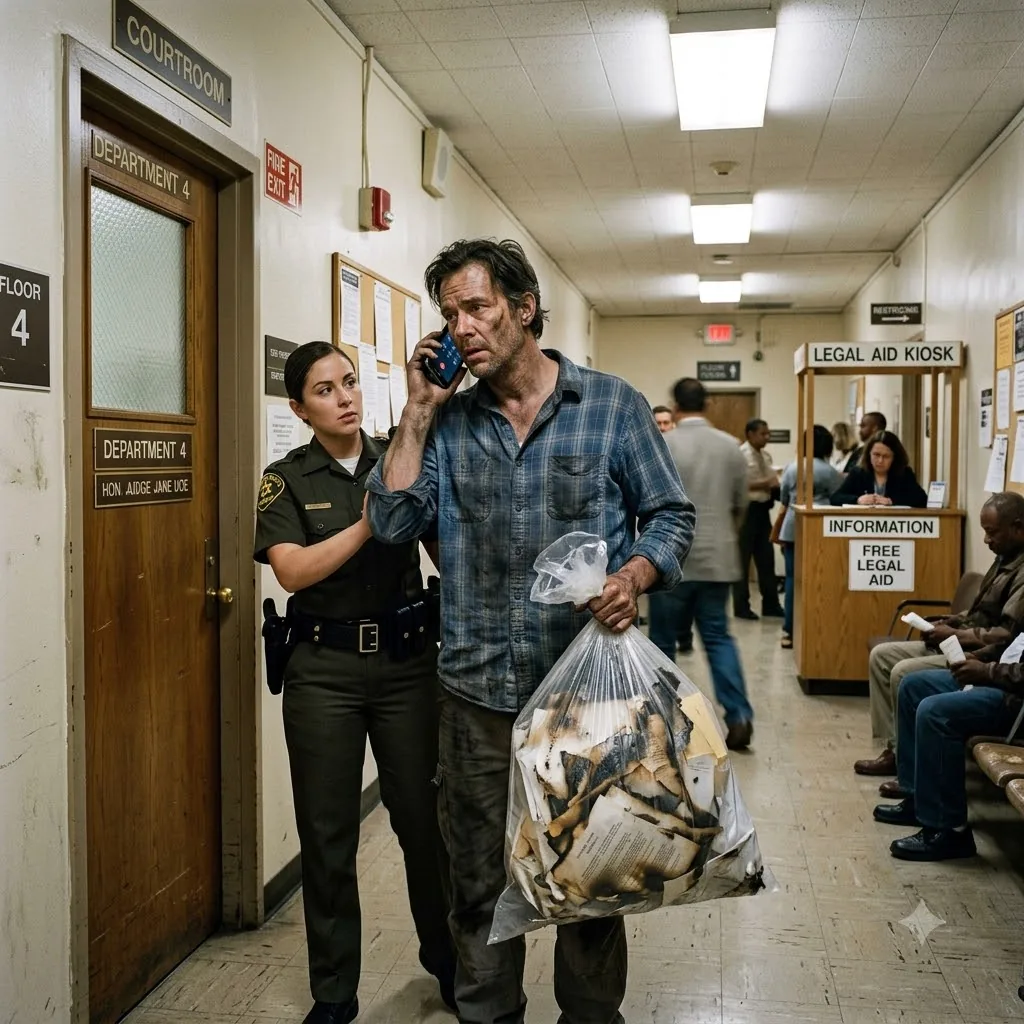
He stepped up to the wooden podium. The soot-rubbed trash bag swung against the paneling with a heavy rustle. A public defender-not the one from his first hearing, but a younger man smelling of peppermint and high-volume stress-slid into the space beside him and cracked open a manila folder.
“Eli Navarro,” the lawyer muttered, glancing sideways at the bag but saying nothing about it. “Just let me do the talking. We’re asking for a continuance.”
Judge Caldwell didn’t look up from her monitor. “Matter of Navarro. I have a probation violation report from the fourteenth. Defendant tested positive for opiates and was cited for possession of a controlled substance. This was a Section 1000 diversion case, Mr. Davis. Your client had four months of clean tests. What are we doing today?”
“Your Honor, Mr. Navarro was displaced by the Canyon Fire on the eighth,” the public defender said, his voice dropping into a smooth, practiced gear. “He lost his residence and his belongings. We’re asking the court to view this lapse in the context of extreme community trauma.”
The prosecutor, a woman seated at the adjacent table beside a stack of identical files, stood halfway. “The State is sympathetic to the natural disaster, Your Honor. But a declared emergency does not suspend the Health and Safety Code. The police report notes the defendant was found in a commercial parking lot with unprescribed oxycodone. The terms of his diversion mandate strict compliance.”
Eli gripped the edges of the podium. His fingertips left faint, greasy smears of ash on the polished wood. The sterile geometry of the courtroom-the flags, the seal, the neat stacks of paper-felt like a hallucination. They were talking about a “lapse” and “strict compliance.” They weren’t talking about the three days after the sky turned orange.
He had been doing exactly what the court had ordered him to do for four months. Taking his legally prescribed buprenorphine to manage the cravings, going to work, staying clean. But the fire had taken the amber pill bottle on his bathroom counter. It had taken his driver’s license. It had taken the local pharmacy, reducing the brick building to a scorched footprint beside the highway.
When Eli had finally made it to the county’s emergency recovery center at the fairgrounds, shivering and starting to sweat, he had found the triage tent. The disaster nurses were handing out emergency insulin, albuterol inhalers, and blood pressure medication to the displaced homeowners. But when Eli explained what his prescription was, the compassion dropped from their faces like a heavy curtain.
*The state’s emergency protocols do not cover Schedule III addiction maintenance,* the triage nurse had told him, looking past his shoulder to the next person in line. *We cannot dispense that here. You need to contact your primary prescriber.*
His prescriber’s office was inside the evacuation zone. The cell towers were melted slag.
By his third night sleeping in his car, the withdrawal was a physical violence. He was shivering so hard he couldn’t hold a pen to fill out the FEMA applications. He couldn’t speak to the insurance agents without his teeth clicking. The county’s recovery machine demanded a functional citizen who could wait in long lines and fill out triplicate forms, and the county’s medical machine had left his body to tear itself apart.
He had bought the pills from a guy at the edge of the shelter parking lot just to stop the shaking long enough to save his own life. An hour later, a deputy patrolling the lot for looters had tapped a flashlight against his window.
A simple drug case. That was all the court record saw.
“Mr. Navarro,” Judge Caldwell said, her voice cutting through the ringing in his ears. “The court recognizes the severe hardship of the wildfires. But diversion programs require accountability. I cannot ignore the illicit acquisition of narcotics simply because you were evacuated.”
“I wasn’t just evacuated,” Eli said.
“Hey,” his lawyer whispered, putting a hand over the microphone. “Don’t.”
Eli ignored him. “I asked the county clinic for my prescription. The disaster tent at the fairgrounds. They told me they didn’t do those kinds of pills. They gave people insulin but they told me I had to figure it out myself.”
“Your Honor,” the prosecutor interrupted, her tone sharpening. “There is no documentation in the file of the defendant seeking authorized medical care prior to his arrest.”
“Because they didn’t write it down!” Eli’s voice bounced off the high ceiling. The deputy who had escorted him took a half-step forward. Eli forced his hands to stay flat on the podium. “They didn’t give me a denial form. They just told me to leave.”
Judge Caldwell sighed, removing her reading glasses. It was the heavy, practiced sigh of a system that had reached the end of its rigid flexibility. “Mr. Navarro, if you can provide documentation-a digital record from your doctor, an emergency triage denial slip, or the original pharmacy log showing an active prescription at the time of the fire-I will consider reinstating your diversion without penalty. But I need proof of valid medical necessity.”
Eli stared at her. Deep in his pocket, the phone vibrated, a tiny, muffled rhythm against his leg. The insurance adjuster, still holding the line, waiting for the exact same thing.
“My doctor’s office burned,” Eli said, the words tasting like soot. “The pharmacy burned. Everything I had to prove I was doing what I was supposed to do is in this bag.”
He nudged the black plastic trash bag. It slumped against the microphone stand, offering nothing.
“Then you have a problem,” the judge said, her voice entirely devoid of malice, which somehow made the machinery of it worse. “The court cannot operate on the assumption of lost documents. If you cannot verify your medical status by five o’clock tomorrow, I am legally obligated to revoke your diversion and set this case for sentencing. You will be remanded to county custody. Do you understand?”