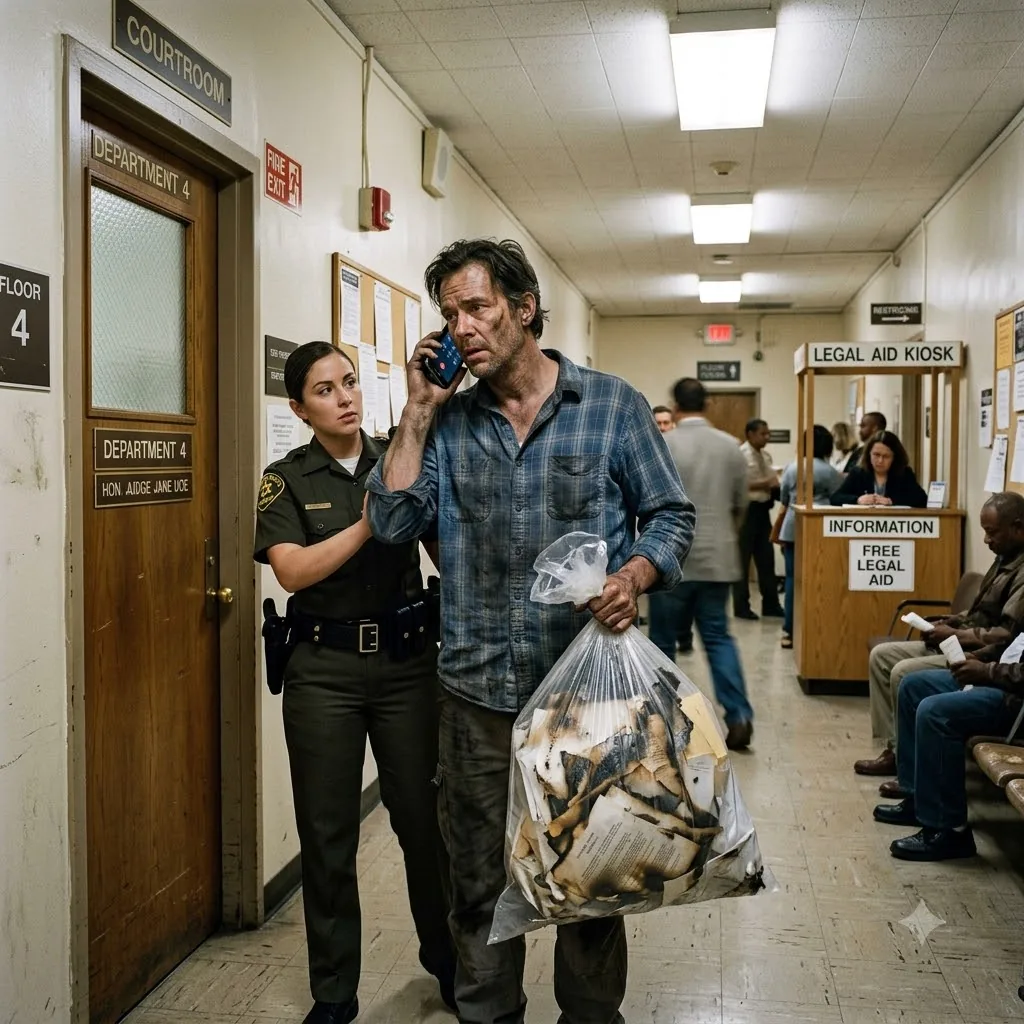
Story code: ST-001563
Part 4: Permanent Record
At four fifty-five the next afternoon, Department 4 smelled of floor wax and stale breath. Eli stood at the podium with his hands flat on the wood. He had left the soot-rubbed trash bag in his car. In front of him sat three pieces of paper: the continuity-of-care receipt, the singed county notice, and a blank intake denial form the recovery liaison had given him.
Judge Caldwell held the receipt up by one corner, as if the paper itself might stain her fingers.
“Mr. Navarro,” she said, her voice amplified and echoing off the wood paneling. “This document says ‘processing delayed.’ It explicitly states it is not a verification of an active prescription.”
“It says the county can’t find my records because the county’s clinic burned,” Eli said.
“And this,” the judge continued, tapping the flame-browned notice. “An envelope is not a lease.”
“My landlord died in the fire,” Eli said. He didn’t raise his voice. He didn’t need to. The exhaustion had burned away everything except the hard, flat truth. “I rented a room from him. The house is ash. He is ash. The pharmacy is a hole in the ground. The county triage tent told me my addiction wasn’t an emergency, and now this court is telling me my survival was a crime.”
Next to him, the public defender put a warning hand on Eli’s arm. “Your Honor, given the totality of the community disaster-”
“The totality, Mr. Davis,” Judge Caldwell interrupted, her tone snapping like a dry branch, “is that your client was found in possession of illicit narcotics while under a diversion order. I gave him twenty-four hours to produce valid medical verification. The court cannot operate on tragedies. It operates on proof.”
Eli looked at the heavy seal on the wall behind her. “You’re sending me to jail because the fire destroyed the paperwork that proved I was doing what I was supposed to do. You’re using the disaster to punish the people who didn’t have enough money to buy fireproof safes.”
“That is enough,” Caldwell said. The gavel didn’t fall, but her posture shifted, locking into the rigid machinery of sentencing. “The defendant has failed to provide verifiable proof of compliance. Diversion is permanently revoked.”
She didn’t stop there. The words flowed out in a practiced rhythm, but they carried a new, punitive weight. She imposed the maximum ninety-day sentence in county lockup for the possession charge. Then she added the probation terms.
“Upon release, defendant is mandated to enroll in a high-intensity outpatient treatment program,” she said, looking down at her screen. “Enrollment requires a verified permanent address within the county. Failure to secure an approved residence will result in immediate remand to custody.”
Eli stared at her. She had just mandated him to provide the exact thing he had spent two days proving he could not get. She had made his recovery legally impossible.
The deputy stepped up behind him. “Hands behind your back.”
The metal of the handcuffs was startlingly cold. As the deputy clicked the heavy steel around Eli’s wrists, the sounds of the courtroom seemed to sharpen.
Eli turned his head as he was guided away from the podium. He watched the court clerk, the woman who had spent all week rejecting imperfect documents. She was supposed to hand Eli’s unverified papers back to the defense table for disposal. Instead, she picked up the continuity-of-care receipt and the singed county notice. She aligned their edges perfectly. She picked up her heavy red stamp, pressed it down on both pages-*RECEIVED AND ENTERED*-and slid them into the permanent case file. A piece of the fire, locked inside the pristine system forever.
In the second row of the gallery, a woman with a press badge hanging from a neon lanyard had stopped scrolling on her phone. She was staring at Eli, her pen hovering over a notebook. She looked up at the television monitor in the corner, which was still silently running the county’s emergency broadcast-*RESILIENCE. RECOVERY. COMMUNITY.*-and then she looked at Eli in handcuffs. She began to write, her pen tearing across the page, capturing the gap between the clean broadcast and the man being taken away.
“Next case,” Judge Caldwell said. “Matter of…”
She paused. The prosecutor stood up to read the charge, but her voice faltered.
“Your Honor, the State moves to proceed under the… the community recovery protocols…”
The prosecutor swallowed hard. The phrase hung in the air, suddenly sounding hollow, stripped of its bureaucratic camouflage. In the dead silence of Department 4, the words sounded exactly like what they were: an excuse for abandoning the people who needed them most.
Eli heard the uncomfortable shuffle of papers as the deputy pushed open the heavy wooden door to the holding cells. The lock clicked shut behind him, leaving the court to choke on its own language.