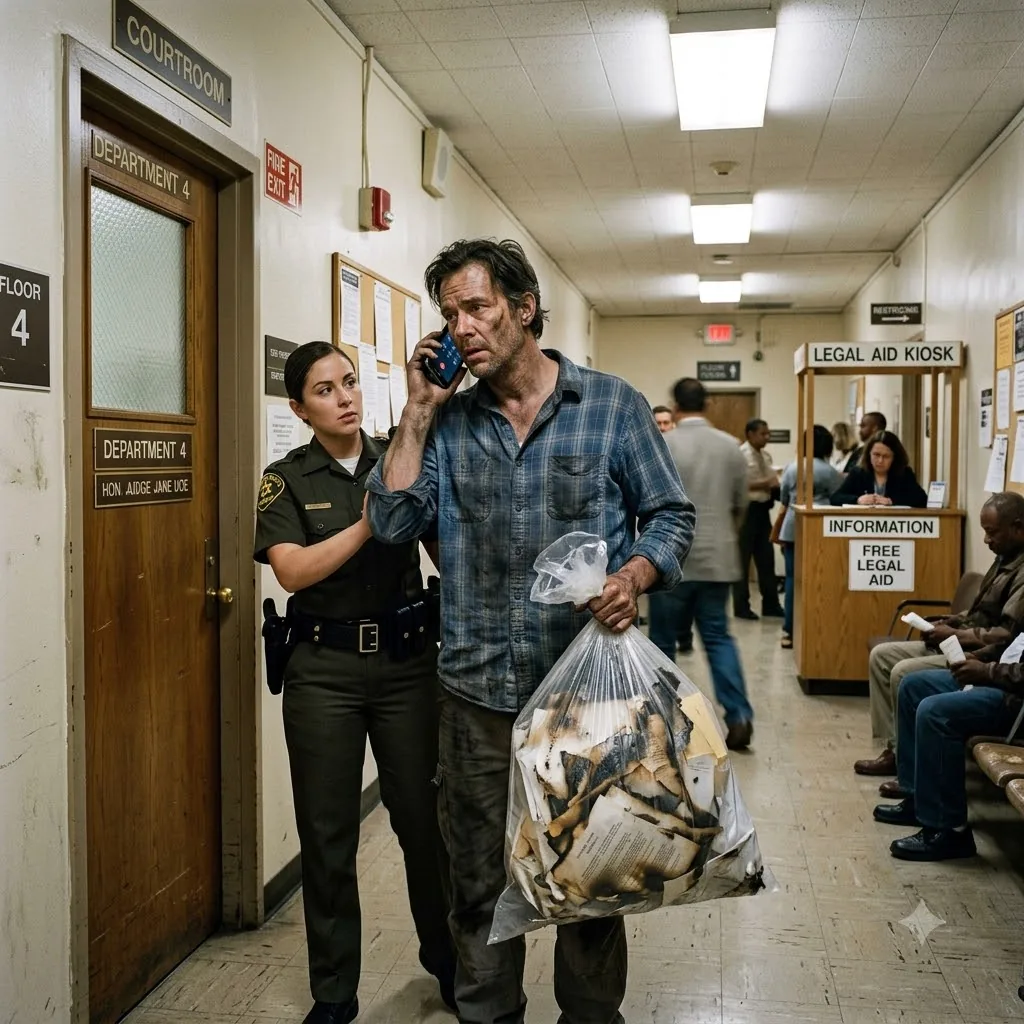
Story code: ST-001563
Part 3: Verified Loss
By the time court broke for the noon recess, Eli had learned the shape of the deadline in his body. It wasn’t the judge’s words anymore. It was the way every minute afterward had to be spent proving, to someone, that he had existed in the right place, in the right condition, with the right kind of need, before the fire took the paperwork that could certify it.
He went first to the clerk’s window because it was closest. The woman behind the glass had the careful, exhausted face of somebody who had already said no a hundred times that morning.
“If I get records from county behavioral health,” he said, “do I bring them here or to Department 4?”
She kept typing. “File them at records before four-thirty. Department copies are not official.”
“What if they email them?”
“Then records prints and stamps them if the transmission header is visible.”
“What if the office is gone?”
That made her stop. Not out of sympathy, exactly. More because it didn’t fit the options in front of her.
“Then you’ll need whoever keeps the files now.” She slid a yellow instruction sheet through the opening without looking at him again. “Next.”
The sheet listed three departments, two room numbers, and a phone tree. Eli stood to the side and called the first number. A recording informed him that due to wildfire disruption, clinic services had been temporarily consolidated. It gave another number. That line rang eight times, then disconnected. He called again. Busy. He called the insurer while he was walking down the stairs, balancing the phone against his ear and the trash bag against his knee.
This time he got a catastrophe team specialist with a low, bright voice and a keyboard clacking under every sentence.
“Mr. Navarro, I see the claim notes here,” she said. “Your file is pending occupancy verification.”
“I heard that part. I need to know what counts if I rented a room and my landlord is dead.”
There was a pause, small but real. “I’m sorry?”
He leaned against the wall by a vending machine humming in the basement corridor. “He died in the fire. The house was his. I paid cash. I got mail there, not bills. I don’t have a lease. I have county notices and pharmacy receipts and a burned envelope with the address on it.”
The keyboard stopped. When she spoke again, the brightness had flattened. “If you were an undocumented tenant, standard review may require third-party verification. Tax records would identify the property owner only.”
“He’s dead.”
“Then we would generally look for utility records, rental agreements, or a landlord affidavit.”
Eli shut his eyes. The machine behind him dropped a bottle somewhere inside itself with a blunt, hollow thud. “You want an affidavit from a dead man.”
“Sir, I understand this is frustrating. I’m just explaining the acceptable forms of proof.”
He looked down at the yellow sheet in his hand. Behavioral Health Archive, Annex B. County Recovery Liaison, Hall of Records. Emergency Medical Documentation Requests. Every route had another route behind it, and every route assumed there had once been paper clean enough to survive the trip.
“Fine,” he said. “Put in the notes that the property owner died in the fire and the tenant records burned with the structure. Put in the notes that I told you that.”
“I can note the reported circumstances,” she said.
Reported. As if his life had become weather.
He ended the call and found Annex B across the street in a modular office that smelled like dust and copier toner. A security guard pointed him toward a counter with taped signs: RELEASES, MEDICAL RECORDS, DISASTER TRANSFERS. Behind the counter, a woman in blue scrubs read his name off the request slip and frowned at her monitor.
“Navarro, Eli. Date of birth?”
He told her.
She clicked through a few screens. “I see prior visits. But your prescribing physician’s files are under continuity review.”
“What does that mean?”
“It means the clinic site was damaged and some records haven’t been reconciled into the central system yet.”
“I need one thing,” he said. He could hear the strain creeping into his voice and hated it. “Just something that says I had an active buprenorphine prescription before the fire. For court. Today.”
The woman turned and asked someone behind her a question too low for him to hear. A man with reading glasses on a cord came over, looked at the screen, then at Eli.
“If the medication was dispensed by the satellite pharmacy, we may not have the final audit loaded.”
“The pharmacy burned.”
“Yes,” the man said, with the vague patience of someone confirming weather damage on a roof he did not own. “That’s part of the issue.”
“So where is it?”
“What?”
“The record. If it isn’t there and it isn’t there, where is it?”
People in line had started listening without turning their heads. Eli could feel them doing it.
The man lowered his voice. “Sir, in disasters there are disruptions. We do the best we can with available systems.”
Eli laughed once, sharp enough to hurt his throat. “Everybody says systems like that means nobody made a choice.”
The woman’s eyes flicked up from the keyboard. The man straightened.
“We cannot issue documentation we cannot verify,” he said.
“But you can tell a court I should have brought documentation you can’t verify because your building burned?”
“No one is telling the court that.”
“Aren’t they?”
He pulled the folded minute order from his pocket and flattened it on the counter with the heel of his hand. The paper still held the heat-softened crease from being jammed into the trash bag. Five o’clock tomorrow. Proof of valid medical necessity.
The man read enough to understand what he was looking at. His expression changed by a degree. Not guilt. Recognition.
“I can give you a continuity-of-care request receipt,” he said. “It won’t confirm the prescription itself.”
“Then give it to me.” Eli took the slip when it printed, looked at the language-REQUEST RECEIVED, PROCESSING DELAYED DUE TO FACILITY DISPLACEMENT-and felt something inside him align instead of break.
Hall of Records was three blocks away. The county recovery liaison occupied a folding table under a banner with mountains and a blue sky untouched by smoke. When Eli laid out the receipt, the judge’s order, the browned county notice, and the pharmacy paper with half the ink gone, the liaison-a man in a polo with RECOVERY PARTNER embroidered over the chest-began sorting them into little administrative categories with two fingers.
“Okay,” he said. “Housing, medical, judicial. These are separate tracks.”
“They’re not separate,” Eli said.
“For intake purposes, they are.”
“No.” Eli heard his own voice go flat. That was new. Worse than shouting. “My landlord died in the fire. I rented a room from him. So I can’t prove where I lived because the person who could say I lived there is dead. I can’t prove my prescription because the clinic records are displaced and the pharmacy burned. And because I can’t prove either one, court says I chose to be in a parking lot with pills that weren’t in the right bottle.”
The liaison gave the small, guarded smile people used when they wanted a distressed person to lower his volume in public. “I understand this feels connected.”
“Feels?”
A couple at the next table stopped pretending not to listen. Down the hall, someone carrying banker boxes slowed almost imperceptibly.
Eli put one finger on each paper as he spoke, pinning them in place. “This county told me to go to the recovery center. The recovery center told me addiction treatment wasn’t an emergency. The insurer says I don’t count at my own address because I was renting wrong. The court says missing records make me irresponsible. Every office is using the damage from the fire as proof I failed before the fire.”
The liaison’s smile disappeared. “Sir, that’s not what anyone is saying.”
Eli slid the continuity-of-care receipt across to him. Then the judge’s order. Then the singed county notice with the address visible through the smoke stain.
“Read it out loud, then,” he said. “Tell me what these papers say happened to me that isn’t exactly that.”