Story code: ST-001587
Part 4: What Help Cost Them
Nobody spoke for a beat after Rick stopped himself.
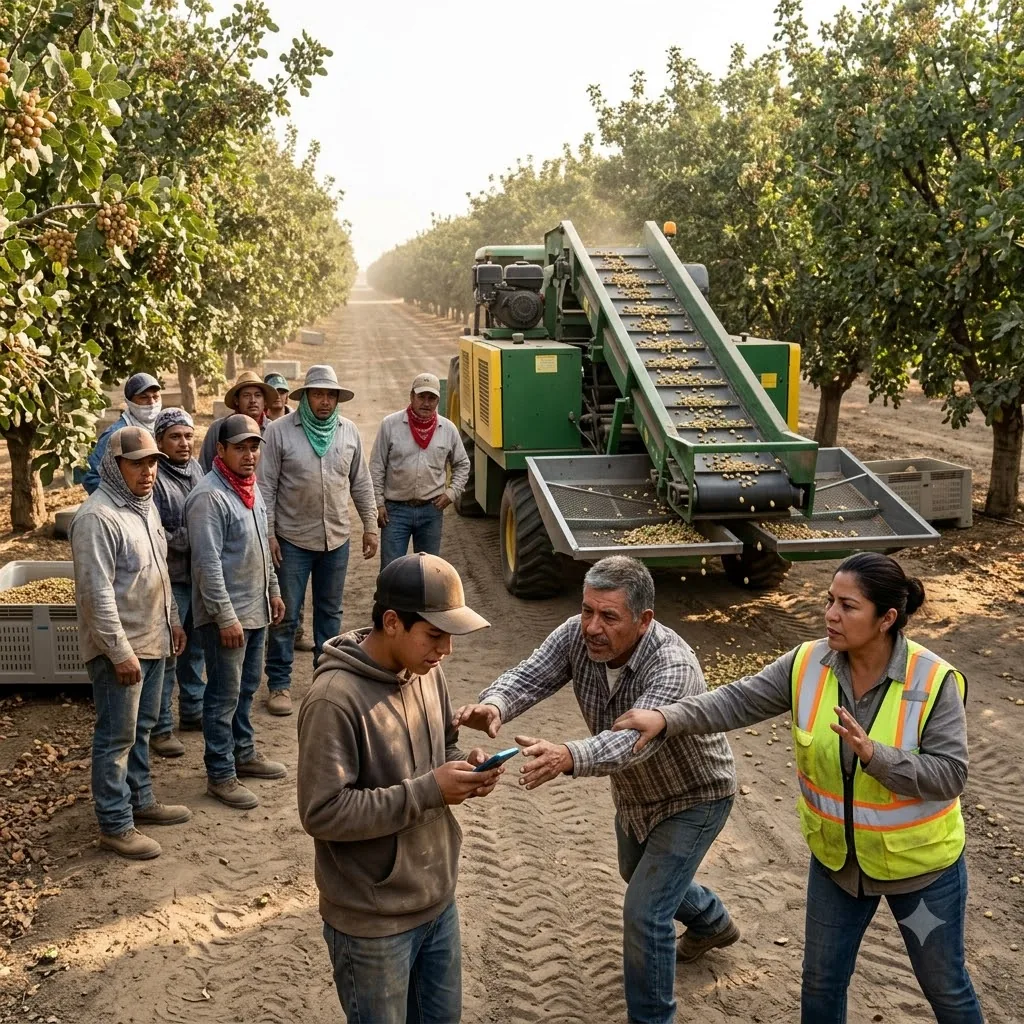
The ranch trucks idled at the end of the row, engines knocking softly in the heat. Mateo heard doors shut, then the quick stride of men who had not yet seen enough to know how fast they should move. Around him, the crew stayed fixed in place. What Rick had let out hung over them heavier than the dust.
Then the younger worker by the machine did the simplest thing any of them had failed to do.
He pulled out his phone and called anyway.
Rick turned at the sound of his voice giving the location, but the turn came late and without force. He still had Emiliano’s phone in one hand. The other lifted halfway, as if habit might finish the order for him. It did not. Tomas stepped into the lane between them, not touching Rick, only standing there. Gilberto moved too, one pace and no more, but it was enough. The row had shifted. Mateo felt it like ground settling under a house after a long tremor.
One of the supervisors came hurrying in, shirt already dark under the arms, asking what happened, who had shut the machine down, why no one had called the office first. He got as far as the rear wheel, saw Lucio in the dirt, and lost the rest of his sentence.
Mateo had not let himself look fully until then.
Now he did, because there was no point protecting his eyes anymore. Lucio’s face had gone the color of wet paper. One leg lay wrong under him, not bent but emptied of its old shape. His hand twitched once against the husks as if he were still trying to reach for something. Mateo dropped to one knee a little distance away, close enough to hear the thin catch in each breath, close enough to know those breaths were being counted now by everyone in the row.
“Don’t move him,” the younger worker said into the phone. “No, don’t move him. Hurry.”
The second supervisor arrived behind the first, then stopped when he saw Rick. Not looked at him. Saw him. Saw the phone in his fist, the faces in the row, the expression he had not put away in time. Something passed over the man’s own face then, quick and guarded, like a window shade yanked halfway down.
“Give me that,” he said.
Rick did not pretend not to understand. He handed over Emiliano’s phone.
Not to Emiliano. To the supervisor.
That small choice landed hard. Emiliano made a sound in his throat but said nothing. Mateo rose and took one step toward them, then stopped. The supervisor glanced at the screen, locked it, and slipped it into his own pocket.
“It stays with me until we sort this out,” he said.
Access gone, just like that. Not only the phone. Whatever name or message lived inside it. Whatever version of the day Rick had hoped to erase. Whatever version Emiliano might have wanted to hide. Mateo looked at his son and saw the first understanding of that loss hit him: not confiscation for an hour, not a father’s punishment, but the feeling of being entered into somebody else’s paperwork.
The ambulance took too long and then arrived all at once, red and white where there had only been orchard green. With it came sheriff’s deputies, not storming, not dramatic, simply because roads closed and reports required names. Witness statements started under the trees while paramedics worked in a hard bright knot around Lucio.
Mateo gave his name, his address, the spelling twice.
The deputy wrote carefully and asked who had first tried to call.
Mateo answered.
Who stopped him.
Mateo answered that too.
When asked whether the injured man had been conscious, whether anyone had discussed taking him somewhere other than the hospital, whether anyone had handled another worker’s phone, Mateo heard the row behind him go quiet in a new way. Not fear of speaking now. Fear of speaking wrong. Every answer cost something. A day’s work was already gone. More than that might go with it.
Lucio left on the stretcher alive, but not awake. One paramedic said they were taking him straight into surgery. Mateo caught only pieces after that: crush injury, blood loss, maybe save above the knee, maybe not. By the time the ambulance doors shut, the shape of the future had changed for a man who had come to work that morning expecting only heat and wages.
The orchard did not start up again.
By noon, men stood in small clumps near the water trailer waiting to hear whether they should clock out or stay. Nobody knew who would sign the sheets. Rick had been taken to one side by the deputies and then farther aside by the ranch manager, where all three spoke in low voices that still looked sharp from a distance. No radio on Rick’s chest now. No hat. Mateo had never seen him with empty hands.
Emiliano sat on an overturned bin with his elbows on his knees, staring at the dirt between his boots. Without the phone he looked younger and, strangely, more exposed, as if the missing rectangle in his pocket had taken not only messages but some layer of skin with it. Mateo wanted to ask him everything at once: who Diego was, how close he had come, what he had promised, what he had believed. He asked none of it there.
Instead he brought him a cup of water.
Emiliano took it and said, very quietly, “I’m sorry.”
Mateo heard how many apologies were packed into the two words and knew neither of them yet had enough strength to sort them.
Before they were released, the manager told the crew the block was closed until further notice and that payroll for the morning would be reviewed after statements were collected. Reviewed. Another soft word laid over a hard thing. Men looked at one another and did the math of rent, groceries, gas, remittances. A blocked row was lost hours. A safety investigation was more. If names got tied to off-the-books hauling, some men would lose side money; if the ranch decided the whole crew had become noisy, they could lose the season.
Rick finally looked toward Mateo once as he was escorted to the office truck. Not with authority anymore. Not even with open hate. With the naked shock of a man who had built his power out of everybody else’s silence and had just discovered the material was gone.
It did not make Mateo feel safer.
When they were allowed to leave, father and son walked to Mateo’s truck under the long flat sun. No one called after them. No one promised anything. Behind them, the machine still sat dead in the row, and yellow tape had begun to flutter from one side of it to the other.
Emiliano reached the passenger door, then stopped.
“If they go through the phone,” he said, not looking up, “there are things that will make it worse before they make it clear.”
Mateo rested his hand on the hot metal of the truck roof. He was tired deep in the bone, tired past anger, but not emptied of it. Lucio in the ambulance. Hours disappearing. Names written down. A son standing beside a road he had not understood was a road at all until it started closing behind him.
“Then we tell the truth faster,” Mateo said.
Emiliano nodded once.
It was not safety. It was not forgiveness. It was only the first thing that did not feel like hiding.
Mateo got in, and his son got in beside him, and together they sat for a moment without starting the engine, listening to the orchard carry on without them.