Story code: ST-001587
Part 3: The Word Rick Did Not Want Said
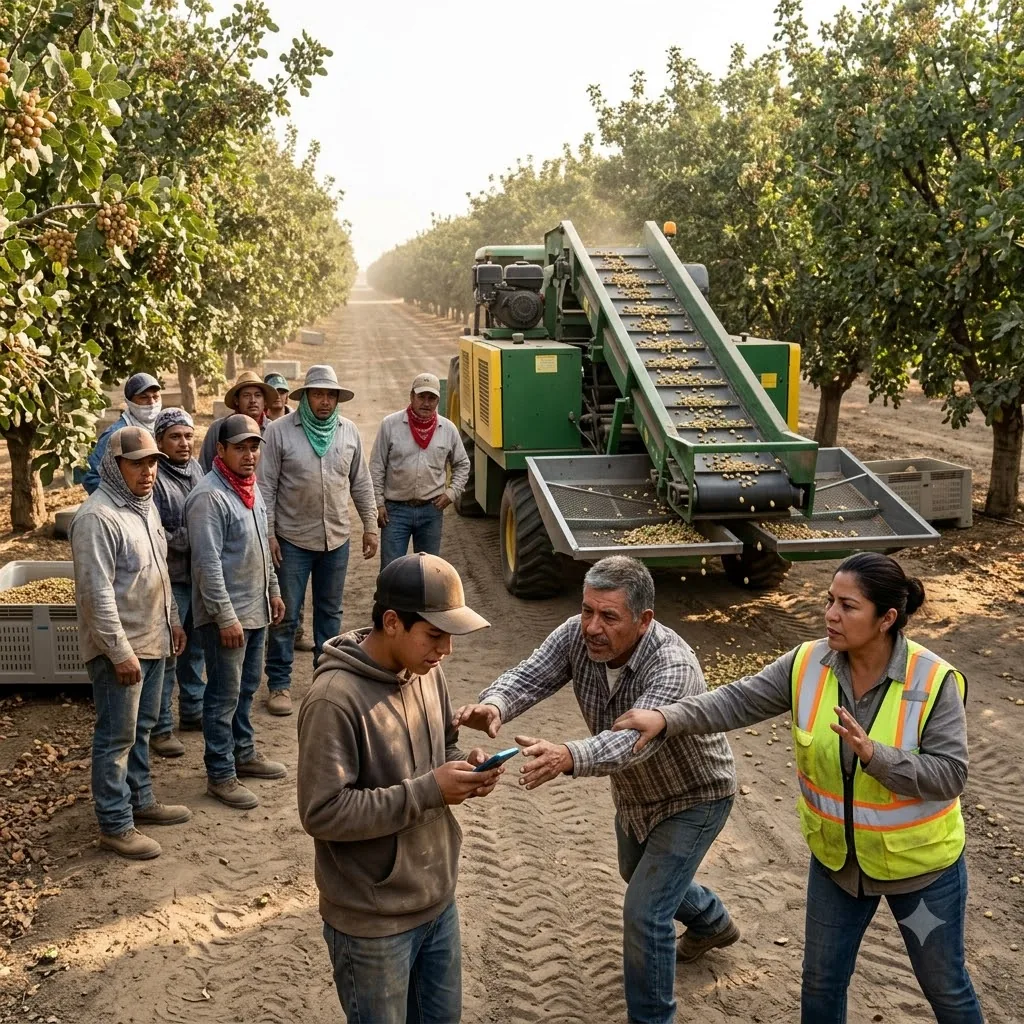
The silence by the machine changed shape.
Before, it had been shock, men holding themselves still because they did not know what else to do. Now it was the kind that made Mateo’s skin prickle. Even the orchard seemed to be listening.
Rick stood with Emiliano’s phone in his hand, eyes moving over the screen. Mateo took a step toward him.
“Give it back.”
Rick did not look up. His thumb dragged once, then stopped. Whatever he had found tightened his mouth, but not in the way Mateo expected. Not surprise. Not exactly anger either. More like a man seeing a door swing open on a room he had hoped stayed locked.
From the lane beyond the trees came the grind of tires over washboard dirt. One truck, maybe two. Men in the row turned their heads toward the sound and then back to Rick, waiting to learn what kind of fear they were supposed to have.
The younger worker nearest the machine finally found his voice. “He’s not breathing right.”
No one answered him.
Mateo saw the moment Rick chose that on purpose.
He lifted the phone a little higher so Emiliano could see the screen too. “Who is Diego?” he asked.
Emiliano flinched.
Mateo felt it in his own chest. He knew the name only as a shadow around his son lately, the kind of friend mentioned too casually or not at all. A ride here, a cousin there, somebody from town. Nineteen-year-old answers. Nothing you could hold.
“Nobody,” Mateo said.
Rick smiled without humor. “Nobody keeps texting where are you every five minutes during a work shift.” He glanced at the crew. “Maybe your boy’s got side business going in my rows. Maybe that’s why he’s so nervous.”
Emiliano’s face went hot, then drained white again. “It’s not my business.”
The words came out too fast. Mateo turned toward him. Rick heard it too.
“No?” Rick said. “Then whose?”
The truck noise got closer. Through gaps in the trees Mateo caught white paint flashing between trunks. Not sheriff. Ranch trucks. One of them the office Ford with the door that never shut right unless you slammed it twice.
Rick heard those engines and grew bolder. He tucked the phone against his chest like evidence. “I ask one simple thing around here. Phones away, heads down, do the work. But every time there is trouble, it’s somebody who thinks the rules are for other people. Somebody with cousins in town, little favors, little errands.”
He was talking to Emiliano, but he was feeding the row.
Mateo knew that rhythm. He had heard it when hours vanished from pay envelopes. When a trailer of broken bins had been blamed on whoever could least afford to argue. Rick always built his story in public so the witnesses could help hold it up.
The younger worker near the machine said, louder now, “We need help now.”
Rick snapped without turning. “I said stay back from him.”
Then, because he had turned his head, Mateo saw it.
Not the phone. Rick’s truck keys in his shirt pocket, bouncing against the radio. A little red plastic tag Mateo knew. He had seen it at the gas station by the highway three nights ago, dangling from Rick’s fingers while Rick stood beside his own pickup talking to two boys too young to shave well. One of them had neck tattoos half hidden by a hoodie despite the heat. The other had loaded taped cardboard boxes from Rick’s truck bed into a dented Honda with no rear plate. Mateo had noticed because the boys did not look like field hands, and because Rick had seen him at pump four and turned away fast.
At the time, Mateo had let it pass. None of his business.
Now Rick shook Emiliano’s phone once and said, “Diego from what? Diego from where?”
Emiliano stared at the ground.
And from the phone, still unlocked in Rick’s hand, a new message slid across the screen bright enough for Mateo to read before Rick’s thumb covered part of it.
YOU SAID RICK KNEW THE BACK ROAD
Mateo looked up.
Rick looked down.
For one beat neither moved.
Then Rick hit the side button, blacking out the screen, too late.
Mateo heard his own voice before he quite decided to use it. “Read that again.”
Rick’s eyes came back to him hard. “Mind your business.”
“It is my business when you take my son’s phone. Read it.”
A few heads lifted along the row. Tomas looked from Mateo to Rick. Even the older picker stopped pretending to study the dirt.
Rick stepped back toward the lane. “Supervisor can sort this out in a minute.”
There it was again. Wait. Delay. Contain.
The younger worker by the machine made a sharp sound. “He’s turning blue.”
Mateo moved toward the machine on instinct, but Rick cut across him, one arm out. Not to help. To block.
That was wrong enough by itself that the whole row felt it.
“What are you doing?” Mateo said.
“Nobody touches him till clinic says-”
“Clinic?” The word came out of Mateo like something bitter. “What clinic?”
Rick hesitated.
Only a second. But Mateo saw men catch it.
Rick recovered fast. “Private doctor. Faster than bringing in county people and shutting down the ranch.”
Mateo stared at him. The trucks were almost on them now; engines idling at the end of the row. Still no ambulance. Still no siren.
Memory snapped into place so suddenly it made him feel foolish for missing it before: two workers gone last month after a ladder collapse, one coming back with stitches and a story that did not match where the blood had been on the packing table; the whispered rides after dark to a cinderblock clinic over in Madera where cash went in an envelope and names stayed loose; boys on bicycles cutting between orchard roads at dusk, carrying taped sacks nobody called lunch.
Rick was not protecting the company from trouble first.
He was protecting the roads underneath it.
Mateo looked at Emiliano. His son would not meet his eyes. Shame did that. Fear too. Not the fear of being caught lying about a girlfriend or skipping a shift. The fear of having stepped too near something older and uglier than he understood.
“Diego works for you,” Mateo said.
Rick barked a laugh. “You’re out of your mind.”
Mateo pointed at the dark screen in Rick’s fist. “The boys who run your loads on the back roads. The ones too young to be on payroll. The ones nobody reports when they get stopped because they were never here officially.”
A rustle went through the row, small and electric.
Rick’s face changed then. The color did not leave it; it settled deeper, as if all the heat in him had found one place to burn.
“Watch yourself,” he said.
“And the clinic,” Mateo said, louder now, because once he started he could hear the shape of it and could not unknow it. “You don’t want an ambulance because then there is a record. You don’t want county here because then there are questions. Not about the machine. About everything else riding under your name.”
One of the ranch trucks cut its engine. Doors opened. No one in the row turned to look.
Rick took one step toward Mateo. “You think you know something because your kid got stupid texts?”
Mateo did not move. His heart was battering his ribs hard enough to hurt, but the fear had changed sides now. He could see that too. Rick was no longer talking like a foreperson. He was talking like a man whose hidden doors had just been named in front of witnesses.
“Say OSHA,” Mateo said.
Rick blinked.
Not because he had not heard. Because everyone had.
Mateo said it again, louder. “OSHA. Ambulance. Now.”
The word landed in the row like a metal bar dropped on concrete.
Rick’s mouth opened, closed. For the first time since the machine stopped, he had no ready script.
Then the mask tore.
“You stupid bastard,” he said, voice rising raw. “You say that word out here and you bury all of us. You, your son, every man in this row. And if those little gang punks think my name came from your house-”
He stopped.
Not because he meant to.
Because he heard himself.
Because the row heard him too.
Because there was no clean way to pull those words back once they were standing in the dust between them.