Story code: ST-001590
Part 3: The Version They Could Use
The phone buzzed in Nico’s hand hard enough to tick against his ring.
For one strange second, that was the loudest thing in the studio.
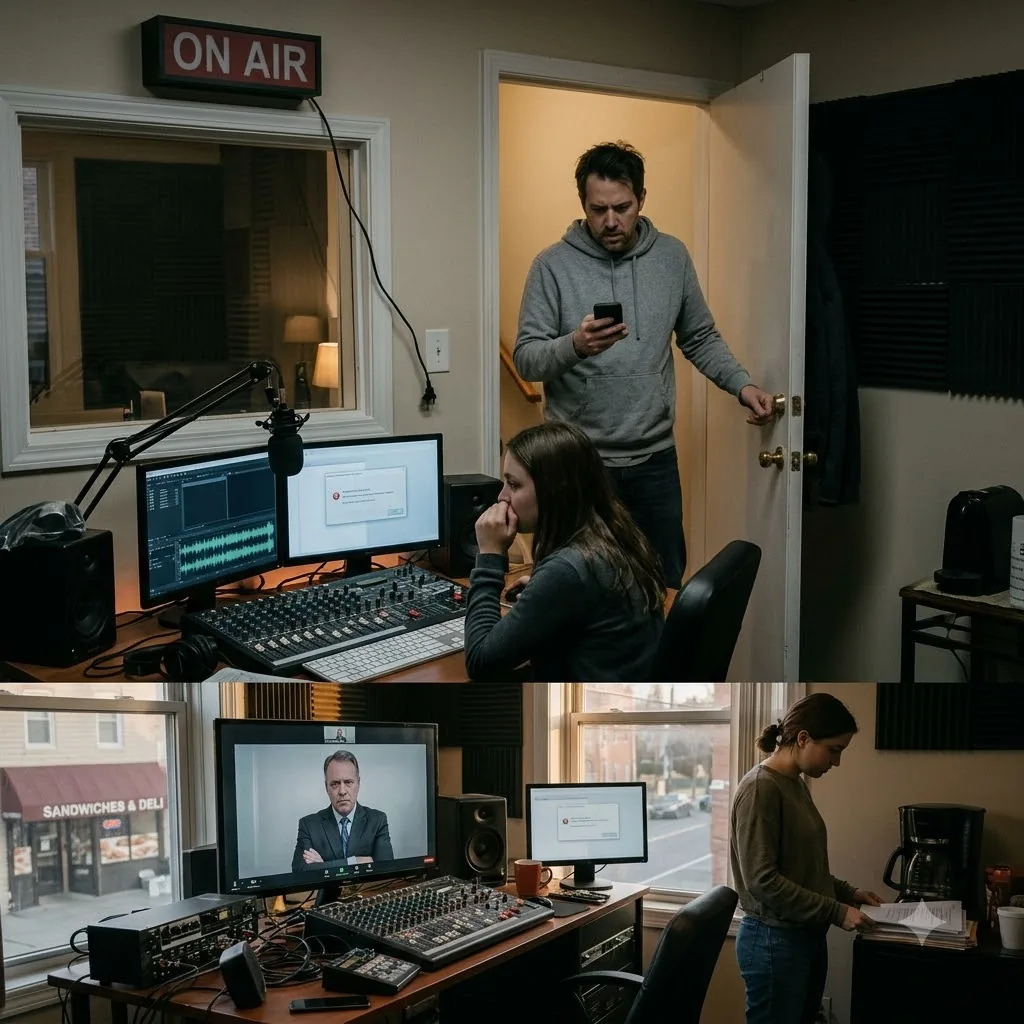
Marisol still had the statement extended toward him. On the screen, Dana waited with the patience of someone who thought waiting itself was pressure. The booth clock rolled down in silent red numbers.
Nico looked at the unknown number he knew too well and hit accept.
He did not step away. He did not ask for privacy. If they wanted him managed, they could hear what management sounded like from the other side.
“Nico.” The voice came rough and immediate, no greeting wasted. “Do not say anything about the part until we talk.”
He knew the voice before he placed the face. Leon Velez. Associate producer on the show that had made him famous, later promoted, later vanished from the calls and reunion panels and anniversary photos. The man who had once stood just off camera and told him which parts of himself tested well.
“You’re a little late,” Nico said.
Marisol’s hand dropped slowly with the paper. Dana leaned closer to her camera.
Leon exhaled into the line. “I’m trying to keep this from getting worse. They’re using a hallway clip to make you sound ungrateful, and if you start naming how that role got built, they’ll make you look unstable before lunch.”
Nico felt something cold and clarifying pass through him. “They.”
Leon went quiet for half a beat. “You know who I mean.”
No, Nico thought. He knew too many possible answers.
“Then give me one reason,” Nico said, “not to tell the truth on air.”
Across from him, Marisol mouthed, Don’t. Dana gave a tiny shake of her head, as if she could stop words through the screen.
Leon lowered his voice, which only made everyone in the room lean in harder. “Because the sponsor isn’t trying to protect anybody who was harmed by that show. They’re trying to protect the anniversary campaign. And because if you say the wrong thing first, they get to point at you instead of what they sold.”
Nobody in the studio moved.
Dana was the first to recover. “Put that call on speaker,” she said.
Nico looked up at her image. “Why?”
“Because an unnamed person making inflammatory claims in a private call is not a basis for anything.”
“Good,” Nico said. “Then maybe you can say on the record what this is a basis for.”
He put Leon on speaker anyway.
The room took the sound of his voice all at once.
“Leon,” Nico said, keeping his eyes on Dana’s face, “say that again. Slowly.”
Static scratched the line. Then: “The sponsor is not in damage control because they suddenly care about stereotypes. They’re in damage control because your old role is central to a brand relaunch next month. They need you as the success story who smiles about it. If you go off-script, the campaign stops being a celebration and starts becoming evidence.”
Marisol made a small sound through her nose, half disbelief, half dread. Glen looked openly at the conference screen now.
Dana’s voice came sharp. “This is inappropriate and inaccurate.”
“Is it?” Nico asked.
He heard himself and almost flinched. Not at the challenge. At the tone.
It was familiar.
Calm, polished, curious in exactly the right places. The version of himself sponsors loved most. The one who could cut his own anger into neat audience-safe strips and call that honesty. He had spent years learning how to speak so that executives heard thoughtfulness where there was actually surrender.
Leon kept going, maybe because once the line had been crossed there was no point pretending otherwise. “They’re terrified you’ll say what everybody in that room already knows. The role wasn’t praised because it was true. It was praised because it made a certain kind of audience feel generous. It let them applaud a version of you that never asked too much from them.”
Something flashed across Dana’s face. Fast. Real.
Then it was gone.
“Nico,” she said, careful again, “whoever this is, he’s trying to pull you into an old grievance. This morning is about accountability for what your audience heard.”
“My audience,” Nico said.
The phrase opened something behind his ribs.
He saw a hotel ballroom from years ago, all chilled air and round tables and spotlights. He was twenty-three, in a fitted suit borrowed by wardrobe, standing beside a podium while a moderator praised him for making people see themselves in a new way. Afterward, an older executive with a hand on his shoulder had laughed and said, They love you because you’re safe enough to invite in.
Safe enough.
At the time he had taken it for approval. A door opening. A blessing from the people who kept doors.
Now the memory turned in place and showed its teeth.
Tasha had said almost the same thing to him three months ago in his kitchen, angry enough not to soften it. You keep talking like your visibility is a gift you earned cleanly. They made you the exception so they could ignore everyone less convenient.
He had answered her with the language he always used when cornered. Nuance. Complexity. Reach. Incremental change. Words polished by panels and profiles and years of surviving rooms where every truth had to come out deodorized.
He could hear some of those same words waiting inside the sponsor statement on the desk.
Learning.
Responsibility.
Thankful for accountability.
Not an apology. A conversion back into product.
“Nico,” Marisol said quietly, and for the first time all morning she sounded frightened for him instead of at him. “Think very carefully.”
He turned to her. “Have you seen the full clip?”
She hesitated.
That was enough.
“Marisol. Have you seen the next sentence?”
Her eyes flicked, involuntarily, toward Dana’s screen.
There it was.
Not certainty. Not proof in hand. Something better and worse: behavior. The shape of everybody protecting the same missing thing.
Nico faced Dana fully now. “You told me not to reference the role except as written. Why?”
“Because this is not the moment to revisit-”
“Why was that in the statement?” he said.
Dana held her expression in place. “Because your remarks concerned that role, and careless improvisation would create additional harm.”
Leon let out one humorless laugh through the speaker. “Say the campaign title, Dana.”
Dana ignored him.
Nico did not. “What campaign?”
No one answered.
He took one step toward the conference screen. Not dramatic. Just enough that Dana’s face filled more of his view than the rest of the room.
“You already had language ready before anyone here would even play me the clip,” he said. “You already had a line about my early career role. You already had a version of me thanking you for holding me accountable. So either you’re all impossibly efficient, or this wasn’t a response to harm. It was protection for something scheduled.”
Dana’s jaw tightened.
“Nico-” Marisol began.
He didn’t look away from the screen. “What was the next sentence in the hallway video?”
Dana said nothing.
“Because I remember enough now,” Nico said. His pulse was hammering, but his voice had gone eerily steady. “I said that role wasn’t a real person. I said it was a trick with better lighting. And then I said the trick was teaching people to love us most when we arrived pre-forgiven.”
The room went still in a different way this time.
Not waiting. Hit.
He saw it land on Marisol first, then on Glen, then somewhere just to the left of Dana’s camera where her eyes flicked before returning to him. Checking with someone. Or something.
That movement told him more than any denial could have.
On speaker, Leon said softly, “Yeah. That’s the sentence they can’t use.”
The red numbers on the booth clock hit zero and kept blinking, unanswered.
Dana opened her mouth.
Nothing came out at first.