Story code: ST-001595
Part 2: The Name She Almost Said
For one beat, the woman looked less angry than caught.
It was small. A flicker. Her chin tipped back, but her eyes changed first, narrowing with a quick calculation Marisol could see happen in real time. Then the woman laughed, too late and too bright.
“Of course it’s mine,” she said. “It’s on the receipt. Have you never processed a return before?”
A few people in line shifted, grateful for a version of events that sounded ordinary. The man with the dog food gave a tired little shrug as if to say there, see, move it along. Lane four’s scanner started up again. Saturday rushed back in around them.
Marisol kept the receipt in her hand.
“I asked because I needed to confirm it,” she said.
“No, you said it like it meant something.” The woman’s smile stayed in place, but it had gone thin around the edges. “If you’re trying to embarrass me because you don’t know your own policy, this is not going to go the way you think.”
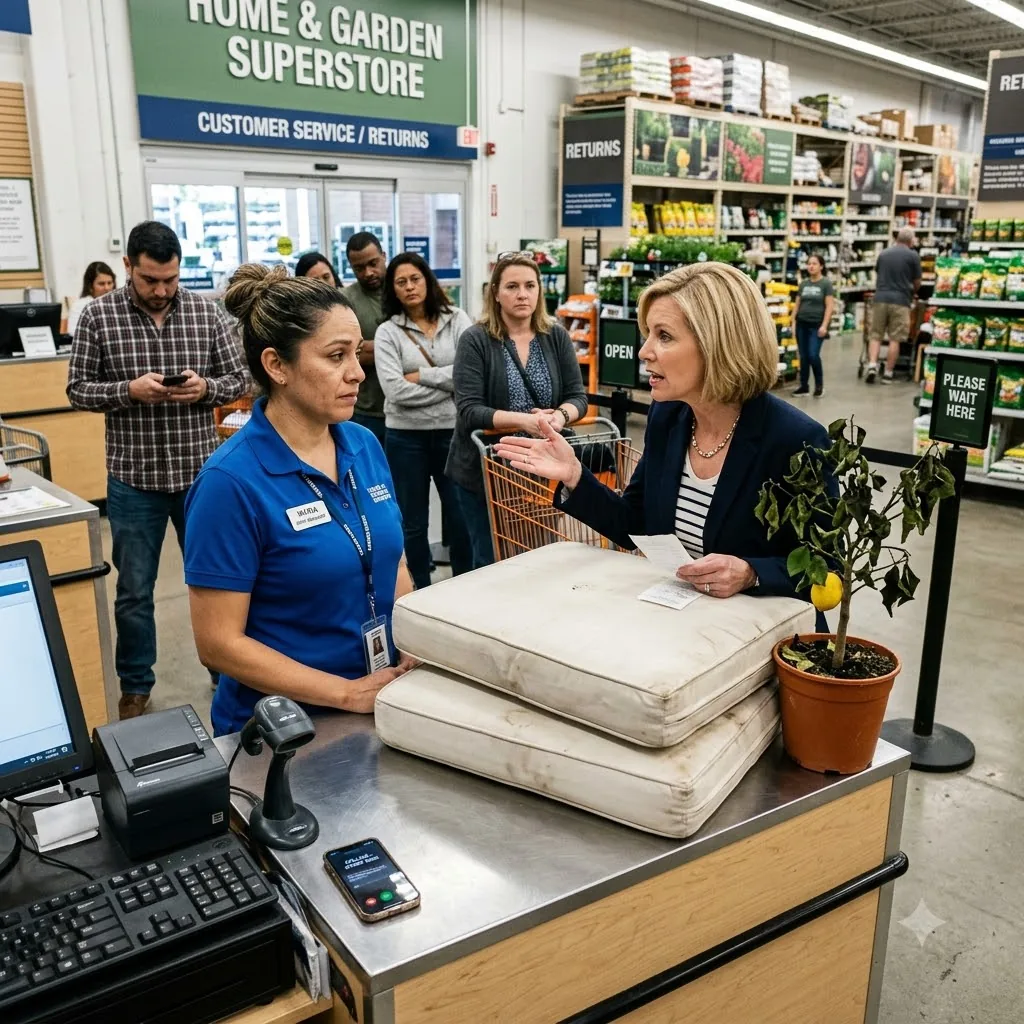
Her phone was already in her hand. She lifted it, not quite dialing, just displaying it. A threat with a glossy case.
The buzzing under the office keys started again.
Marisol heard it and did not look down. She could feel heat building under her collar. She folded the corner of the receipt back along its old crease, then flattened it again, buying herself one breath.
The address sat there in black thermal ink, ordinary as any other line on any other receipt. But ordinary things could cost people houses. Ordinary things could sit in county offices with rubber bands around them while families waited for someone else’s signature or silence.
The woman saw Marisol still looking.
“What exactly is your problem?” she asked, louder now. “Because from where I’m standing, I brought back defective merchandise, and your store is refusing to refund me while your manager stares at my personal information like she found buried treasure.”
That got attention.
A woman near the candy rack frowned. One of the teenage cashiers looked over despite herself. Privacy landed harder with an audience than policy ever did.
Marisol set the receipt on the counter, keeping two fingers on it so it would not curl. “Your information is printed as part of the order,” she said. “I’m reviewing the transaction connected to the return.”
“Then review faster.”
“I can’t issue cash for this without approval.”
“You keep saying that like words can turn incompetence into a system.”
The customer stepped closer and tapped one manicured nail against the total on the receipt. “Here is the amount. There are the items. There is the damage. Give me my money.”
Marisol heard one of the cashiers call her name from two lanes down, tentative and frayed. She did not turn. If she turned now, the woman would only get louder. If she gave in now, the drawer would come up short and the paperwork would land on her before close. If she said the wrong thing, if she said too much, she could drag something from another office into the middle of seasonal and paper towels and Saturday strangers.
The phone vibrated so hard it clicked against the keys.
“Answer it,” the customer snapped. “Maybe it’s someone who actually knows what they’re doing.”
Marisol looked down this time. The screen lit the underside of the keys. Same caller. Same name. She felt the pull of it in her chest, the immediate ugly certainty that repeated calls almost never brought harmless news. But the line was watching, and the smoke-damaged boxes were still in the cart, and the receipt was still under her fingers.
She turned the phone facedown again.
The customer let out a short, incredulous sound. “Wow.”
Then she raised her own voice enough for the people behind her. “She won’t process my refund, she won’t call anyone with authority, and she won’t even take what is obviously an emergency call. Is there an adult in this building?”
A couple of people laughed, not because it was funny but because crowds liked a clean lane to stand in. Marisol felt the laugh move through the front end like a draft under a door.
“Monica,” she called to the nearest cashier without looking away from the customer, “red light on three, please.”
It was not a code, not really. Just enough store language to send someone moving.
Monica, all of nineteen and already exhausted, hurried toward the service desk. “Do you need Travis?”
“I need him at the front,” Marisol said.
The woman seized on the name immediately. “Great. Finally. Someone with authority.”
“Assistant manager,” Marisol said.
“Wonderful. Maybe he can explain why you’re making this personal.”
Marisol’s mouth went dry. She had not made it personal. The woman had brought that in with her, folded into a receipt corner and hidden in plain sight. But saying that out loud would be saying too much.
Instead she reached for the damaged-return binder under the counter and opened it to the form she already knew by memory. Item count. Condition. Original tender. Reason cash could not be issued at lane level. Her handwriting looked too careful as she filled the boxes.
“What are you doing now?” the woman demanded.
“Documenting the return.”
“I did not authorize paperwork. I authorized a refund.”
“The items are unsellable. I have to log them out correctly.”
“No. You are building a case because you don’t want to hand over cash.”
The woman leaned across the counter far enough for her perfume to cut through the smoke smell. “Listen to me very carefully. If this isn’t resolved in the next sixty seconds, I will call corporate, I will call the police, and I will make sure everyone in this store knows you are retaliating against a customer for where she lives.”
There it was.
Not the truth. Just the edge of it.
Marisol felt her pulse turn heavy in her wrists. Around them, the line went attentive in that ugly, eager way people did when they sensed a word underneath the words. Where she lives. Not what she bought. Not store policy. Where she lives.
The woman seemed to hear it too, because her expression changed again, just for an instant. She had not meant to frame it that way. Or maybe she had meant to and only now realized how it sounded.
“That is not what I said,” she corrected quickly. “I said this employee is being unprofessional.”
But the sentence was already out there.
Marisol thought of the office downtown. The plastic chairs. Her mother pressing documents flat against her knee. A clerk saying not yet, not until the adjacent parcel issue is cleared. Another owner’s claim pending review.
She picked up the receipt before she could stop herself.
The woman saw the movement and reached for it at the same time. Their fingers hit the paper together. The receipt tore a little down the folded seam.
“Do not touch my information again,” the woman said, low now, all performance stripped out of her voice.
That was worse than the yelling.
Travis came through the swinging gate at last, breathing hard from the stockroom, radio clipped crooked at his hip. He took in the cart of smoke-damaged boxes, the frozen line, the half-torn receipt between their hands, and Marisol standing too still behind the register.
“What’s going on?” he asked.
The customer turned to him so fast it looked rehearsed. “Perfect timing,” she said. “Your shift manager just recognized my address, and now she’s refusing my refund for reasons she won’t say in front of witnesses.”
Travis looked at Marisol.
Before she could answer, the phone under the keys started vibrating again, louder than before, skittering against the laminate until it slipped free and spun screen-up across the counter.
This time everyone could see the name on it.
And Travis’s face changed before he could hide it.