Story code: ST-001595
Part 3: What She Pulled Back
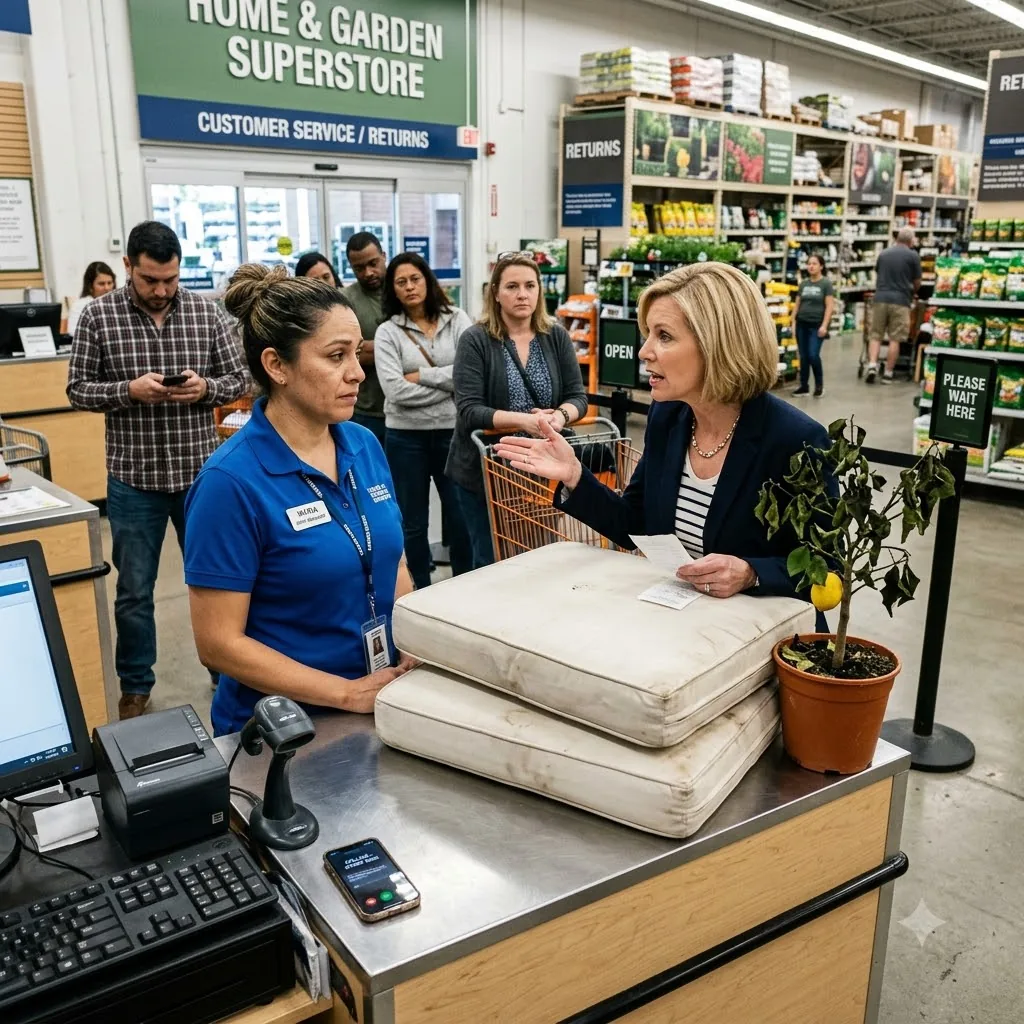
Travis reached for the phone before Marisol did, then stopped himself with his hand half out, like touching it might make whatever was on the screen more real.
The caller name glowed in bright white against the cracked protector.
County Housing Office.
The words sat there between the register, the receipt, the smoke-stained boxes, and the woman with one hand still pinning the torn paper to the counter.
The customer saw Travis looking and gave a brittle little laugh. “What, is this suddenly everyone’s business now?”
The phone kept vibrating. Marisol picked it up.
Her throat felt scraped hollow. “I need to take this,” she said.
“No,” the woman said immediately. “Absolutely not. You do not get to freeze my refund again because your personal life is chaotic.”
Something in Travis’s face sharpened at that. He looked from the phone to Marisol, then to the customer, then down at the receipt in Marisol’s hand. His eyes caught on the address line. Marisol saw recognition land there too, ugly and fast.
“Take the call,” he said.
The woman turned on him. “Excuse me?”
“Take the call,” Travis repeated, this time to Marisol.
He was trying to sound managerial, neutral, but his voice came out too tight. The nearest people in line had gone quiet again. Even lane four seemed to pause, all the front-end noise suddenly thinner around the service desk.
Marisol hit accept and pressed the phone to her ear. “Hello?”
A woman on the other end launched in without preamble, voice clipped with office strain. “Marisol Alvarez? We’ve been trying to reach you. I need to confirm whether your family still intends to take the Pine Creek guesthouse placement if the hold clears today.”
Marisol closed her eyes for one beat. Pine Creek.
She did not need to look at the receipt again. She could see the address already, black on white.
“Yes,” she said. Her voice came out rough. “Yes, we still intend to take it.”
The customer moved, not backward exactly, but with the startled recoil of someone hearing a door open in the wrong room.
The county worker kept talking. “There was a withdrawal from the property side after preliminary approval, then conflicting communication this morning. I’m trying to determine whether I can keep your file active while legal clarifies liability language. If I don’t hear back, the unit may be released.”
Marisol heard every word and, at the same time, heard the woman across from her say, too quickly, to no one in particular, “This is absurd.”
Travis’s head turned.
Marisol’s grip tightened on the phone. “The property side withdrew?”
“That’s what I’m saying. The owner representative flagged smoke exposure concerns, occupancy concerns, and damage risk after wildfire displacement placement was already moving. Then someone from that address called again this morning asking whether temporary tenants had already been told they were approved.”
The county worker paused. “Ms. Alvarez? Are you there?”
Marisol looked up.
The woman had gone very still. Not angry stillness. Not performance stillness. It was the kind that came when the next sentence had to cross too many lies to get out clean.
“I’m here,” Marisol said.
The smell of smoke from the boxes seemed stronger now, threaded through with the woman’s expensive perfume and the hot-metal scent of the registers.
“Can you hold one moment?” Marisol asked.
“Briefly.”
Marisol lowered the phone just enough to cover the microphone with her hand. She looked at the woman directly.
“Pine Creek guesthouse,” she said.
The woman blinked once. “I have no idea what you’re talking about.”
It was too fast.
Marisol lifted the torn receipt an inch off the counter. “This address.”
“That proves where I live,” the woman snapped. “Not whatever story you’re trying to build.”
Travis did not move. The line behind the woman held in that awful, suspended silence crowds made when they sensed the real thing had finally stepped into the room.
Marisol heard her own mother in memory, not words exactly but the exhausted cadence of the last week: approved, then not approved, call tomorrow, call again, the owner has concerns, they said smoke, they said insurance, they said strangers. Plastic chairs. A clipboard. Her little brother asleep with his shoes still on because every place they stayed felt temporary enough to leave quickly.
She uncovered the phone. “What name is on the property side?”
The county worker answered at once. “Dana Hargrove.” A shuffle of paper. “Mailing and service address match. Why?”
The woman made a sound under her breath, almost a curse, almost a swallowed protest.
That was the first clean crack.
Travis looked at her. “Your name is Dana?”
“This is inappropriate,” she said. “I am here for a retail return.”
Nobody answered that.
Marisol put the phone back to her ear. “I’m here,” she said to the county worker, though her eyes never left Dana’s face.
“Do you want me to note that the family remains ready to occupy if the withdrawal is reversed?” the worker asked.
Ready to occupy.
As if they were waiting beside packed suitcases instead of sleeping in borrowed rooms and counting who could miss another shift.
“Yes,” Marisol said.
Dana found her voice again. “You cannot do this at work,” she said, low and furious now. “You cannot stand there and use my private information to ambush me because you are upset about some housing office mix-up.”
Marisol felt something in her go cold and steady.
“A mix-up?”
Dana’s chin came up. “I don’t know what your family was told. The area had smoke issues. There were liability concerns. We had to be careful. We don’t know who people are.”
There it was, laid out in the same polished language the county had fed back to them all week.
Smoke issues. Liability. We don’t know who people are.
But the boxes in Dana’s own cart sat inches away, reeking of smoke so badly the store could not resell them. Her demand for cash still hung in the air. Her complaint was not that smoke made a place unlivable. Her complaint was that smoke-damaged things she owned should be immediately paid for.
Marisol heard it before she said it, heard how simple it was.
“You brought smoke-damaged patio cushions into a store and demanded your money back,” she said. “But my family was too much smoke risk to stay in your guesthouse?”
Dana’s mouth opened.
Closed.
A man in line shifted his dog food to the other arm. Somewhere behind him, a cart wheel squeaked once and stopped.
Dana tried again. “That is completely different. A rental property is-”
“Strangers?” Marisol asked.
Dana’s eyes flashed. “Yes, actually. Strangers. That’s allowed.”
The county worker was still faintly audible through the phone at Marisol’s ear, a distant office voice asking hello, hello, but Marisol did not answer yet.
“We were already approved,” Marisol said.
Dana’s expression changed at the word we. Not confusion. Recognition. Exact and unwilling.
“My mother signed every paper they put in front of her,” Marisol said. “My family was the family approved for that place.”
Dana looked at Travis, at the line, anywhere but at Marisol now.
“I didn’t know it was you,” she said.
And that was not a denial.
It landed in the space between them harder than if she had shouted.
Marisol saw the instant Dana realized what she had admitted, how much of the county language, the address, the hold, the withdrawal, and this whole ridiculous cash-refund scene had just collapsed into one body standing at a register.
The phone at Marisol’s ear crackled. Travis drew a breath like he might finally say something.
Dana’s hand slipped off the receipt.
She opened her mouth again, but this time nothing clean came out.