Story code: ST-001634
Part 2: The Root Override
Leo slowly uncurled his fingers from the hot metal casing of the flash drive. He lowered his arm, brushing his palm against his jeans to dry the sweat, and brought his hand up into the harsh fluorescent light. It was empty.
“I was checking the peripheral cable,” Leo said. His voice sounded remarkably steady, though his pulse hammered against his ribs. “My knee bumped the tower. The terminal hung up on a sector error.”
Corinne did not blink. Her narrowed eyes made it clear she didn’t buy the excuse, but she immediately shifted her attention to the stalled progress bar on his primary monitor. The GEO-CORP migration had been hovering at sixty percent for three minutes. In the high-frequency data brokerage world, a three-minute lag was an eternity.
“Get up,” she ordered.
Leo pushed his chair back, the casters scraping loudly against the thin industrial carpet. He stood aside, leaving the flash drive still slotted into the blind USB port in the back of the machine. The secondary, hidden script was still frozen in the background, tethered to the corrupted packet in the main memory buffer. The system tray icon remained a dull, angry red.
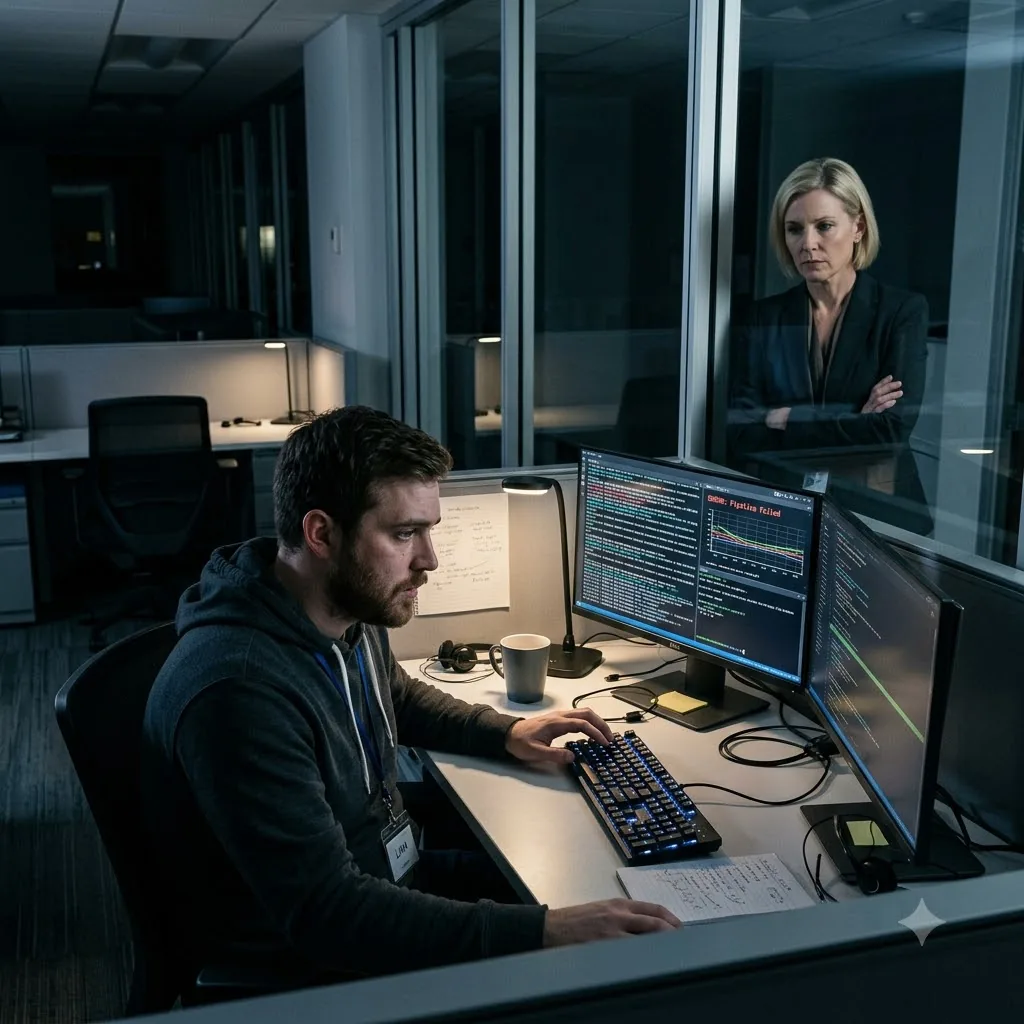
Corinne took his seat. She didn’t bother adjusting the height. Her fingers flew across his mechanical keyboard, the rapid clack-clack-clack echoing in the empty, darkened expanse of the open-plan office. She opened a secondary terminal, pulling up the network diagnostic logs.
Leo watched over her shoulder, his chest tight. If she checked the local hardware tree, she would see the mounting path for his external drive. If she ran a process trace, she would find his skimming script chewing through the background cache.
Instead, Corinne focused entirely on the outbound pipeline. “It’s a handshake mismatch,” she muttered, glaring at the scrolling text. “GEO-CORP’s inbound servers are running a real-time checksum on the demographic arrays. The packet didn’t corrupt on our end, Leo. Their firewall rejected it because the volume exceeded their temporary intake buffer.”
“They’re throttling us?” Leo asked, trying to sound like a concerned employee rather than a thief in the middle of a heist.
“They’re paranoid,” Corinne snapped. “They treat this dataset like it’s weapons-grade material. They slapped an automatic quarantine on the stream the second the packet sizing fluctuated.”
She pulled a heavy, titanium thumb drive from her blazer pocket-her executive admin key. She slotted it into the front panel of Leo’s workstation. A prompt demanded her biometric authorization. She pressed her thumb against the reader, and the terminal flashed green, granting her root access.
Leo felt a cold bead of sweat slide down his spine. She was bypassing the server’s safety protocols to force the packet through.
“I’m going to manually rewrite the packet header and shove it past their quarantine,” Corinne said, her eyes locked on the code. “Once the bottleneck clears, the rest of the batch will push at maximum velocity.”
“Is that safe?” Leo asked. “If their firewall trips again, it could sever the connection entirely.”
“We have a contractual deadline of seven-thirty,” Corinne said coldly. “If this data doesn’t populate their mapping software by the time their board meets, we lose a twenty-million-dollar account. I don’t care about their firewall.”
She hit the execute command.
The primary migration bar on the screen shuddered. The error message vanished. The green progress bar leaped forward. Sixty-five percent. Seventy percent.
Down in the corner of the screen, disguised as the antivirus icon, the red warning light vanished. It turned back to green.
Leo’s stomach dropped. Corinne’s root override hadn’t just cleared the primary pipeline; it had cleared his hidden buffer script as well. The flash drive in the back of the tower resumed pulling the duplicated data.
The workstation’s cooling fans immediately spun up, howling like a jet engine as the CPU struggled to manage both the massive outbound network push and the intense local encryption writing process.
Corinne frowned, glancing down at the computer tower. “Why is your rig running so hot?”
Before she could open the task manager, her cell phone vibrated violently against the desk.
She snatched it up, her annoyance shifting to a rigid, professional mask the moment she saw the caller ID. She stood up, taking a few steps back into the aisle. “Yes, Mr. Vance,” she answered. “I’m looking at the migration right now. We had a minor packet mismatch, but I’ve overridden the-”
She stopped. She listened, her brow furrowing.
Leo kept his eyes glued to the screen. The primary migration was at eighty-five percent. His hidden copy was trailing slightly at eighty-two percent.
“What do you mean, a mirrored read request?” Corinne said into the phone, her voice dropping an octave.
Leo’s blood ran cold. GEO-CORP wasn’t just receiving the data. Their security architecture was actively monitoring the memory states of the sending machines. They could see that the buffer was being read twice-once by their pipeline, and once by a local protocol.
Eighty-eight percent.
Corinne turned slowly, the phone still pressed to her ear. She stared at Leo, her eyes darting from his pale face to the screaming computer tower under the desk.
“Hold on, Mr. Vance,” she said softly.
Ninety-two percent.
She lowered the phone and took a step toward the workstation. “Leo. What exactly is your terminal writing to?”
“Just a routine diagnostic log,” Leo lied, backing away slightly. He needed the transfer to finish. Every second bought him thousands more records-thousands more names, ZIP codes, and behavioral scores that the syndicate intended to use for their private detention network.
“Cancel it,” Corinne ordered, her voice devoid of any earlier impatience. It was now laced with pure, dangerous realization. “Cancel the diagnostic.”
Ninety-six percent.
Leo didn’t move. “I can’t. You initiated a root override. The system locks out standard user inputs until the primary execution completes.”
Corinne dropped her phone onto the desk. She lunged for the keyboard.
Leo reacted instantly, throwing his weight forward to block her. His shoulder slammed into her arm, knocking her hand away from the mouse. “Don’t touch it!” he yelled.
Corinne stumbled back, her expression morphing from shock to absolute fury. She didn’t try to fight him for the keyboard again. Instead, she reached under the collar of her silk blouse and pulled out a small, red panic button on a breakaway lanyard.
Ninety-nine percent.
“You have no idea what you’ve just done,” Corinne whispered, and she crushed the button in her fist.
A localized alarm blared overhead, a sharp, two-tone electronic shriek. The heavy magnetic locks on the glass doors at the far end of the hall engaged with a loud, final clack. The elevators powered down, their floor indicators going completely dark.
The computer chimed. One hundred percent.
A small notification box popped up in the center of the screen, overriding all other windows: *Migration Complete. External Drive Disconnected Safely.*
Leo dove under the desk, his hand finding the blistering hot metal of the flash drive. He ripped it free from the port and scrambled backward, clutching the drive to his chest as he hit the opposite wall of the cubicle.
He had the data. He had the entire map.
But as the red emergency strobes began to wash the darkened office in a violent, flashing crimson, Leo realized the true cost of his success. He was sealed inside a vault on the thirtieth floor, holding the most damning piece of corporate evidence in the state, and the architects of a billion-dollar prison syndicate were already on their way.