Story code: ST-001647
Part 4: The Patchwork Wall
The word “trash” hung in the freezing air, bouncing off the linoleum and the corrugated steel gate. Arthur didn’t blink. He just stared at her, watching the flushed, blotchy rage transform her features, stripping away every ounce of her academic superiority.
Then, a voice murmured from the other side of the rusted metal curtain.
“Holy shit, Kevin, tell me you got that audio.”
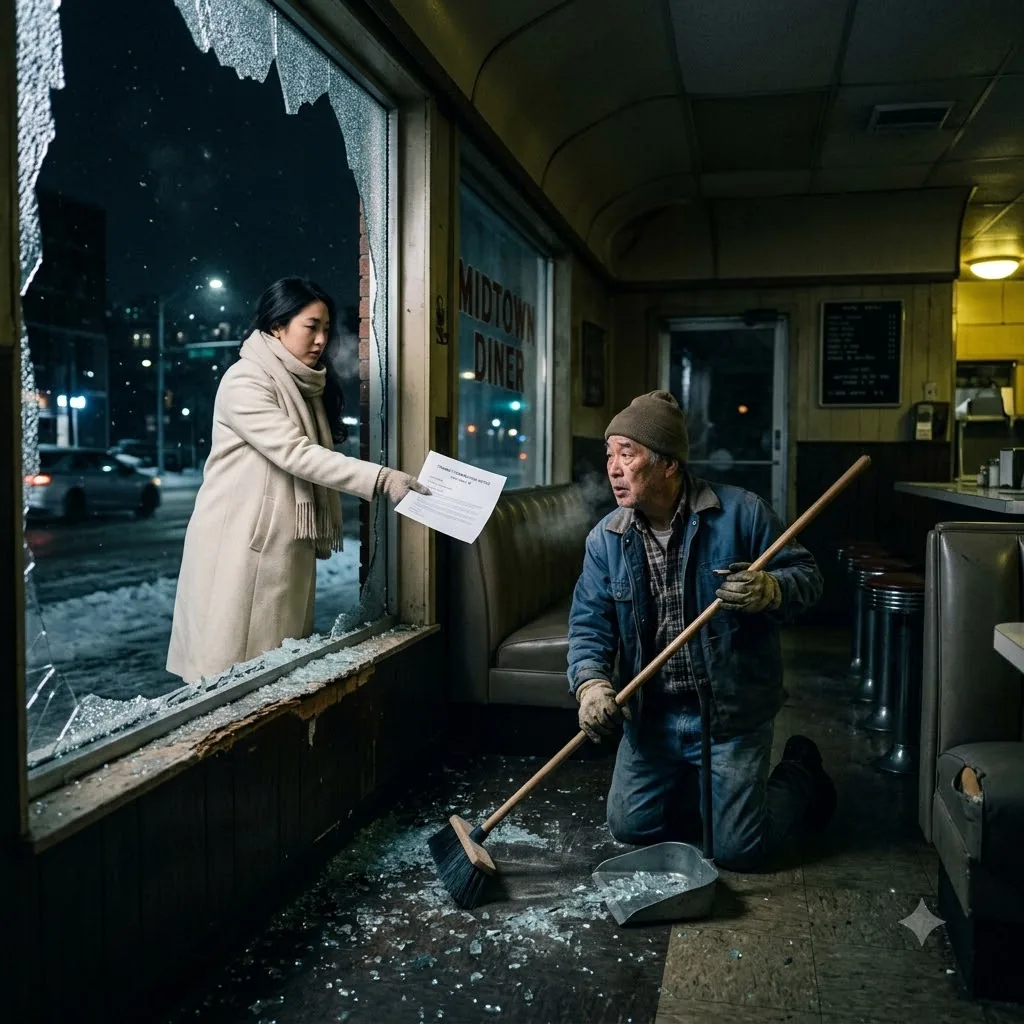
The student whirled around, her wet leather boots slipping on the icy tiles. Through the narrow slats in the steel gate, the harsh, white glare of a smartphone flashlight cut through the dim vestibule. Two figures stood on the sidewalk, their faces illuminated by the screens of their cameras. They had their lenses pressed right up against the metal grating. Arthur recognized the canvas tote bags and the expensive camera rigs strapped around their necks. Campus press. They had been out there the whole time, waiting to document a triumphant, righteous eviction of a local class traitor.
Instead, they had recorded a prominent coalition leader screaming about “uneducated townies” and “blue-collar trash.”
“Turn that off!” the student demanded. She lunged toward the gate, her hands wrapping around the freezing iron bars. “Delete that right now! That was taken out of context!”
“He literally just asked you to do math, Chloe,” a female voice replied through the slats, thick with disgust. “You called him a townie. My dad’s a mechanic in this town.”
“I was provoked! This is a hostile space!”
“It’s a diner,” the male voice, Kevin, muttered. “And you’re acting like a psycho. We’re not publishing this for the coalition. I’m not putting my byline on this.”
“Kevin, wait!” Chloe shouted, rattling the heavy metal curtain. “We have a media strategy!”
The two glowing screens moved away from the gate. The crunch of boots in the icy slush echoed loudly, growing fainter as the student journalists turned their backs on the diner and walked briskly down the avenue. They didn’t look back.
Chloe stood frozen against the gate. Her immaculate cream-colored coat was speckled with dirty gray sludge. Her expensive boots were ruined. The grand, academic revolution she had marched in to enforce had dissolved into a petty, recorded temper tantrum. Without her audience, without the threat of her coalition’s righteous backing, she was just a trespassing college student standing in a puddle.
Arthur walked past her to the heavy chain mechanism on the wall. He didn’t say a word. He didn’t need to. Her leverage was gone. If she tried to call the city now, the audio of her meltdown would make her the laughingstock of the campus.
He gripped the chain and pulled. The gears shrieked, and the massive steel curtain rose just about three feet off the ground-enough to clear the smashed window frame, but leaving the diner mostly sealed from the howling wind.
“Get out,” Arthur said softly.
Chloe didn’t argue. She didn’t look at him or reach for her heavy-stock manifesto left on the counter. She ducked awkwardly under the jagged rim of the broken aluminum frame, her ruined coat scraping against the sill, and scrambled out onto the freezing sidewalk. She disappeared into the gray evening without a backward glance.
Arthur watched the empty street for a moment, then lowered the gate completely, sealing the diner in twilight shadows.
The silence returned, broken only by the steady *drip-drip-drip* of the fractured intake valve.
He had won, but the victory paid no bills. The ledger on the counter still showed a seventy-four-dollar profit. The window was still a five-thousand-dollar hole. The temperature in the dining room was hovering just above freezing.
Arthur moved with mechanical efficiency. He went to the basement and shut off the secondary water main, cutting the pressure to the fractured pipe. The dripping finally stopped. He grabbed three rolls of heavy-duty duct tape and a stack of flattened cardboard delivery boxes from the dry storage room.
For the next two hours, he worked in total isolation. He taped layer after layer of thick, corrugated cardboard over the shattered window frame, sealing the edges against the aluminum to block the gale-force wind. It was ugly-a massive, brown, patchwork wall where his gold-leafed glass used to be. It blocked out the streetlights, plunging the dining room into absolute gloom.
When the draft was finally stopped, he brought up a portable propane space heater from the utility closet and set it near the plumbing access panel under the register. The coil glowed a dull, angry orange, slowly fighting back the frost on the copper lines.
Arthur stood up, his joints aching, his fingers completely numb. His wet cotton boots felt like blocks of ice. He walked behind the counter, bypassing the heavy-stock manifesto, which was now soaked through with dirty water and freezing to the Formica.
He turned on the industrial coffee machine. The boiler rumbled to life, a deep, comforting vibration in the quiet room. He took a fresh, unbroken ceramic mug, set it under the spout, and waited.
He was alone. The town was quiet. The blockade would likely dissolve tomorrow, fractured by its own hypocrisy. But Arthur knew the fight wasn’t over. The landlord still wanted rent. The suppliers still wanted cash. Tomorrow morning, he would unlock the front door, turn on the neon ‘OPEN’ sign, and start all over again for a dollar-twenty margin.
The coffee finished brewing. Arthur wrapped his freezing hands around the hot ceramic, letting the heat seep into his bruised knuckles. He took a sip in the dark, standing guard over his fractured, freezing livelihood.