Story code: ST-001700
Part 3: The Sheet Music
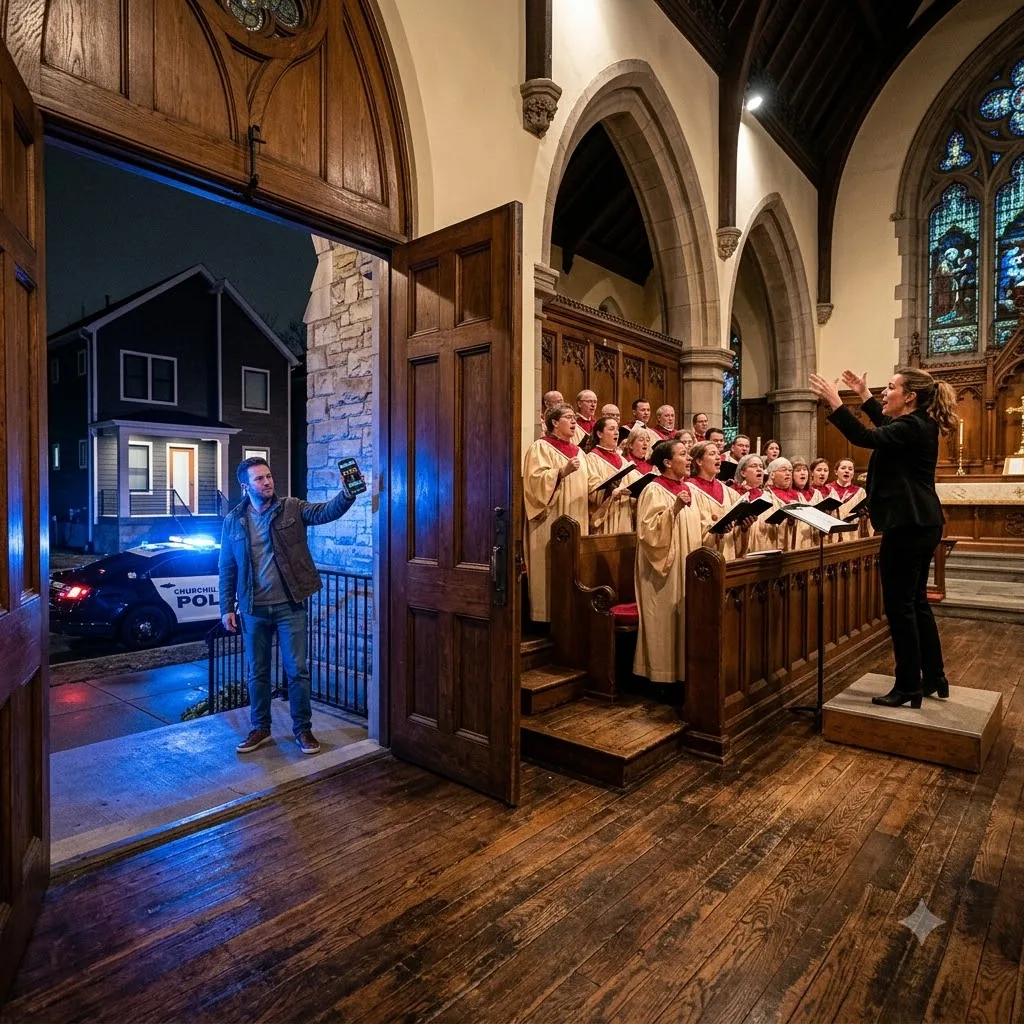
The freezing night air hit Beatrice’s face the moment the lead officer shoved her through the heavy oak doors and out onto the portico. The sudden drop in temperature shocked her lungs, but it was the sound from inside the sanctuary that made her stomach turn over. Without her there to drive the tempo, the choir’s massive, vibrating wall of sound began to fracture.
It did not fade out gracefully. It shattered.
The sopranos lost their breath first, their high, piercing notes breaking into ragged, off-pitch gasps. The tenors tried to hold the chord, but the underlying rhythm was gone. Beatrice stood on the concrete steps, her wrists burning against the biting steel of the handcuffs, and listened to the devastating collapse of the only fortress they had. The music devolved into dry, desperate coughing, and then into the exact thing they had all been fighting to keep at bay: the silence.
Into that terrible, ringing silence, a raw, agonizing shout echoed from the loft. It was Marcus. It wasn’t a musical note; it was the sheer, ugly sound of a man being pulled under by his own memories.
Julian stepped out through the doors right behind her, completely ignoring the devastation echoing from the rafters. He smoothed the front of his gray cashmere sweater, shivering as the cold bit through the fine fabric. He held his smartphone tightly in his right hand, the screen still glowing with the bouncing red bars of the decibel app.
“You heard them,” Julian said, his voice clipped and breathless as he addressed the second officer stepping out behind him. “It was a complete riot in there. I’ve sent six emails to the zoning board this month. I have the right to the quiet enjoyment of my property. I spent two million dollars renovating that Victorian, and my walls are literally vibrating.”
The lead officer grabbed Beatrice by the elbow and spun her roughly against the brick wall of the vestibule. The rough masonry scraped her cheek. “Face the wall. Spread your feet,” he barked over the idling engine of the cruiser parked at the curb.
Beatrice complied, her shoulders screaming in protest as she leaned her weight forward. The strobe of the red and blue police lights washed over Julian’s perfectly manicured lawn next door, illuminating the sharp, expensive contrast between his pristine home and the crumbling facade of St. Jude’s.
The officer began a standard, aggressive pat-down, checking her waistband before jamming his heavy, gloved hands into the deep exterior pockets of her wool coat.
Julian took a step closer, holding his phone up as if to record the arrest. “I want it on the official report that she was wildly uncooperative. She intentionally escalated the volume when you arrived. It was malicious.”
The officer’s glove caught on something bulky in Beatrice’s right coat pocket. He yanked his hand back, pulling out a thick, heavy stack of papers, folded in half and bound shut with a heavy-duty binder clip.
“What’s this?” the officer muttered, shining his shoulder-mounted flashlight onto the bundle. He squeezed the thick stack of paper, determining it wasn’t a weapon, and moved to toss it onto the nearest concrete bench.
“Don’t,” Beatrice said. Her voice was entirely spent, reduced to a coarse, vibrating rasp from swallowing decades of church dust. She turned her head, pressing her cheek against the cold brick so she could look directly at the wealthy neighbor shivering on her steps. “Julian wants to know what we’re singing. He wants to know what he’s shutting down.”
Julian frowned, his thumb hovering over the screen of his phone.
Beatrice nodded at the officer’s hand. “Give it to him. Give him our sheet music.”
The lead officer hesitated, looking between the exhausted choir director pinned against the wall and the agitated man in the cashmere sweater. Wanting to de-escalate the civilian’s frantic energy, the officer took a step back and shoved the thick, heavy bundle directly into Julian’s chest.
“Here,” the officer grunted. “Take her paperwork. Just step back from my suspect, sir.”
Julian grabbed the bundle reflexively. He fumbled with the heavy binder clip for a second, his fingers stiff from the cold, before snapping it off. He unfolded the thick stack of papers. The harsh, strobing blue light from the cruiser illuminated the top page.
It was not sheet music. There were no staffs, no treble clefs, no lyrics separated by neat, metered bars.
It was a low-resolution, black-and-white printout of a photograph. A teenage boy in a high school track uniform, smiling awkwardly under fluorescent lights. Beneath the photo was a dense paragraph of text.
Julian’s eyes scanned the first few lines. *Tragically and suddenly… beloved son… taken too soon…*
He flipped the page. The next sheet was a photocopy of a funeral program. A girl with braids and heavy, dark eyeliner. *Sunrise: August 14th. Sunset: November 2nd.*
He flipped again, his thumb moving faster now. Another face. Another paragraph. Another devastatingly short gap between the birth year and the death year. Sixteen years. Nineteen years. Seventeen years.
Beatrice watched Julian’s chest stop moving. The furious, self-righteous indignation that had animated him for the last hour evaporated, leaving his face slack and bloodless in the flashing lights.
“Twenty-two pages,” Beatrice said quietly over her shoulder. “Twenty-two obituaries. That is our sheet music.”
Julian stared at a picture of a young man holding a toddler. His mouth opened, but his perfectly rehearsed arguments about property values and zoning ordinances died in his throat.
“A bad batch of fentanyl rolled through this neighborhood last winter,” Beatrice said, her voice steady and hollow in the freezing air. “It wiped out half a generation in three blocks. It took Marcus’s little brother. It took Sarah’s nineteen-year-old daughter. They bought pills on the exact corner where your new wrought-iron gate stands, and they went to sleep, and they never woke up.”
Julian looked up from the stack of papers. He looked at the open doors of the church. Inside, the sound of weeping was growing louder, echoing off the stained glass. It was a terrifying, broken sound.
“They come to my loft,” Beatrice said, “because if they sit in their apartments in the quiet, they hear the death rattles. If they sit in the silence, the grief drags them right back out into the cold to buy a needle and join their kids.”
She looked down at the glowing screen of Julian’s phone, still clutched in his left hand. The red bar graph was hovering near forty decibels. The quiet ambient hum of a gentrified street.
“Ninety decibels, Julian,” Beatrice whispered, staring at the screen. “That is the exact volume it takes to build a wall thick enough to keep the ghosts out. That is what it takes to drown out the silence.”