Story code: ST-001700
Part 4: The Monument
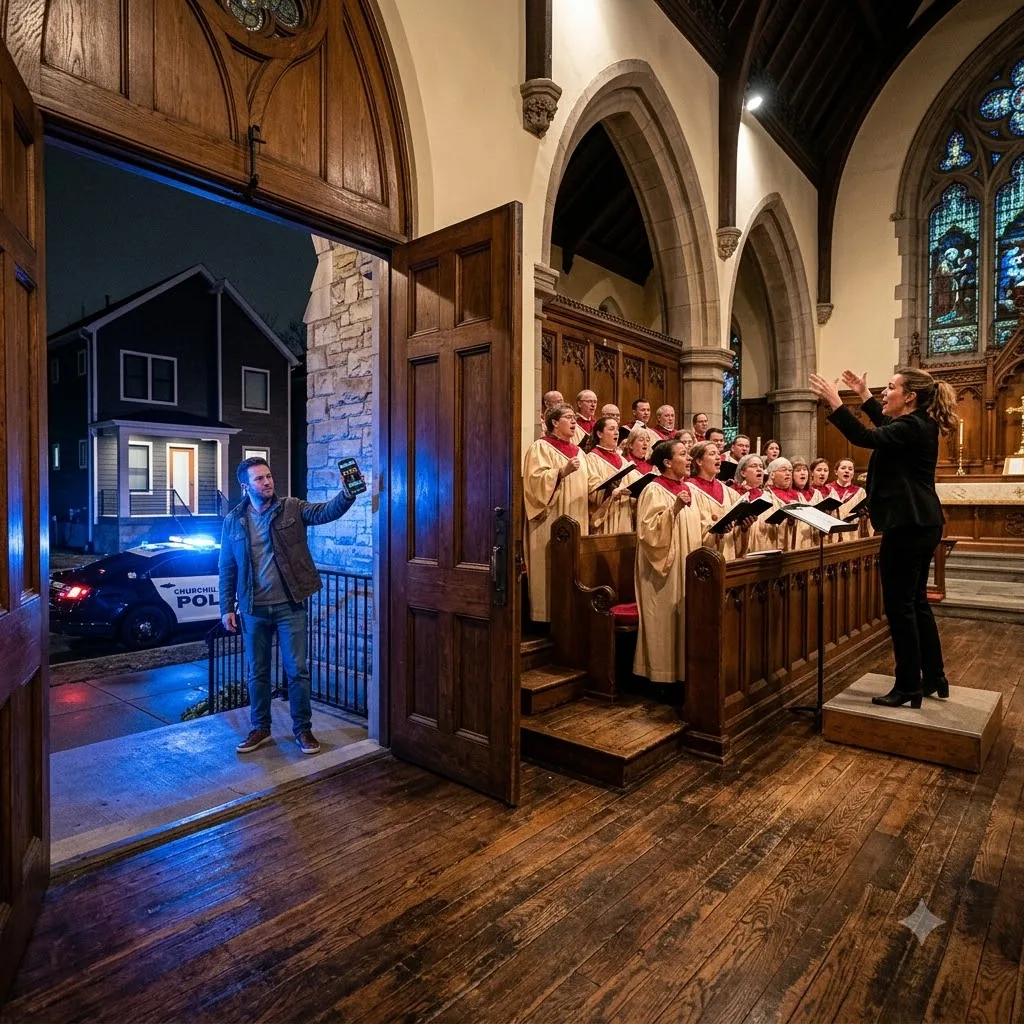
The lead officer shifted his weight. The harsh beam of his shoulder-mounted flashlight caught the edge of the printed obituaries in Julian’s trembling hands. The officer read the birth and death dates on the top page, then looked slowly up at the open church doors. The raw, guttural weeping echoing from the sanctuary was unmistakable now. It was not the sound of a riot. It was the sound of a massacre’s aftermath.
The officer swallowed hard. The thick leather of his utility belt creaked as he stepped away from the brick wall. He reached out and caught Beatrice by the shoulder-not to shove her, but to turn her around.
“Hold still,” the officer murmured. His voice had lost its mechanical bark.
Beatrice felt the cold steel of the handcuff key slide into the ratchet. With a sharp click, the biting pressure vanished from her left wrist, then her right. She brought her arms forward, rubbing the deep, angry red indentations pressed into her skin.
“We got a call for a noise complaint,” the lead officer said, looking directly at Julian. He keyed his shoulder radio, turning the volume down so the dispatcher’s static was reduced to a mere whisper. “I’m not shutting down a memorial service, sir. Not for a noise ordinance.”
Julian stood frozen on the portico. The stack of twenty-two obituaries hung heavy in his hands. He looked from the black-and-white faces of the dead teenagers to the exhausted woman rubbing her wrists in the freezing air. The blue and red strobe lights washed the last remaining color from his face.
“But the decibels,” Julian whispered. The argument lacked any conviction; it was just a reflex. His thumb twitched against his smartphone, but he didn’t raise it. The screen had gone dark.
“Go home, Julian,” Beatrice said. Her throat felt lined with shattered glass. “Go back inside. Lock your doors. Enjoy your property value.”
Julian didn’t argue. He carefully, almost reverently, placed the heavy stack of papers on the concrete bench beside the vestibule. He turned away, wrapping his arms tight around his cashmere sweater, and walked back across the frost-covered grass. Beatrice watched him ascend the steps of his newly renovated Victorian. He opened the heavy front door and stepped inside, shutting it firmly behind him.
Through the pristine, double-paned glass of his front window, Beatrice could see him standing in his foyer. He didn’t turn on the lights. He was just a solitary shadow, sealed away in an expensive, airtight tomb, surrounded by a sterile silence that suddenly looked suffocating.
Beatrice turned away from the house and walked toward the open oak doors of St. Jude’s. The officers were already climbing back into their cruiser, cutting their emergency lights. They didn’t say another word as she crossed the threshold and stepped back into the sanctuary.
The nave was a disaster of grief. Without the music to hold the line, the despair had flooded the room. Marcus was sitting on the floor of the riser, his face buried in his large hands, his shoulders heaving with violent, silent sobs. Sarah was curled into the end of a pew, rocking back and forth, staring vacantly at the plaster dust coating the hardwood. The remaining choir members were scattered, heads bowed, entirely defeated by the crushing weight of the quiet.
Beatrice did not speak. She didn’t offer hollow comforts. She walked down the center aisle, her heavy boots echoing in the cavernous space. She reached the chancel steps, bent down, and picked up her wooden baton from where it had rolled near the altar.
She stepped onto the podium.
*Tap. Tap. Tap.*
The sharp sound of the wood hitting the music stand cut through the weeping.
Marcus raised his head. His eyes were bloodshot, his face wet and shining under the dim chandelier. He looked at Beatrice. She raised her right arm, the baton pointing directly at the ceiling. She raised her left hand, palm up, demanding they stand.
Slowly, Marcus gripped the railing and pulled himself to his feet.
Sarah stopped rocking. She wiped her face with the back of her sleeve and stood.
One by one, the forty members of the choir rose. They looked at Beatrice, their faces hollowed out by sorrow, their chests rising and falling as they took a collective, shuddering breath.
Beatrice didn’t give them a gentle count-in. She didn’t let them ease back into it. She brought the baton down with every ounce of strength left in her aching shoulder.
The sound exploded from them.
It was no longer just a desperate defense; it was a furious, towering monument. The sopranos hit the high note with a clarity that threatened to shatter the stained glass. Marcus drove the bass line up from the floorboards, a rumbling, tectonic force that shook the remaining dust from the rafters. The harmony locked into place, dense and impenetrable, building a fortress of vibration and air that pushed the shadows back into the corners of the church.
Beatrice conducted with both hands, her wrists bruised, her muscles screaming, but she smiled. The music swelled stronger than before, ninety decibels of pure, defiant life pouring out of the open doors into the freezing night, washing over the brick and iron, leaving the ghosts no room to enter.