Story code: ST-001754
Part 4: The Line Item
The heavy oak doors leading to the atrium stood slightly ajar, the magnetic seals completely deactivated by the system’s exit protocol. A thin sliver of natural light from the distant lobby spilled into the windowless east wing corridor, cutting a bright, dusty line across the thick carpeting.
Greg stepped forward, his hands empty, reaching out in a futile gesture of pastoral comfort. “Caleb,” he said, his voice stripped of its practiced, resonant authority. “Caleb, please. Let me come with you. Let me talk to your father. I can explain the context, I can tell him it was a misunderstanding-”
Caleb didn’t retreat this time. He didn’t press himself against the glass of the sanctuary doors in fear. He just stared at Greg. The boy’s red, tear-streaked eyes darted from Greg’s empty hands to the dead smartwatch on his wrist, and finally up to the massive digital displays that had just publicly terminated the youth pastor’s career.
The terror that had paralyzed the teenager only moments ago began to dissolve, replaced by a cold, hollow clarity. Caleb looked down at his own phone, the screen still displaying the automated email that had just detonated his family life, and then back up at the man who had installed the bomb.
“Talk to him with what?” Caleb asked. His voice didn’t tremble. It was flat, completely devoid of the deference he had always shown church leadership. “You don’t even have an email address anymore.”
“I still have authority,” Greg insisted, though the words tasted like ash in his dry mouth. “I am still an ordained minister of this church. The elder board will listen to me.”
Caleb shook his head slowly. The boy saw exactly what the algorithm had seen: a redundant middleman. Greg wasn’t the shepherd. He wasn’t the voice of divine authority. He was just a dismissed employee in a wrinkled button-down shirt, locked out of his own network.
“They don’t care about you,” Caleb said, wiping a tear from his cheek with the back of his sleeve. “You’re just the guy who bought the software.”
Greg flinched as if he had been physically struck. He opened his mouth to argue, to quote scripture, to reassert the spiritual hierarchy that had defined his entire adult life. But no words came.
Caleb slipped his phone into his pocket. He adjusted the straps of his backpack, his posture shifting. The hunch of a guilty, cornered student was gone. He was walking into a nightmare at home, but he realized the man standing in front of him held no power over him whatsoever. Without another word, Caleb turned his back on Greg. He walked toward the heavy oak doors, pushed them open, and stepped out into the bright, airy atrium. The doors swung shut behind him with a heavy, final thud, the hydraulic hinges sealing the corridor back into its windowless, fluorescent-lit gloom.
Greg was completely alone.
Above him, the four massive high-definition monitors flickered. The stark white background and the crisp corporate typography of his termination vanished. The screens reset, automatically resuming their scheduled broadcast. The looping promotional video for the summer retreat began to play. High schoolers laughed in slow motion, splashing water in a sunlit lake, accompanied by a muted, upbeat acoustic guitar track.
It was exactly as it had been ten minutes ago. The system had restored itself to a state of perfect, uninterrupted normalcy. The only difference was that Greg no longer existed within its architecture.
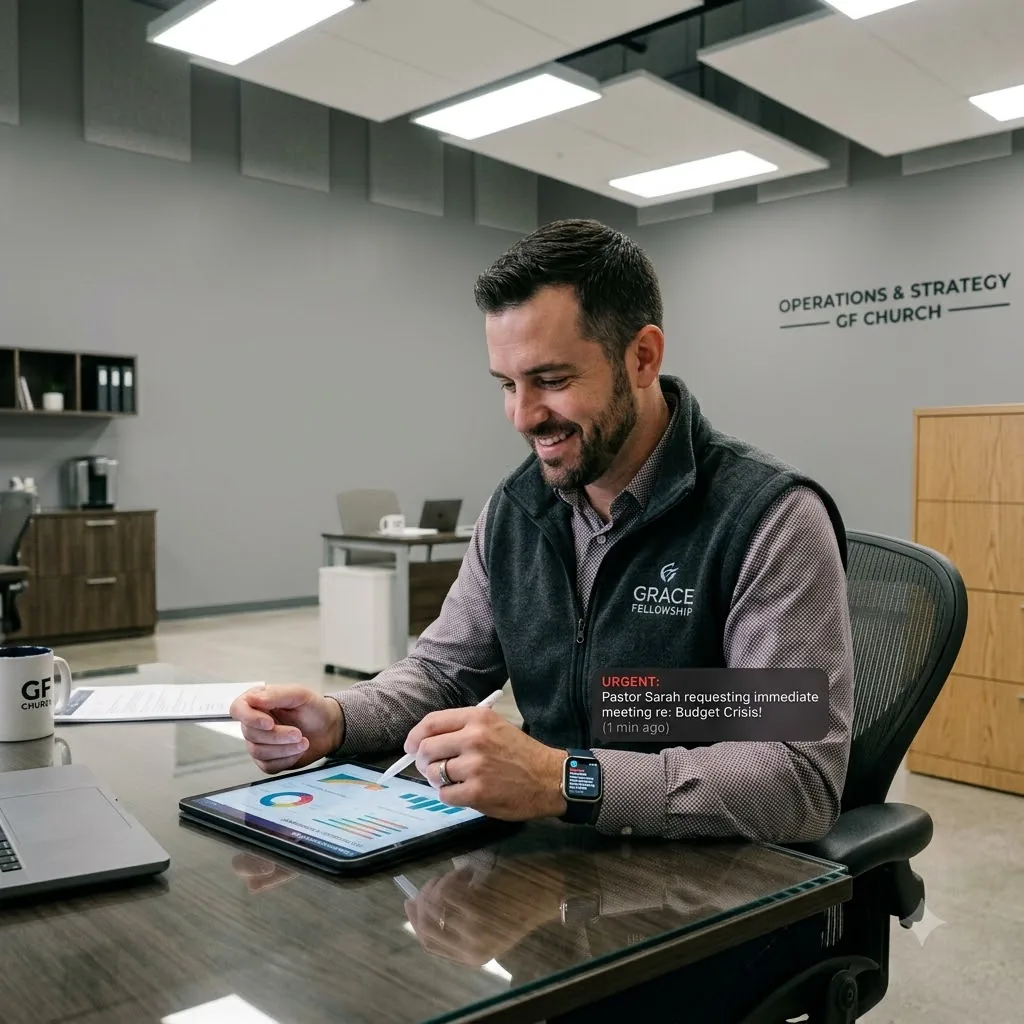
He walked slowly over to where he had dropped his iPad. He knelt on the carpet and picked it up. The screen was completely black, a useless slab of glass and aluminum. He pressed the power button, held it down, and prayed for the Apple logo to appear. Nothing happened. The remote factory reset had been absolute, bricking the device entirely to protect the church’s proprietary data from a terminated employee.
Greg sat down heavily on the padded bench near the water fountain, exactly where Caleb had been sitting.
He stared at the blank screen of the tablet, catching his own reflection in the dark glass. He looked pale, small. He thought about the three months he had spent crafting the perfect pitch for CovenantTracker. He had used all the right buzzwords for the board. *Proactive spiritual alignment. Digital accountability fencing. Fiscal efficiency.* He had convinced the elders that the sixty-thousand-dollar investment was necessary to protect the flock. He had sold them on the power of data, on the necessity of total surveillance, believing with his entire heart that he would always be the one wielding the scalpel.
But a machine didn’t understand the nuance of a pastoral intervention. It didn’t care about the dramatic tension of a hallway confrontation, or the careful, deliberate application of guilt to bring a teenager to repentance. It only understood inputs and outputs.
Caleb had crossed a digital boundary, triggering a ninety-nine percent confidence score. The system had calculated the most efficient route to discipline: notify the parents directly. It took a fraction of a second. No salary required. No benefits package. No human hesitation.
Greg’s devotion to the church, his theology, his carefully curated image as a spiritual protector-none of it had been weighed in the final calculation. He wasn’t a martyr falling on his sword for his faith. He hadn’t been defeated by a hacker or a malicious secular enemy. He had been erased by a spreadsheet. His devout loyalty had been quantified, measured against a software licensing fee, and found wanting.
The fluorescent lights buzzed softly overhead. The summer retreat video looped again, the laughing teenagers splashing in the digital lake. Greg sat in the windowless corridor, clutching his dead tablet to his chest, waiting for someone to come and escort him off the property.