Story code: ST-001785
Part 3: The Telemetry Bridge
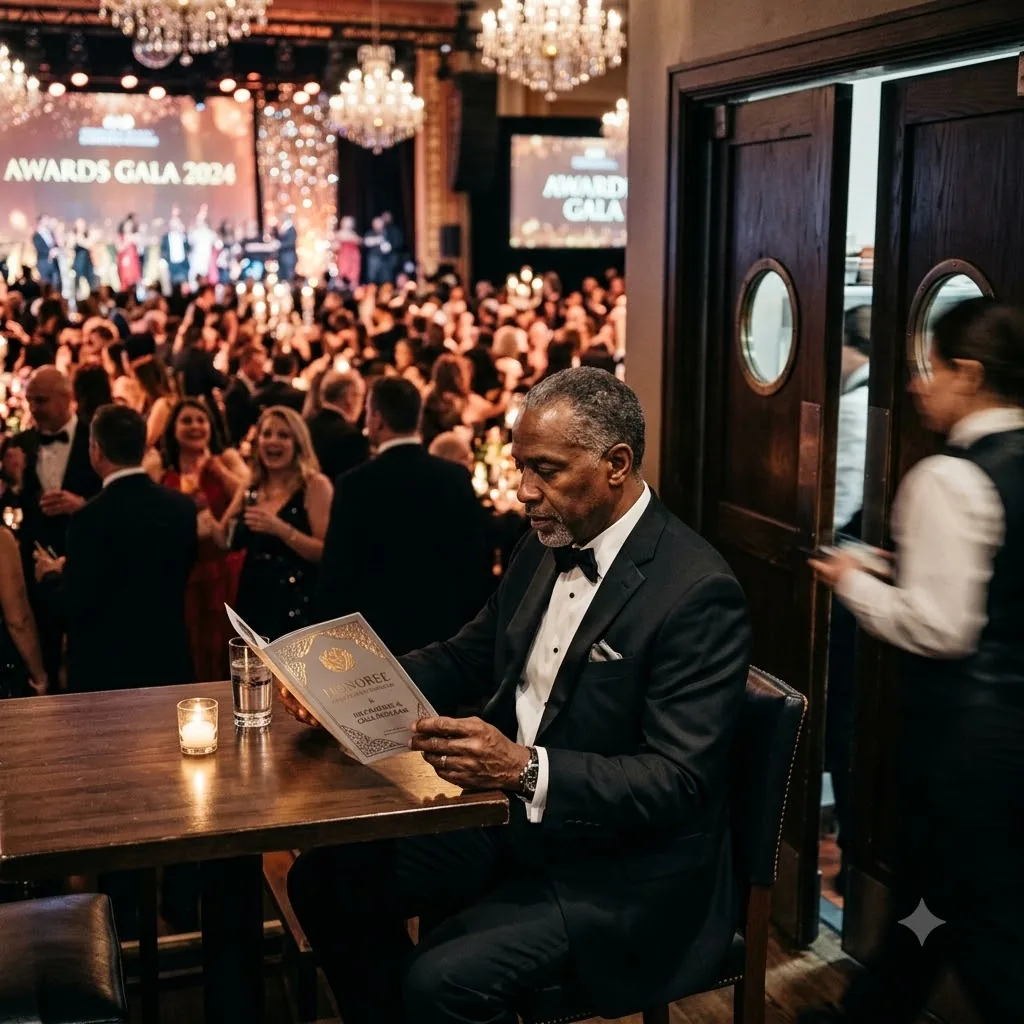
Marcus shoved his chair back. The metal legs shrieked against the scuffed hardwood floorboards. He didn’t care who heard it. He slipped his hand deeper into his jacket pocket, his thumb running over the grooved edges of the offline security fob. He needed to reach the basement server room. If he could hardwire into the physical terminal, he could lock out the remote migration sequence before the countdown clock hit zero. He took one determined step toward the perimeter hallway, aiming for the velvet-roped exit.
A hand clamped down firmly on his right shoulder, stopping his momentum instantly.
“Not toward the stage, Marcus,” a low, polished voice said. “Out the service doors.”
Marcus turned. Bradley Hayes, Vanguard’s Chief Legal Officer, stood blocking the narrow path between the decorative faux-ficus tree and the kitchen wall. Bradley was a master of corporate optics, a man who wore a bespoke Tom Ford tuxedo with the casual ease of a track suit. His silver hair caught the ambient light from the kitchen doors. He was not smiling. Tucked tightly under his left arm was a thick, sealed manila envelope.
“Bradley,” Marcus said, keeping his voice steady despite the adrenaline spiking in his chest. “Get out of my way. I need to get downstairs.”
“You’re not going anywhere near a terminal tonight,” Bradley said. He stepped forward, forcing Marcus to take a step back until the backs of Marcus’s knees hit his flimsy banquet chair. Bradley didn’t wait for an invitation. He pulled out the opposite chair, brushed a crumb of stray bread off the cheap plastic tablecloth with visible disgust, and sat down. He dropped the heavy envelope onto the table. It made a flat, authoritative slap. “Sit down, Marcus. Let’s handle this with dignity.”
Marcus remained standing. He looked out over the ballroom. On the fifty-foot LED screens flanking the main stage, the digital countdown clock flashed in aggressive crimson numbers: *00:41:15*.
“You don’t understand what’s happening,” Marcus said, pointing at the massive screens. “Wright’s migration sequence-”
“I understand perfectly,” Bradley interrupted, his tone chillingly flat. “I drafted the transition timeline myself. David wanted a clean break for the twenty-fifth anniversary. Out with the old analog foundation, in with the new automated future. You are the analog foundation, Marcus. You just refused to see it.” Bradley tapped the manila envelope. “Sit down.”
The sheer, absolute certainty in Bradley’s eyes made Marcus’s stomach twist. This wasn’t just David Sterling’s ego. The entire executive board had signed off on this execution. Marcus slowly lowered himself back into his chair.
Bradley pulled a gold fountain pen from his breast pocket and laid it precisely parallel to the envelope. “Inside is your early retirement package. It is exceptionally generous. Full vesting of your founder’s shares, a cash severance that ensures your grandchildren won’t have to work, and immediate transition to a purely honorary ‘Chairman Emeritus’ title.” Bradley leaned forward, lowering his voice below the thumping bass of the cover band starting their next set. “The condition is your signature on an ironclad, non-disparagement, non-disclosure agreement. And you hand over all company hardware currently on your person. Specifically, the master offline security fob I know you’re gripping in your right pocket.”
Marcus stared at the envelope. “You want me to sign a gag order while Thomas Wright crashes the entire fleet?”
Bradley sighed, pinching the bridge of his nose like a disappointed parent. “There is no crash, Marcus. The Apex AI has been running in the sandbox environment for six months. It’s flawlessly efficient. Thomas is brilliant. You are letting your bruised ego cloud your judgment. Just because you didn’t write the code doesn’t mean it won’t work.”
“Logistics isn’t just data, Bradley,” Marcus said. His voice dropped to a harsh whisper. “It’s physics. Did Thomas Wright review the 2014 NHTSA compliance patch? Did he run a dependency check on the legacy braking bridge?”
Bradley waved a hand dismissively. “I am not here to debate server architecture. I am here to execute a contract.”
“Listen to me!” Marcus slammed his palm flat against the table. The battery-powered tea light rattled. “In thirty-nine minutes, Thomas Wright’s program is going to purge the legacy routing protocol to clear server capacity for his AI. What he doesn’t know-what David intentionally scrubbed from the system architecture to make this transition look seamless to the board-is how the legacy servers interact with the physical hardware.”
Bradley crossed his arms, his jaw tightening. “Sign the paper, Marcus. A black car is waiting in the alley.”
“The automated braking and telemetry systems on the two thousand Peterbilts currently running our overnight freight are hardcoded to the legacy protocol,” Marcus continued, refusing to break eye contact. “They ping the home server every three seconds to verify load weight against downhill momentum. If the server drops the ping mid-transit, the truck’s internal safety logic assumes a catastrophic communications failure.”
Bradley’s rigid posture shifted. A microscopic flicker of uncertainty crossed his polished features. “The AI will pick up the ping.”
“The AI doesn’t know the ping exists,” Marcus said, his voice turning deadly cold. “Wright built his AI to optimize fuel routes and predictive maintenance. He didn’t build it to hold the hand of an eighteen-wheeler going down a black ice grade in the Rockies. When Wright pulls the plug at midnight, the legacy server dies. The ping drops. Two thousand trucks will instantly register a critical failure and default to their fail-safe.”
“Which is what?” Bradley demanded, his corporate mask slipping slightly.
“An emergency mechanical lock,” Marcus said. “The air brakes will engage at maximum pressure. Automatically. Without driver input. At midnight, two thousand long-haul trucks driving seventy miles an hour on packed interstates are going to lock their axles. The trailers will jackknife. They will wipe out every sedan, minivan, and commuter bus in the adjacent lanes. We will have a thousand multi-vehicle pile-ups from Seattle to Boston in the span of four seconds.”
Bradley stared at him. The ambient noise of the gala-the clinking glasses, the laughing executives, the blaring brass section-seemed to instantly drain from the small space between them. Bradley looked out toward the main stage, where David Sterling was patting Thomas Wright on the back. He looked at the giant crimson countdown clock. *00:36:10*.
“You’re lying,” Bradley whispered, though the sudden pallor of his skin betrayed his panic. “David assured the board the migration was entirely software-based. There is no physical danger.”
“David doesn’t know how the trucks work,” Marcus said, picking up the gold pen and tossing it back across the table. “He knows how the stock price works. He erased me from the history books, but he forgot to erase my code from the brake lines.”
Marcus slowly pulled his right hand from his jacket pocket. He placed the heavy, brushed-steel security fob squarely in the center of the manila envelope.
“This isn’t just an offline key,” Marcus said softly. “It’s the only local hardware token that can authorize a staggered, parallel server migration. I can keep the telemetry bridge active while Wright’s AI boots up. But it requires manual terminal access in the basement, and it requires my encryption syntax.”
Bradley stared at the fob. He didn’t reach for it. His hands were suddenly trembling.
Marcus pushed the un-signed NDA back across the table. “So, you have a choice to make, Bradley. You can enforce this NDA, escort me out the service doors, and spend the rest of your life defending Vanguard Logistics against a thousand counts of corporate manslaughter. Or you can get the hell out of my way.”
Bradley sat frozen in the cramped shadows of the kitchen doors, his eyes darting frantically between the un-signed contract, the steel fob, and the ticking red numbers dominating the ballroom screens. He opened his mouth, but no words came out.