Story code: ST-001785
Part 2: The Erasure
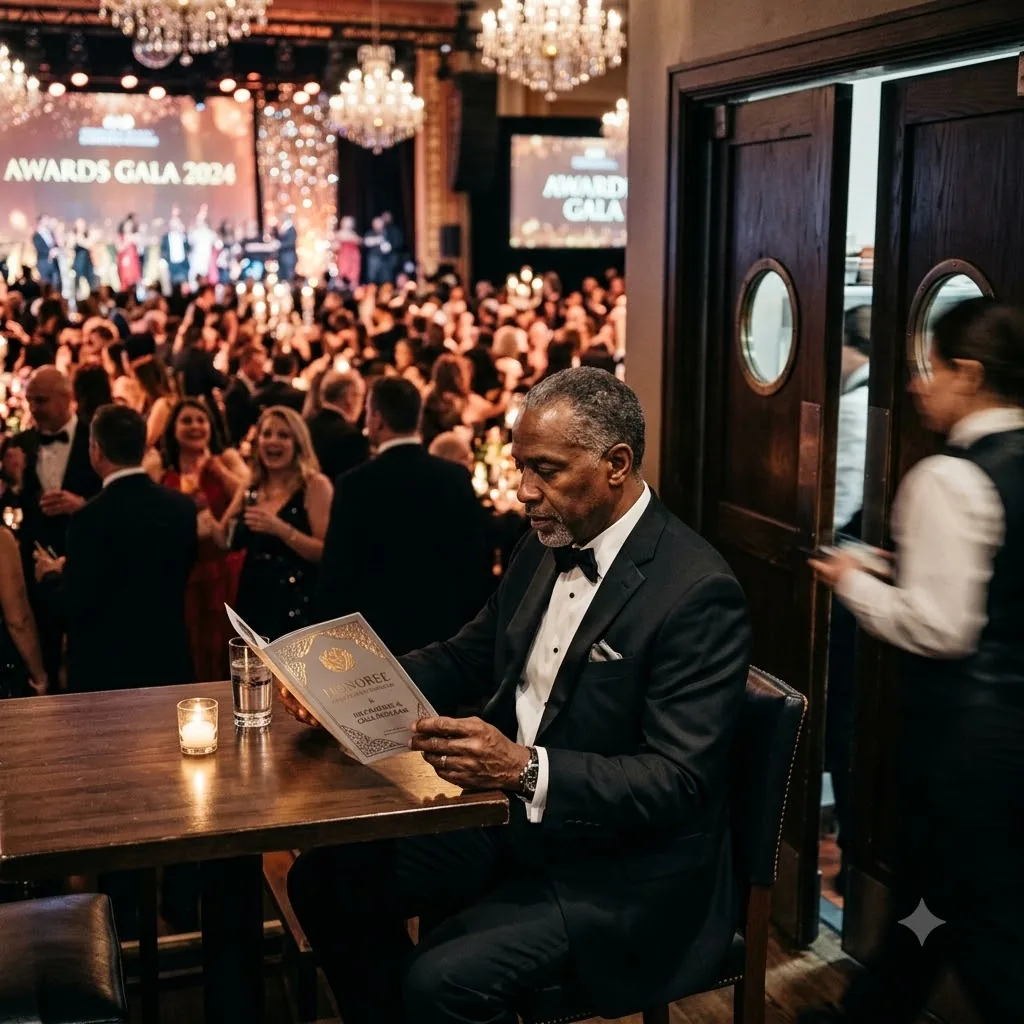
Marcus stared at the negative space. The typesetting was flawless. The heavy, black serifs of David Sterling’s name sat at the top, perfectly centered on the glossy page. Directly beneath it, aligned with mathematical precision, was the name of Richard Vance, the Chief Financial Officer. Between them, there was nothing but smooth, bright white paper. It was not a typo. A typo left an awkward, gaping hole, a ragged edge where text should have naturally flowed. This was a deliberate graphic design choice. The kerning and line spacing had been adjusted to perfectly bridge the gap where Marcus’s name had lived on every official company document for two decades. Someone had gone into the master file and surgically excised him, realigning the margins so no outside observer would ever know a third founder belonged in that space.
The swinging metal doors behind his chair crashed open, catching the back of his seat and jolting him forward. A busboy carrying a gray plastic tub piled high with scraped plates and half-eaten prime rib pushed past. The edge of the tub clipped Marcus’s shoulder, leaving a smear of brown grease on the dark wool of his tuxedo jacket. The kid did not pause, did not look down, merely muttered a breathless curse and kept walking toward the dishwasher station. Marcus brushed at the grease with his thumb, smearing it deeper into the expensive fabric. He looked back at the program. His breathing felt shallow, restricted by the sudden, crushing gravity of the room. He turned the heavy page, the thick cardstock feeling like lead in his trembling fingers.
He found the company timeline on page four. *1999: The Proprietary Routing Software Launch.* Marcus leaned in, squinting in the flickering, weak light of the battery-powered tea candle. The text read: *Under the visionary direction of David Sterling, Vanguard revolutionized freight logistics by implementing the industry’s first dynamic routing protocol.* Marcus touched the dry ink. The winter of 1999 had been a nightmare of freezing rain and rolling blackouts. Marcus had spent three months in an unheated, leased garage in Scranton, coding the dynamic routing protocol in C++ while David was down in Florida playing golf with prospective investors. Marcus had stress-fractured a molar grinding his jaw that winter. Now, his labor was reduced to a sterile bullet point, credited entirely to a man who didn’t know the difference between a server rack and a filing cabinet.
“Marcus?”
Marcus snapped his head up. Standing on the edge of the scuffed hardwood perimeter was Sarah Jenkins. He had hired her twelve years ago right out of grad school. He had spent hundreds of hours mentoring her, teaching her how to navigate the brutal logistics union negotiations in the Midwest. Now she was the Vice President of Southeastern Operations, wearing a stunning emerald evening gown and holding a champagne flute. She looked from his face, down to the wobbly two-top table, and finally to the swinging kitchen doors. Her expression shifted rapidly from polite surprise to a tight, excruciatingly uncomfortable wince.
“Sarah,” Marcus said, his voice sounding entirely too loud over the distant, blaring brass of the cover band. He stood up, trying to project the easy, commanding authority he had possessed just an hour ago in the lobby. “The Atlanta expansion numbers looked solid this quarter.”
She took a half-step backward, her eyes darting nervously toward the blinding center of the room, specifically toward Table 1. “Thanks, Marcus. Yeah, David is really thrilled with the projections.” She hesitated, shifting her silver clutch from one hand to the other. “What… what are you doing back here? The executive tables are all up front.”
“Just a mix-up with the event coordinators,” Marcus said. He forced a stiff, practiced smile, adjusting his lapel to hide the grease stain. “Seating chart error.”
Sarah did not smile back. Her eyes dropped to the open program on his table, settling precisely on the timeline page. She swallowed hard, her throat bobbing. The pity in her eyes was absolute, and it was devastating. She knew. Everyone at the executive level must have known for weeks. This was not a mistake by a frantic planner with a headset. This was a coordinated execution. “Right,” Sarah murmured, her voice dropping to a whisper. “Well. I should get back. David is about to give the toast. It was… it was really nice seeing you, Marcus.” She turned and hurried back toward the illuminated center of the ballroom, practically fleeing into the safety of the crowd.
Marcus sat heavily back into the flimsy banquet chair. The isolation was no longer just an abstract feeling; it was a physical barrier, a quarantine line drawn permanently around his table. The cover band abruptly stopped playing mid-song. A shrill burst of microphone feedback echoed through the cavernous ballroom, instantly silencing the thousands of guests. The massive crystal chandeliers overhead dimmed to pitch black. The only illumination left in the room was the blinding array of white stage lights focused directly on David Sterling, who stood at the center podium holding a glass of champagne.
“Twenty-five years,” David’s voice boomed through the towering line-array speakers, vibrating against Marcus’s ribcage. “Twenty-five years ago, two men had a vision for a better way to move the world.”
*Two men.*
Marcus gripped the edge of the table. The cheap plastic tablecloth bunched tightly under his knuckles.
“And while we honor our past,” David continued, gesturing expansively with his free hand, “tonight is strictly about the future. It is about passing the torch to a new generation of innovators.” David turned and pointed directly to the young vice president sitting in Marcus’s former seat at Table 1. “Which is why I am thrilled to announce that as of midnight tonight, our entire global fleet is migrating to the new Apex Routing AI, developed exclusively by our new Chief Operating Officer, Thomas Wright!”
The ballroom erupted into thunderous, standing applause. Marcus watched Thomas Wright stand, buttoning his jacket, and wave humbly to the crowd. A massive, high-definition graphic flashed onto the fifty-foot LED screens flanking the main stage, displaying the new corporate hierarchy. Marcus’s entire logistics division was gone, swallowed whole by Wright’s new department. But Marcus wasn’t looking at the organizational chart. He was staring at the digital countdown clock displayed beneath the words *Global Fleet Migration*. It read: *00:45:00*. Forty-five minutes until midnight.
Marcus felt the blood drain rapidly from his face, leaving his skin ice-cold despite the suffocating waves of heat radiating from the kitchen. Thomas Wright had no idea what he was doing. The legacy routing algorithms were fundamentally intertwined with the automated braking and telemetry systems of the two thousand long-haul trucks currently operating on the interstates. A forced, mid-transit migration to a raw, untested AI system wouldn’t just crash the corporate servers; it would instantly sever the safety link to every active truck in the country. Marcus reached into his jacket pocket, his fingers closing around the cold, heavy metal of the master offline security fob. He was the only person in the world with the encryption key required to halt a system-wide overwrite.