Story code: ST-001805
Part 3: The Timestamp
The cruiser’s tires hissed over the sun-baked asphalt of the strip mall parking lot. Marcus dropped flat across the front seats of the van, the emergency brake digging sharply into his ribs. He held his breath as the black-and-white rolled slowly past the windshield. The moment the cruiser’s brake lights flared, turning toward the rear alleyway, Marcus popped the passenger-side door lock. He rolled out onto the blistering pavement, leaving the keys in the lockbox, and sprinted for the narrow tree line that separated the commercial lot from a sprawling residential subdivision.
He was officially running. By leaving the disabled van, he was committing an actual violation, turning the algorithm’s hallucination into a self-fulfilling prophecy. But surrendering to the county jail meant losing his job, his apartment, and his year of clean time while a faceless IT department took weeks to investigate a glitch they had every financial incentive to cover up.
The two-mile trek back to Elmira Street was a paranoid, suffocating ordeal. Marcus navigated through overgrown backyard easements and jumped rusted chain-link fences, keeping off the main roads. The July heat radiated in visible waves off the pavement, but a cold sweat soaked through his uniform shirt. The black plastic box strapped to his ankle felt as heavy as an anvil, a silent traitor still clamped to his bone. If the GPS was truly pinging him three miles east on Oakwood Drive, the system wouldn’t know he was doubling back. He had to bet his entire life on the machine’s catastrophic failure.
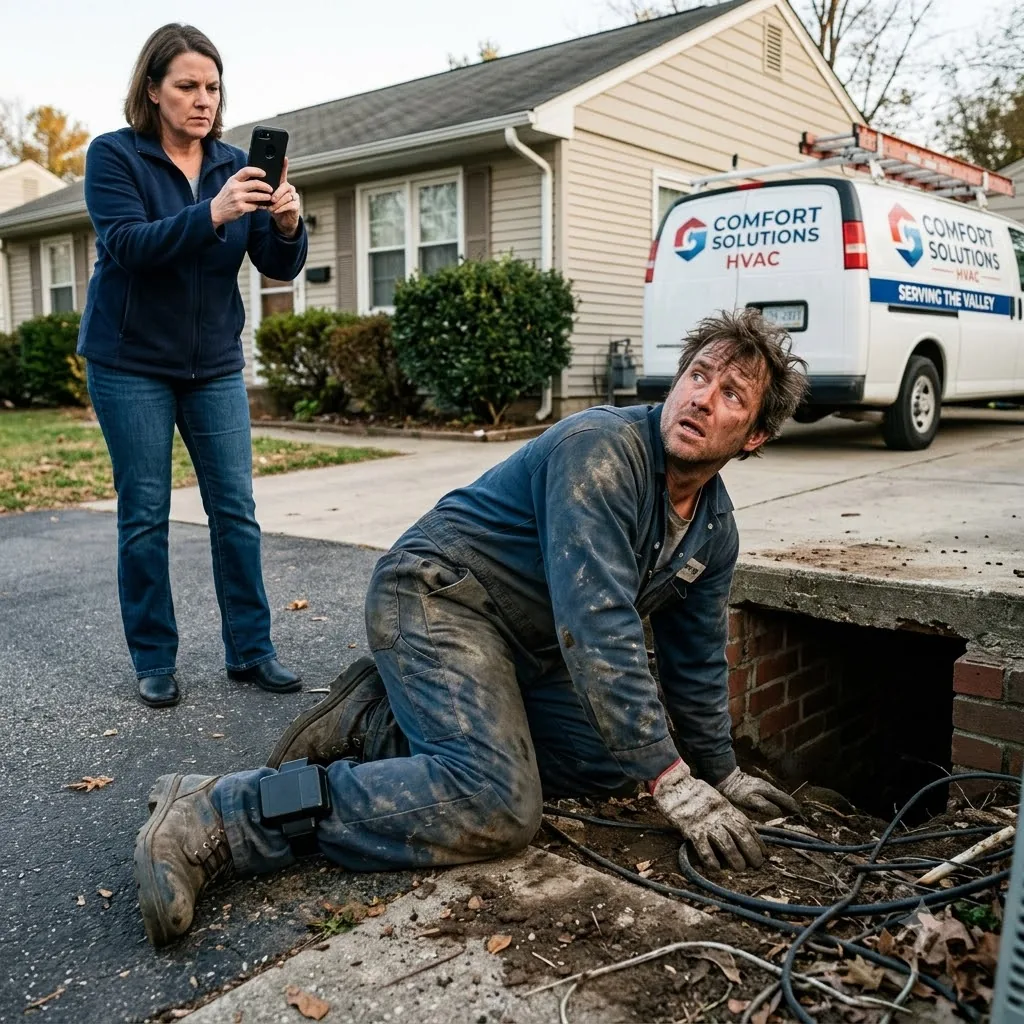
Ten minutes later, Marcus crouched behind a thick wall of hydrangeas at the corner of Elmira Street. He parted the leaves, his chest heaving. Across the cul-de-sac, a second police cruiser was parked at an angle in his customer’s driveway. The homeowner stood on her pristine lawn, animatedly pointing at the spot where Marcus’s van had been, showing the officers the viral video on her silver phone.
Marcus didn’t look at her. His eyes locked onto the two-story colonial directly across the street from the customer’s house. It had pale blue siding and a prominent, black doorbell camera mounted flush against the brick entryway. The lens was angled perfectly to capture the entire street, including the driveway where Marcus had been parked.
He checked the street. The officers were facing away, writing in their notepads. Marcus broke from the bushes, staying low behind a row of parked cars, and darted up the driveway of the blue colonial. He flattened himself against the brick wall beside the front door, safely out of the officers’ line of sight, and pressed the doorbell button.
A blue LED ring spun around the button. Marcus waited, his pulse thundering in his ears.
“Can I help you?” a voice crackled through the tiny speaker. It was a younger man, his tone thick with suspicion.
“Please,” Marcus whispered fiercely, leaning inches from the camera lens. “I’m the HVAC tech from across the street. The one the woman is talking to the cops about. My parole tracking monitor broke. It triggered a false alarm and they think I ran. I need your footage to prove I didn’t.”
Silence stretched from the speaker. Then, the deadbolt clicked. The door opened two inches, restrained by a heavy brass chain. A man in his late twenties, wearing a graphic tee and holding his smartphone like a shield, peered out.
“I just saw you on the neighborhood Facebook group,” the man said, his eyes darting to Marcus’s ankle. “You’re a fugitive. I should yell for those cops right now.”
“The video she posted cuts off before I left,” Marcus said, keeping his hands visible and pressed against the brick. “My parole officer says my GPS monitor pinged me three miles away on Oakwood Drive from 2:10 to 2:16 PM. He says the software registered my heart stopping, that I took the device off. Your camera records on motion, right? It faces her driveway. Pull up the log for 2:10 PM.”
The man frowned, his thumb hovering over his screen. “If you’re lying, I’m screaming for the cops.”
“Do it,” Marcus said without hesitation. “Check the time.”
The man opened an app on his phone, scrolling down a list of timestamped thumbnails. He tapped one. The faint sound of Marcus’s van engine played from the phone speaker.
“Look at the time in the corner,” Marcus urged, sweat stinging his eyes.
“It’s 2:12 PM,” the neighbor murmured, his hostility morphing into profound confusion. He tilted the screen toward the crack in the door. The high-definition video clearly showed Marcus’s company van parked in the driveway across the street. At the center of the frame, Marcus walked out of the side door, wiped his forehead with a rag, and opened the van’s rear doors to grab a roll of aluminum tape.
“I was there,” Marcus said, his voice trembling with exhausted vindication. “The machine made it up. Please. Text me that video right now.”
A minute later, Marcus sat slumped against the shady side of the neighbor’s garage, staring at his tablet. He attached the video file to an email, sent it to Davis’s official state address, and immediately dialed the direct line from his phone.
Davis answered on the first ring. “Vance. The local precinct just found your abandoned van. You just caught a felony evasion charge.”
“I just emailed you,” Marcus gasped, his lungs burning. “Open it.”
“I am not playing games with you, Marcus.”
“Open it!” Marcus shouted, his voice cracking. “You said the Sentinel system is infallible! You said it pinged me on Oakwood Drive from 2:10 to 2:16 with no pulse! Look at the email!”
He heard the heavy sigh of a bureaucrat, followed by the clatter of a mouse clicking. Then, silence fell over the line.
“That is a doorbell camera,” Davis finally said, his voice stripped of its usual commanding weight.
“From the house directly across the street from my dispatch,” Marcus said, pressing the phone hard against his ear. “Look at the timestamp on the top right. 2:12 PM. Look who is walking out to the van.”
More silence.
“It’s me,” Marcus said softly. “At the exact minute your software says I was three miles away. The algorithm lied, Mr. Davis. The GPS glitch is real. The biometric drop is fabricated. I never left the zone.”
Davis’s breathing hitched over the receiver. The absolute, unshakeable certainty of the state’s multi-million-dollar tracking system shattered in real-time. “The software logs… they come direct from the contractor’s servers. The biometric sensors don’t fabricate data. If the pulse drops, it drops.”
“You’re looking at the video,” Marcus said, staring out at the suburban street where the police were still searching for a ghost. “You are watching me breathe, and walk, and work at 2:12 PM. The machine made it up.”
Davis didn’t have an answer. The silence stretched, heavy and dangerous, as the undeniable physical truth of the footage violently collided with the black box on Davis’s screen, leaving the parole officer staring at a lie he could no longer defend.