Story code: ST-001805
Part 4: The Firmware Issue
The phone pressed against Marcus’s ear felt slick with sweat. He sat on the sun-baked concrete beside the neighbor’s garage, listening to the hollow, digital static on the line. Davis had put him on hold for almost twenty minutes. Every time a car drove past the cul-de-sac, Marcus flinched, pulling his knees to his chest and waiting for the police cruisers to return.
Finally, the line clicked.
“Vance,” Davis said. He sounded entirely different now-professional, detached, completely insulated by the bureaucracy he served. “I took the video up the chain. Director Vance at the regional office reviewed the doorbell footage alongside the Sentinel system’s data packets.”
“And?” Marcus asked, his voice raw. “You saw it. The machine lied.”
“Nobody is saying it lied,” Davis replied smoothly. “Director Vance is begrudgingly voiding the warrant. They are officially classifying the incident as a localized firmware issue. A synchronization error between the biometric sensor and the GPS satellite. The manufacturer is pushing a remote patch to your device tonight.”
Marcus stared at a crack in the concrete. “A synchronization error? It told you my heart stopped for six minutes while I was three miles away. The system completely fabricated a reality to put me in a cage.”
“The warrant is voided, Marcus. You aren’t going to jail today,” Davis said, his tone sharpening, a warning not to push the philosophy of the failure. “The evasion charge is being dropped because the initial dispatch was generated in error. The police have been called off.”
Marcus let out a long, shuddering breath. The anvil on his chest lifted just a fraction. “Okay. Okay, thank you. Can you call Greg? Tell my boss it was a system error so I can get my job back?”
“I’m your parole officer, not your references department,” Davis said. “If your employer terminated you, you are unemployed. You have fourteen days to secure a new W-2 job, or you will be in violation of your parole terms. And Marcus?”
“Yeah?”
“Because the monitoring device requires an off-cycle firmware update and an emergency system reset, your account has been charged a two-hundred-dollar administrative fee. Plus the standard ninety-dollar false-dispatch penalty.”
Marcus froze. The blistering heat of the afternoon suddenly felt freezing cold. “I have to pay for the glitch? I didn’t do anything wrong!”
“It’s in the terms of the monitoring contract you signed,” Davis recited, stripped of all empathy. “The user bears the cost of all out-of-band maintenance. I suggest you pay it before Friday. If the balance sits unpaid, the Sentinel software will automatically flag your profile for non-compliance, and I won’t be able to stop that warrant.”
The line went dead.
Marcus lowered the phone. He was stranded three towns over from his apartment, with no job, no van, and a mounting debt to the very algorithm that had just tried to ruin him.
He pushed himself off the concrete and began the long walk to the county transit line. The two-mile hike to the bus stop was agonizing. Every time a car slowed down, Marcus kept his head down, terrified that the driver would recognize his uniform.
When he finally boarded the dilapidated city bus, he collapsed into a cracked vinyl seat in the back. The air conditioning was broken, the cabin smelling of diesel and hot dust. He pulled out his phone, his thumb hovering over the browser. He didn’t want to look, but the hard knot in his stomach demanded to know how bad it was.
He opened Facebook. The link his coworker had sent him was no longer just a post in a local neighborhood watch group. It had breached containment.
The homeowner’s video had been downloaded, re-uploaded, and shared across multiple platforms. The view count on the main aggregate page was sitting at over two hundred thousand and climbing violently.
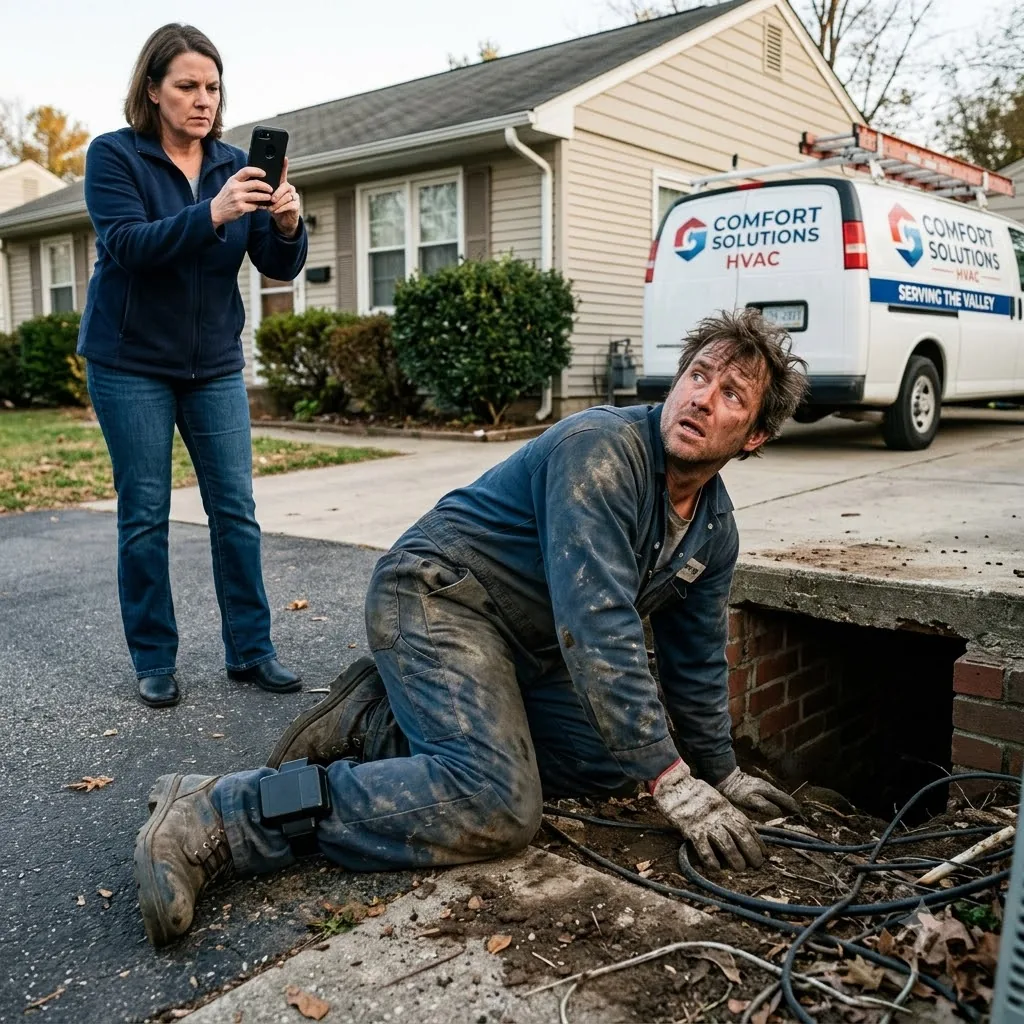
Marcus watched the silent playback. Without context, without the doorbell footage he had sent to Davis, it looked exactly like the homeowner described. A large, sweaty man in a dirty uniform, his ankle monitor shrieking a perimeter breach, lunging aggressively toward a terrified woman before fleeing the scene.
He opened the comments. It was a digital firing squad.
*”I looked up the company van. The guy’s name is Marcus Vance. He’s an ex-con.”*
*”Why are they letting predators out of prison to work in our homes? He was clearly going for her!”*
*”This animal needs to be put down.”*
*”I just called the HVAC company and they said he was fired. Good. Keep this predator away from our kids.”*
His name, his face, and the word predator were now permanently fused together in the algorithmic memory of the internet. The state had quietly voided the warrant in a back room, protecting their contractor’s reputation by blaming a firmware issue, but they had issued no public correction. There would be no viral exoneration. The doorbell footage that proved his innocence was locked away in a parole department inbox, entirely useless against the tidal wave of public outrage.
Marcus locked his phone screen and pressed his forehead against the vibrating window of the bus. He watched the suburban landscape roll by-houses he could no longer repair, neighborhoods he could no longer enter, a society that had already held its trial and executed his character.
Down by his boot, the heavy black plastic box vibrated. It was a short, sharp buzz. The firmware updating. The machine adjusting itself, remaining securely bolted to his ankle, silently tracking his every move.