Story code: ST-001820
Part 2: Depraved Indifference
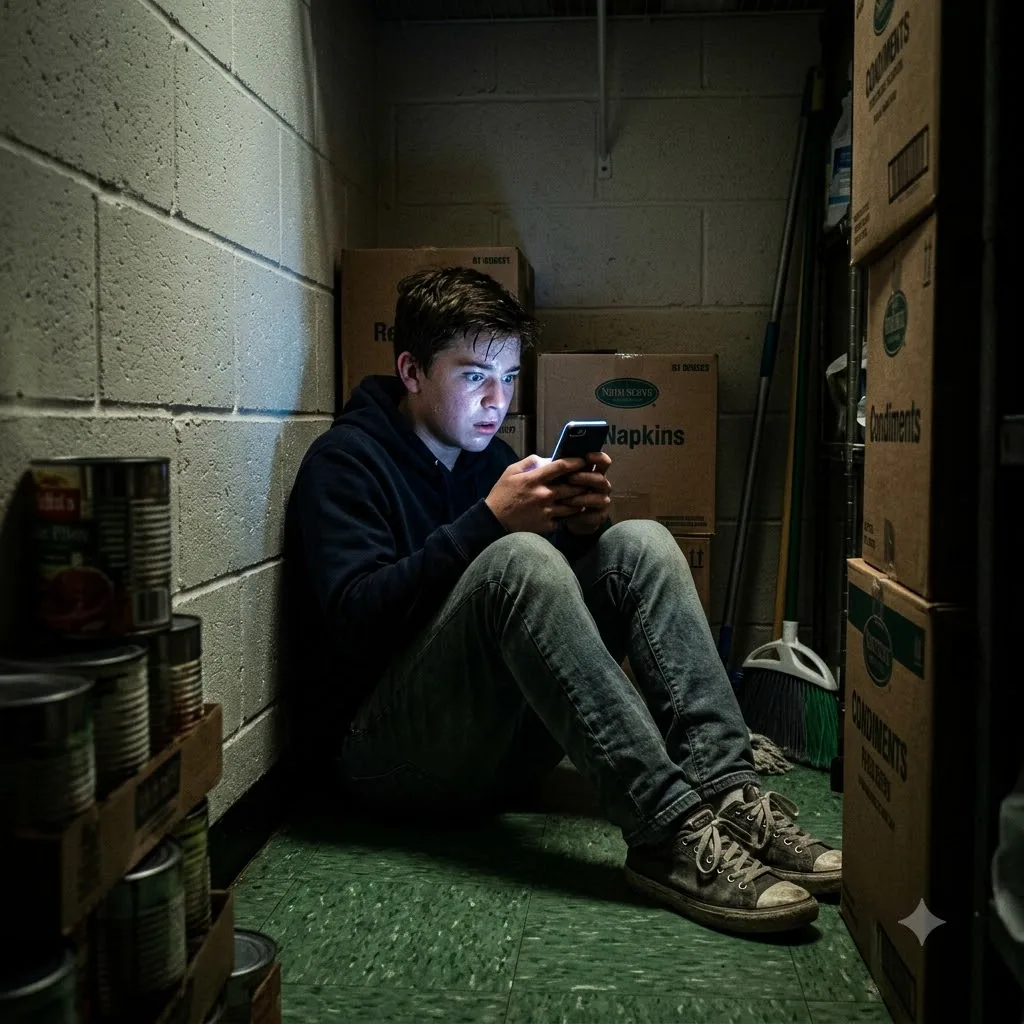
It caught on the rusted internal lock with a harsh, metallic clank. Mateo had thrown the deadbolt out of pure instinct when he slipped inside, but the fragile mechanism groaned under the force of the person on the other side.
“Locked!” a deep, muffled voice barked through the wood. “Kick it.”
Mateo’s heart slammed against his ribs. He jammed his thumb down toward the screen, aiming for the tiny red trash can icon. But his sweat-slicked hand trembled, and a heavy boot slammed into the center of the door. The wood splintered with a deafening crack. Mateo flinched, his thumb slipping off target and hitting the side button instead. The screen instantly went black, locking the device.
The door blew open. The rusted deadbolt tore straight through the doorframe, raining sharp wooden shrapnel over the mop bucket. A blinding beam of white LED light slashed through the dark, hitting Mateo directly in the eyes.
“Hands! Let me see your hands!”
Mateo dropped the locked phone into his front pocket and threw his arms up, his elbows knocking a plastic ketchup jug off the tin shelf. It hit the floor with a wet thud. He squeezed his eyes shut against the piercing glare.
“Don’t shoot,” Mateo choked out, his voice cracking. “I work here.”
A strong hand clamped down on his bicep, dragging him out of the suffocating closet and into the harsh fluorescent glare of the back hallway. The officer patted him down in three quick, aggressive movements, his heavy radio digging into Mateo’s ribs. Finding no weapon, the cop shoved Mateo toward the main dining room.
The scene out front was a chaotic nightmare bathed in the strobing red and blue lights from the cruisers parked outside. Tables were overturned. Silverware and shattered porcelain covered the checkered linoleum. But Mateo’s eyes locked immediately onto the space in front of the vinyl booth.
The man wasn’t thrashing anymore.
Two paramedics were kneeling beside him, but they weren’t moving with urgency. One of them slowly peeled off a pair of blue nitrile gloves, shaking his head at a police sergeant. The sergeant dragged a bright yellow tarp over the man’s face.
Dead.
Mateo’s breath hitched. He had taken the CPR class. He knew the grim biological math. Four to six minutes before brain death. He had stood there with his phone for forty-three seconds. How long had he hid in the closet? Five minutes? Ten?
“Sit,” the officer commanded, pressing Mateo down into an intact booth near the kitchen double doors. The cold vinyl stuck to the cold sweat on the back of Mateo’s neck.
A detective in a wrinkled tan suit broke away from the paramedics and walked over. He carried a small, spiral-bound notepad. His tired eyes swept over Mateo’s grease-stained blue uniform polo, lingering on the nametag pinned to his chest.
“Mateo,” the detective read, his voice unnervingly calm compared to the shrieking static of the police radios. “I’m Detective Vance. You the only employee left in the building?”
Mateo nodded numbly. “The manager ran out the front when… when the guy collapsed. The cooks left through the loading dock.”
“But you stayed.” Vance clicked his pen. “Why hide in the mop closet, Mateo?”
“I was scared,” Mateo whispered. It wasn’t entirely a lie. His hands were shaking so violently he had to press them flat against his thighs to keep them still. Beneath his right palm, his pocket buzzed. Another text message. Mom, probably, still waiting for proof he was safely away from the scene. Every vibration felt like an electric shock straight to his nervous system. The locked phone held the undeleted file.
Vance leaned against the edge of the table, towering over him. “Scared of the victim? Did he threaten you before he went into convulsions?”
“No. He just… he fell. Started shaking.”
“Did anyone else touch him?” Vance asked, his eyes locking onto Mateo’s. “Anyone come near him while he was on the ground?”
“No,” Mateo said quickly. “Nobody.”
Vance’s expression hardened. He tapped the pen against his notepad. “Are you absolutely sure about that, son? Because we have a witness across the street. An off-duty nurse. She was grabbing a coffee at the drive-thru next door and had a clear view through the diner’s front window.”
Mateo’s stomach plummeted. He felt the blood drain from his face, leaving his cheeks freezing cold.
“She said,” Vance continued, his voice dropping an octave, “that a kid in a blue diner uniform stood right over the man while he was dying. Said the kid didn’t roll him on his side. Didn’t check his airway. Just held a phone over him like he was filming a movie.”
The diner’s ambient noise-the crackle of radios, the murmur of the paramedics, the hum of the neon sign in the window-seemed to fade into a hollow, underwater ringing in Mateo’s ears. His right leg vibrated again. The locked phone was practically burning a hole through the denim of his jeans.
“People do sick things for internet clout these days,” Vance said, leaning in closer. The smell of stale coffee and peppermint gum washed over Mateo. “They watch people die just to get a viral video. Now, if someone intentionally let this man choke on his own spit just to record it, we’re looking at depraved indifference. Criminal negligence.”
Mateo swallowed hard. His mouth was completely dry. If he opened his phone to delete the video now, right in front of a detective, it would be destruction of evidence. A felony. If they searched him and found it, they would see exactly what he had done. He was trapped.
“We’re collecting all electronics from the staff to corroborate the timeline,” Vance said, pulling a large, clear plastic evidence bag from his jacket pocket. “Just to clear you, Mateo. Hand over the phone.”