Story code: ST-001836
Part 2: The Covenant of Purity
Marcus forced his eyes to track across the dense paragraphs, fighting the rising panic in his chest. The legal jargon was archaic, but the intent was razor-sharp. Under a section titled *Operational Stewardship*, Clause 3B demanded the bakery close on all recognized Holy Days and submit to weekly financial audits by the Initiative’s ledger board. Clause 4 dictated a mandatory twenty percent tithe on all gross revenue, skimmed directly from the point-of-sale system before overhead or payroll could be met.
But it was Clause 7 that stopped the air in his lungs. *In the event of a breach of the Covenant of Purity-to be determined at the sole discretion of the Deacon Board-the Beneficiary agrees to immediate forfeiture of the property deed to the Sanctuary Trust, waiving all rights to arbitration or appeal.*
“This isn’t a grant,” Marcus said, his voice sounding thin and scraped in the quiet shop. He looked up from the heavy paper, his knuckles white. “This is a hostile takeover. You’re trying to take the deed.”
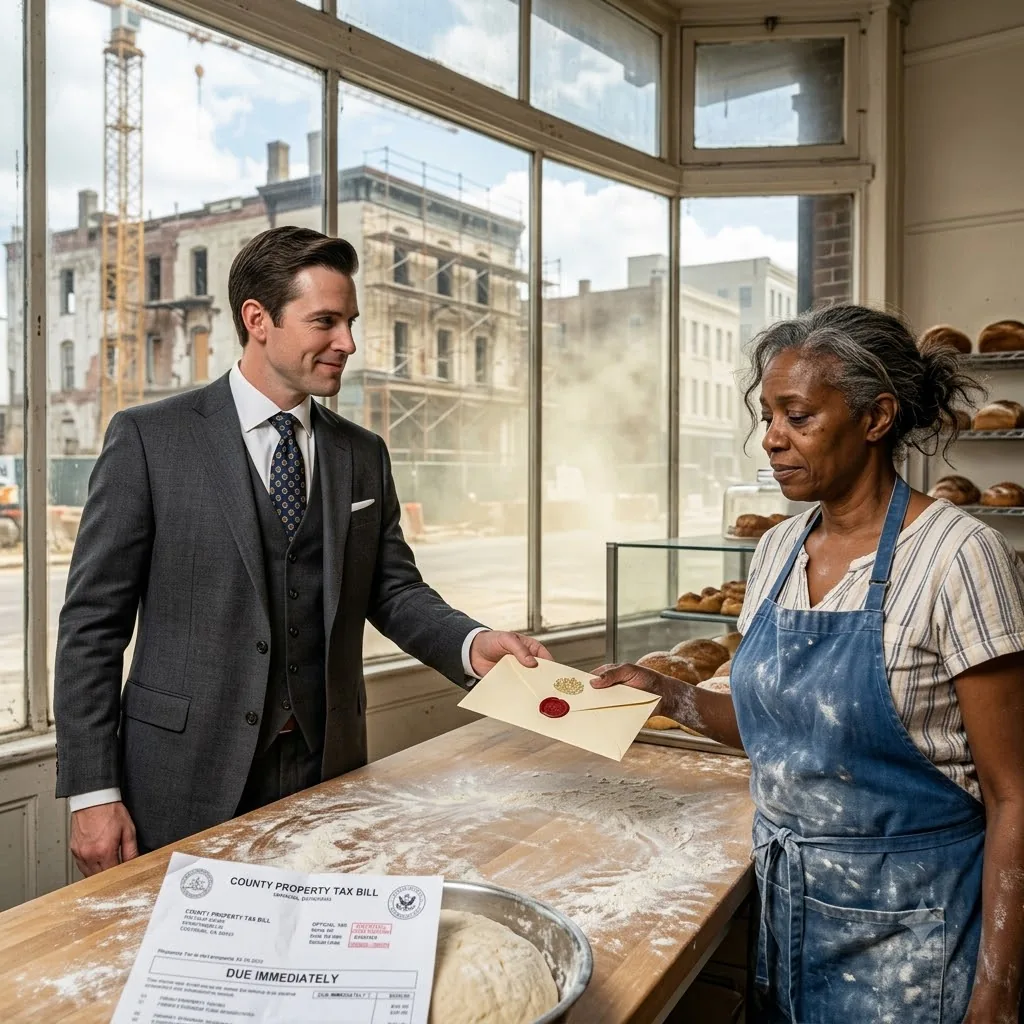
Elias-Deacon Miller, Marcus realized, suddenly connecting the man’s polished face to the aggressive zoning board filings he’d seen taped to the streetlamps weeks ago-merely adjusted his charcoal cuffs. The benevolent, pastoral smile remained frozen in place.
“We are offering stewardship, Marcus,” Deacon Miller said, his tone dripping with practiced, suffocating patience. “The Lord provides, but He also requires a hedge against the wicked. The county will seize this building in fourteen days for back taxes. When it goes to public auction, my congregation will purchase it for a fraction of its value, and we will bulldoze it to make room for our new fellowship hall. The outcome of the real estate is already written.”
Miller tapped a manicured fingernail against the thick vellum. “This covenant is the only path where you get to keep standing behind this counter. You merely have to run your business in a manner pleasing to the church. No serving those who live in sin. No open hours on the Sabbath. A modest return on our investment. A true partnership in the light.”
“And if I sneeze on a Sunday, you take the building anyway,” Marcus said, his grip tightening on the edge of the glass display case.
“Only if you lack faith,” Miller replied softly. He turned toward the door, his leather shoes silent on the flour-dusted floor. “You have until Friday at noon to sign. After that, we withdraw the grace, and we let the tax assessor do his work.”
The brass bell chimed as Miller stepped out into the dust-choked street. Almost instantly, the heavy machinery next door roared back to life. A massive vibration rolled through the floorboards, rattling the pastry tongs against their metal trays.
Marcus snatched the phone from the wall mount, his hands trembling so badly he dropped the receiver once before dialing. He punched in the direct line for his loan officer at the community bank. The line rang four times before Sarah picked up.
“Sarah, it’s Marcus. I need that emergency line of credit we talked about last year. Whatever the interest rate is, I’ll take it.”
There was a heavy, terrible pause on the other end. “Marcus… I left you a voicemail yesterday. The underwriters denied the application.”
“I have equity,” Marcus pleaded, pacing behind the counter, trailing flour from his apron onto the floor. “My grandfather bought this building outright fifty years ago. Even with the ridiculous reassessment, the land alone is worth-”
“The land is zoned in a contested redevelopment grid,” Sarah interrupted, her voice tight with genuine apology. “The Sanctuary Initiative has already filed preliminary architectural plans that overlap your lot lines. They told the county board you were willingly vacating. Commercial lenders consider your property a distressed, high-risk asset because of the impending tax foreclosure. Nobody is going to write a mortgage on a building that’s slated for public auction in two weeks.”
Marcus stopped pacing. “They engineered this. They got the county board to triple the taxes, and now they’ve poisoned the well with the banks. They’re starving me out.”
“I’m so sorry, Marcus. If there was anything I could do…”
Marcus hung up. The dial tone hummed briefly in the empty kitchen before cutting out. He looked around the space that had defined his entire life. The massive Hobart mixers, the custom stone deck ovens, the maple proofing boxes-if he liquidated everything by tomorrow, he might get twenty thousand dollars from a predatory restaurant supplier. The tax bill was four times that amount. He couldn’t bake without the equipment, and selling it wouldn’t even save the building.
He was completely, hopelessly boxed in.
Another violent tremor shook the building, harder than any before. The excavator’s heavy bucket slammed into the bedrock just on the other side of the shared brick wall. A sharp, terrifying crack echoed through the kitchen, loud as a gunshot.
Marcus spun around. A jagged fissure had appeared in the plaster above the deck ovens, spider-webbing downward with a steady hiss of falling dust. The structural integrity of his bakery was literally fracturing under the church’s assault.
Through the front window, he saw Mrs. Gable, an elderly regular who came in every Tuesday for a half-loaf of sourdough, struggling to navigate the broken, rubble-strewn sidewalk the construction crew had deliberately left hazardous. She was exactly the kind of marginalized local Deacon Miller’s “Covenant of Purity” would likely deem an unprofitable nuisance. If Marcus signed the contract, he would become a puppet for the very people destroying his neighborhood. He would have to lock his doors to his own community.
If he didn’t sign, the county would lock the doors for him on Friday.
He walked slowly back to the counter and stared at the thick, cream-colored pages of the contract. His survival required a miracle, or a willingness to play a very different kind of game. He pulled the heavy document closer, his eyes scanning the dense, archaic print not for a way to comply, but for a fatal flaw in the church’s airtight trap.