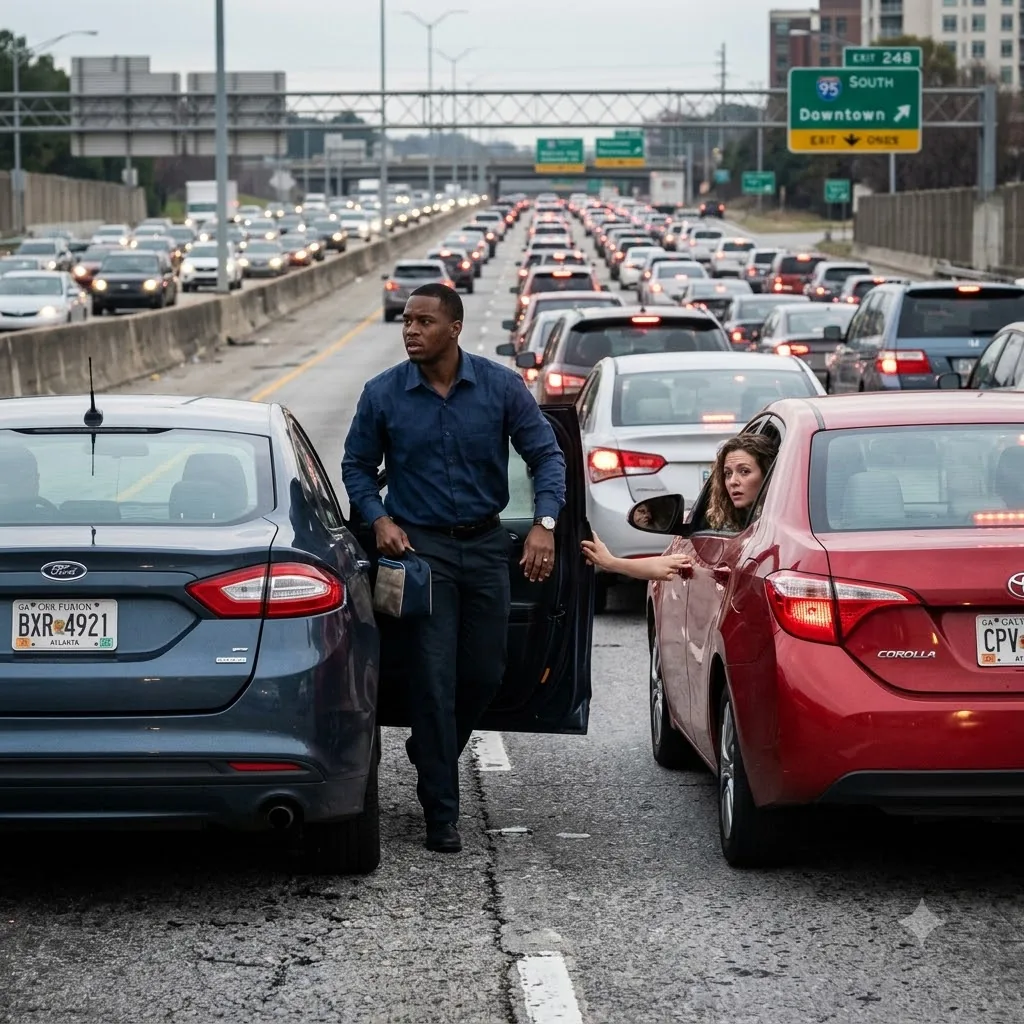
Story code: ST-001856
Part 4: The Arithmetic of Ruin
Sarah’s right hand trembled as she slowly brought it out from behind her back. Her fingers were uncurled, her palm flat, revealing the black plastic grip of the pepper spray canister. It slipped from her hand, clattering loudly against the asphalt.
The first trooper kicked the cylinder away with the toe of his boot. “Sit down and do not move,” he ordered, his voice clipped and exasperated.
Marcus let out a long, ragged exhale against the oily pavement. The burning on his neck was a relentless, searing hum, but a small spark of relief flickered in his chest. Liam had told the truth. The police saw the pink slip. It was over.
“Alright, get him up,” the first trooper said.
Rough hands grabbed Marcus by his biceps, hauling him to his knees and then to his feet. His legs wobbled, his bruised tailbone throbbing in time with his racing pulse. He waited for the click of the handcuff key, rolling his shoulders in anticipation.
The click never came. Instead, the second trooper shoved him forward, steering him toward the black SUV.
“Wait,” Marcus croaked, his throat raw from the chemical fumes. “He just told you what happened. She attacked me. I have to go to work.”
“You breached a police perimeter and aggressively approached an unauthorized barricade,” the trooper said, his grip like a vise on Marcus’s arm. “You’re detained until we sort out the charges.”
“Charges? I didn’t do anything!” Marcus twisted, trying to look back at the line.
“Stop resisting, or you’re going to catch a felony,” the trooper barked, slamming Marcus chest-first against the side of the cruiser. The hot metal burned through his thin uniform shirt. The officer patted him down, yanked his wallet and keys from his pockets, and shoved him into the cramped, hard-plastic backseat of the vehicle. The heavy door slammed shut, sealing Marcus inside a stifling, sound-dampened cage.
Through the thick, reinforced glass, Marcus could see the digital clock glowing on the dashboard console of the cruiser.
8:06 AM.
The final warning. It was done. Manager Higgins wouldn’t care about a protest, or police tape, or pepper spray. The system at the fulfillment center was automated. At 8:01 AM, his employee badge had been deactivated. He was officially unemployed.
Marcus leaned his head back against the wire mesh partition, closing his eyes as a hollow, suffocating numbness washed over him. The heat in the cruiser amplified the caustic chemicals smeared across his neck. His skin felt like it was melting, but he didn’t have the energy to care.
Outside, the cavalry had arrived. Three more cruisers and a tactical extraction van pulled onto the shoulder. Marcus opened his eyes and watched the surreal theater unfold through the smudged window.
The troopers didn’t draw weapons on the activists. Instead, they approached the line with practiced, bureaucratic caution. A negotiation began. Marcus watched a lieutenant in a pristine white shirt lean down, speaking in calm, measured tones to Sarah. A support officer from the van carried over a flat of bottled water, twisting the cap off one and offering it gently to Liam, who took a sip through a straw.
They were getting water. Marcus was handcuffed in a baking cruiser, his skin blistering.
Sarah, having recovered from her momentary panic, was now holding court. Another activist from the support team stood safely on the grass shoulder, aiming a smartphone at her. Sarah spoke passionately to the camera, her face perfectly framed by the neon banners. Marcus couldn’t hear the words through the thick glass, but he didn’t need to. Her gestures told the entire story. She pointed at her own face, mimicking trauma, then gestured broadly toward the police cruisers. She was the victim. They were the martyrs. The man in the faded work shirt who had begged for his livelihood was just a convenient prop in their narrative of oppression.
Marcus looked away, staring down at his scuffed steel-toed boots. They were stained with dirty water from the highway.
He began to do the math. It was a cold, brutal arithmetic that he had practiced in his head a thousand times, but never with a zero on the income side.
He had forty-two dollars in his checking account. Rent was eight hundred and fifty. The eviction notice taped to his apartment door gave him until Friday to pay the arrears, or the locks would be changed by Monday morning.
Monday. Four days.
He couldn’t pawn the Corolla; it was already collateral on a title loan he took out to pay for his daughter’s asthma medication last winter. He had no savings. No family to call. The warehouse job was the only thing standing between them and the street, and it was gone.
Outside, a cheer went up from the support team as the first set of PVC pipes was carefully cut away by the police. Sarah raised her fist in triumph for the smartphone camera, a defiant smile on her face.
In the back of the cruiser, Marcus squeezed his eyes shut. He pictured his daughter’s small pink suitcase sitting in the trunk of his car, miles away in the gridlock. He tried to figure out how he was going to explain to a seven-year-old that they were going to have to sleep in the backseat, all because her father had stepped out of his car to ask for a favor. The tears came then, silent and hot, mixing with the pepper spray, burning him all over again.