Story code: ST-001863
Part 4: The Unyielding Ghost
By Thursday morning, the stolen recording of *The Ashen Crown* breached the top ten on the platform’s global audiobook chart. By Friday afternoon, it sat comfortably at number eight, sandwiched between a massive celebrity memoir and the newest thriller from a legacy publishing house.
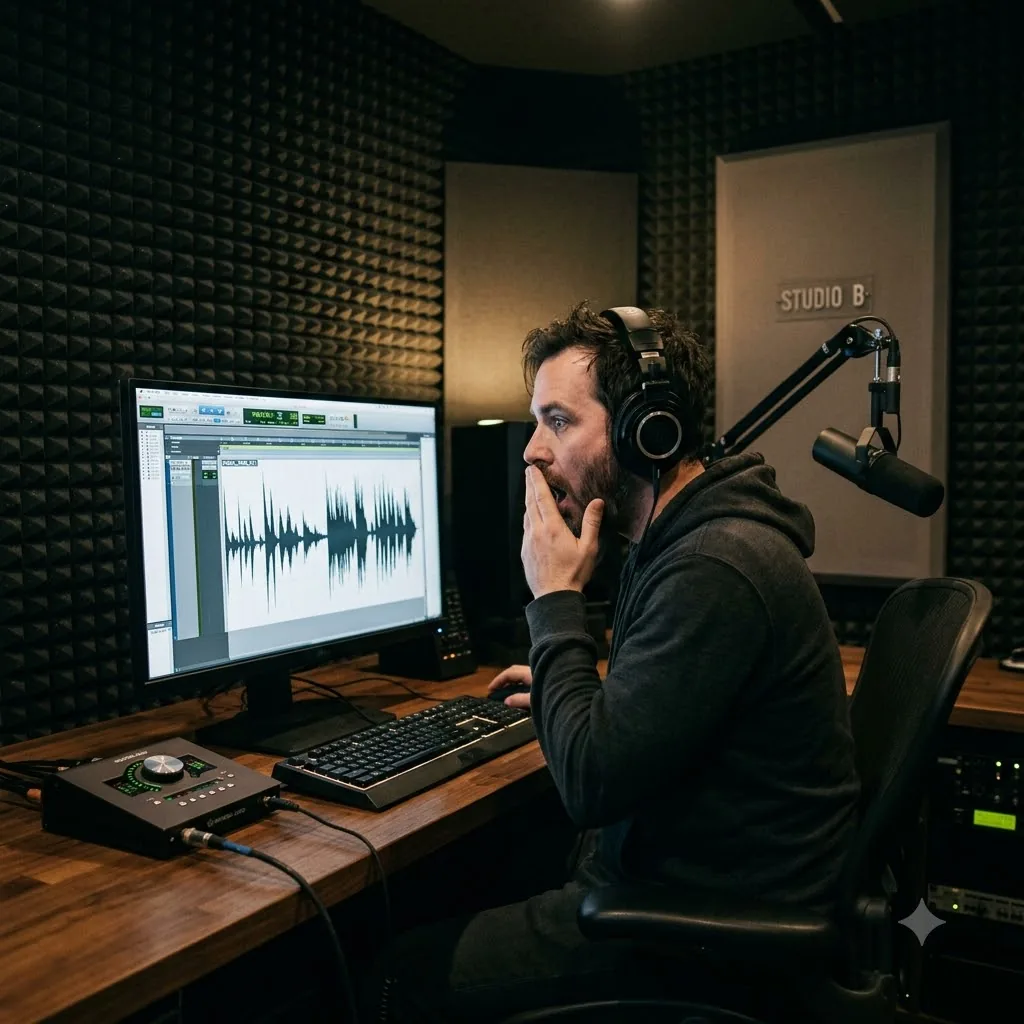
Arthur sat in his foam-lined booth, the main monitor radiating a harsh white light in the dim acoustic space. He hadn’t turned on his condenser microphone in four days. There was no point.
His smartphone vibrated against the desk. The caller ID showed Elaine, his primary agent in New York. Arthur picked it up, putting it on speaker so her voice filled the dead air of the small room.
“Tell me you have a backdoor injunction,” Arthur said, rubbing his tired eyes.
Elaine let out a slow, measured breath. It sounded human. Imperfect. “I spoke with the platform’s senior acquisitions team, Arthur. And I spoke with three different IP litigators.”
“And?”
“And it’s a brick wall,” Elaine said gently. “The terms of service update was airtight. Because the algorithm automatically classified the title as a High-Yield Asset, the platform’s legal department stepped in to shield the publisher under their safe harbor clauses. Ironweed Press officially withdrew their Chapter 11 bankruptcy filing this morning.”
Arthur stared at the screen. Marcus had survived. The man had cried in his sister’s guest room, terrified of losing everything, and now the automated machine that stole Arthur’s voice had paid off Ironweed’s crippling debts. Marcus wasn’t going to fight the platform anymore. He couldn’t afford to. He was a wealthy hostage, completely complicit in the theft of Arthur’s life’s work because the checks were clearing.
“So that’s it,” Arthur said, his voice flat. “They just take it. They take me.”
“Arthur, listen to me,” Elaine said, her tone shifting into a careful, calculated cadence. “The Vance book is doing incredible numbers. The reviews are universally praising the narration. They love your performance.”
“It’s not my performance, Elaine. I wasn’t there.”
“To the listeners, you were. And the producers at the major houses are looking at the margins. The platform generated a forty-hour epic fantasy in three minutes for zero upfront cost.”
A cold weight settled deep in Arthur’s chest. “What are you saying?”
“I’m saying we need to adjust our strategy moving forward,” Elaine said. “Your current rate is four hundred dollars per finished hour. We have two upcoming auditions for Macmillan. I think we need to submit at two hundred and fifty. Maybe two hundred.”
Arthur leaned back in his ergonomic chair. The leather creaked, loud in the silent room. “You want me to cut my rate by fifty percent.”
“I want you to keep working,” Elaine pleaded. “You are competing against a ghost, Arthur. A ghost that doesn’t need to sleep, doesn’t need to drink throat coat tea, and doesn’t charge union minimums. If we don’t undercut the synthetic model, the big houses are just going to click the same checkbox Ironweed did.”
Arthur looked at the audio timeline still loaded on his screen. The jagged green waveform of the AI file stretched endlessly to the right, mathematically perfect and completely unyielding.
“I’ll think about it,” Arthur lied, and tapped the glass screen to end the call.
He was alone again in the soundproof box. The heavy foam walls, designed to keep the noise of the outside world at bay, now felt like a sealed tomb. He reached for his mouse and clicked play on the AI file.
His own voice washed over him, delivering a dramatic monologue about a fallen kingdom. The baritone was rich, the pacing flawless, the emotional resonance perfectly tuned to the algorithm’s vast, aggregated understanding of human grief.
Arthur took a deep breath, trying to speak along with the ghost. He matched the rhythm, his natural voice overlaying the synthetic echo. For ten seconds, they were perfectly in sync.
Then, the ghost kept going. The paragraph was incredibly long, filled with complex compound sentences and rising dramatic tension. Arthur’s chest tightened. He needed oxygen. He had to pause, taking a sharp, desperate inhalation.
The ghost did not pause. It didn’t need oxygen. It executed a mathematically flawless zero-point-four-two-second breath simulation and launched right into the next sentence, leaving Arthur choking on real air, lagging behind his own shadow.
Arthur stopped speaking. He slumped forward, resting his forehead against the cool edge of the recording desk, listening to his replacement read on into the silence. The machine was indefatigable. It was cheaper. It was perfectly obedient. And the world, it turned out, didn’t care about the difference between a real breath and a calculated pause, as long as the story never stopped.