Story code: ST-001863
Part 2: The Safe Harbor
The line clicked, and a tinny, exhausted voice echoed in the small acoustic space. “Ironweed Press. This is Marcus.”
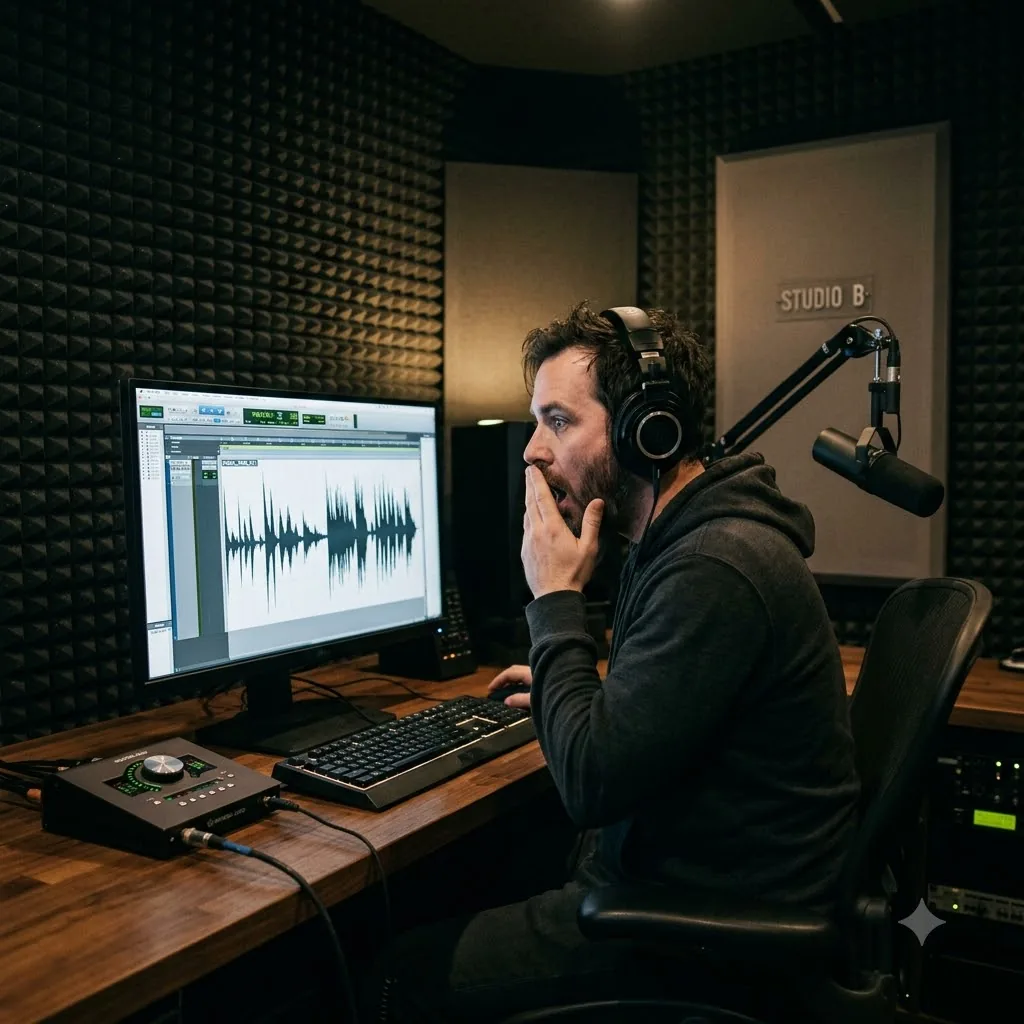
Arthur didn’t bother with pleasantries. He kept his eyes locked on the jagged green waveform of his cloned voice. “Marcus. It’s Arthur Pendelton. I’m looking at a retail page for a book by J.K. Vance. I’m listening to myself read it, but I never stepped into a booth for you. Explain.”
A long, heavy silence stretched over the phone’s speaker. When Marcus finally spoke, the fight was already gone from his voice. “I wondered if you’d catch it this early. It only went live on Tuesday.”
“Take it down,” Arthur said, his voice dropping into the stern, resonant register he usually reserved for narrating military generals. “Right now. While we’re on the phone.”
“I can’t,” Marcus said. The scratchy audio of the speakerphone caught the sound of a heavy sigh. “I literally don’t have the button on my dashboard anymore, Arthur. The platform locked the listing.”
Arthur leaned forward, pressing his elbows into the desk. “You pirated my voice, Marcus. You fed my old masters into a generator.”
“I clicked a checkbox!” Marcus’s voice cracked, a sudden spike of defensive panic. “It was the platform’s new ‘Legacy Audio Monetization’ beta. We’re going under, Arthur. Ironweed is filing for Chapter 11 on Friday. The platform offered an advance to run our entire text backlist through their proprietary voice-synthesis engine. I just checked a box that said we owned the audio rights to the original performances.”
“You owned the distribution rights to the finished recordings,” Arthur corrected, his knuckles turning white as he gripped the edge of the desk. “You do not own my actual vocal cords.”
“Try telling that to their legal department,” Marcus shot back, bitter and hollow. “The contract update we all signed last year buried a clause about ‘derivative synthetic processing’ for out-of-print audio. By the time my lawyer found it, they already had the files. I tried to pull yours yesterday when another narrator threatened to sue me. The platform refused. Once a synthetic title hits the top hundred in sales, it gets flagged as a ‘High-Yield Asset.’ It strips the publisher’s deletion privileges until the end of the fiscal quarter.”
Arthur felt a cold sweat breaking out on the back of his neck. The booth, usually a sanctuary of controlled quiet, suddenly felt like a sealed tomb. “I’ll sue you into oblivion, Marcus.”
Marcus let out a dry, humorless laugh. “Get in line. The printer is suing me. The cover artists are suing me. The LLC has exactly forty-two dollars in its checking account. I’m taking this call from my sister’s guest room. Sue me all you want, Arthur. You won’t get a dime, and it won’t take the book down.”
The line went dead. Marcus had hung up.
Arthur stared at the phone. He reached out and tapped the screen, navigating to his mobile browser. He pulled up the retailer’s support portal, bypassing the public pages and logging into his verified creator account. He found the copyright infringement claim form. He filled it out meticulously, attaching the metadata extraction log as proof, and hit submit.
He didn’t even have time to stand up and stretch his legs before his email chimed.
It was an automated response from the platform’s legal-bot.
*Claim Rejected. Title is enrolled in the Automated Monetization Beta by the verified rights-holder of the text. Disputes regarding synthetic derivative generation must be resolved between the vocal copyright holder and the text copyright holder. The platform acts solely as a distributor and claims safe harbor. To force a takedown, please provide a federal court injunction.*
Arthur stared at the brightly lit words until they blurred. A federal injunction. That meant hiring an IP litigator. It meant tens of thousands of dollars in retainers, months of hearings, and a grueling discovery process. By the time a judge even looked at the paperwork, the fake audiobook would have run its course, raked in a small fortune for the platform, and permanently devalued Arthur’s market rate. Why would any publisher pay his hourly studio fee when they could just license his synthetic clone for pennies?
He was entirely boxed in. The publisher was a dead end. The platform was hiding behind automated walls and legal loopholes.
Arthur turned his attention back to the digital audio workstation on his main monitor. He unmuted the track and pressed the spacebar.
His own voice filled the booth again, rich and perfect.
*Too* perfect.
Arthur zoomed in on the waveform, ignoring the breathing markers this time. He highlighted a complex string of dialogue, a rapid-fire sequence of harsh consonants. He watched the digital readout of the frequencies.
If he couldn’t use the law to force the platform to take the file down, he would have to make the platform’s own automated systems do it for him. The retailer had strict, non-negotiable quality control algorithms. Audio files were instantly purged if they contained certain digital signatures, corrupted frequency bands, or hidden watermarks that violated their upload standards.
Arthur stopped the playback. He opened a dusty folder on his hard drive, one labeled ‘Diagnostic Tools.’ He wasn’t a programmer, but he was a master audio engineer who had spent twenty years manipulating sound waves. He just needed to find the invisible seams in the AI’s generation-the mathematical baseline it relied on-and figure out a way to break it from the inside out.