Story code: ST-001871
Part 2: The Compliance Waiver
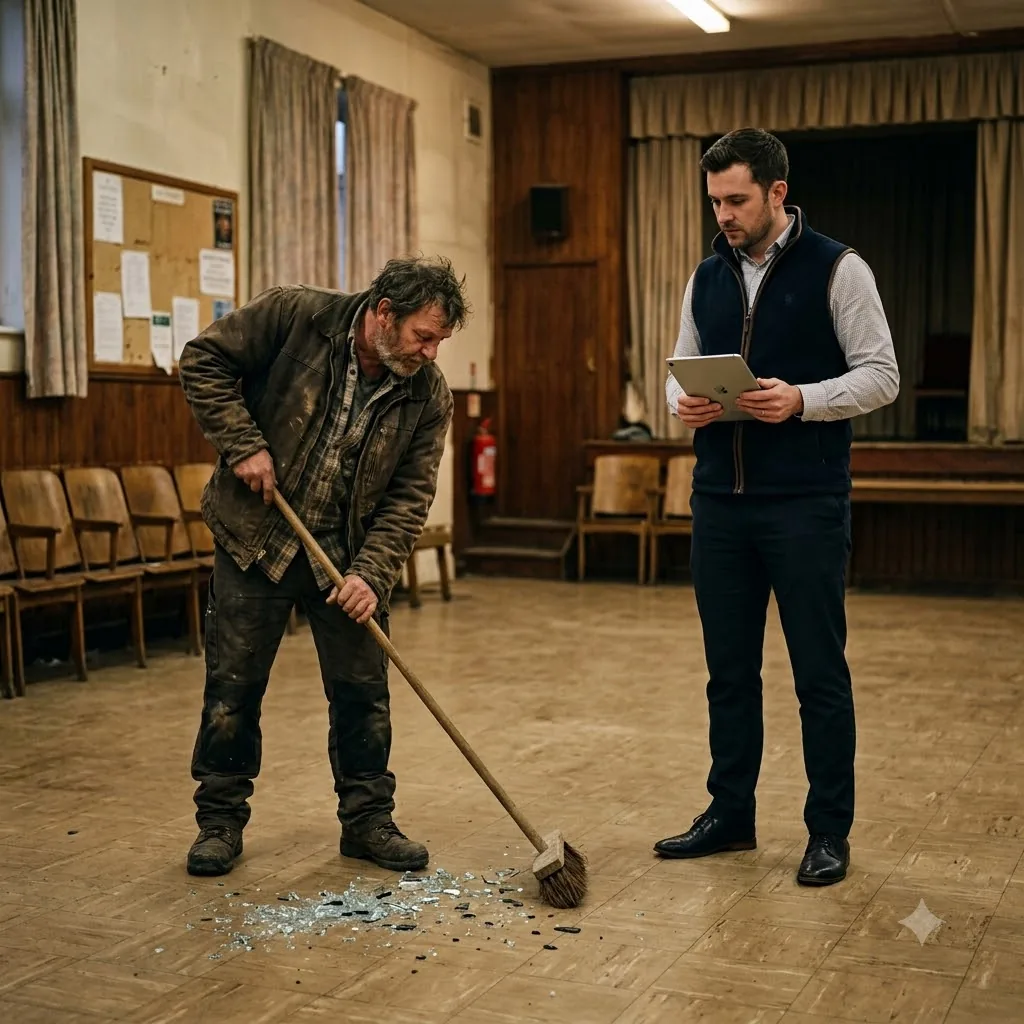
I kept my thumb pressed hard over the face of the man in the center of the glossy board of directors photo. The researcher in the pristine slate-gray fleece vest stumbled backward, his expensive hiking boots crunching heavily into a pile of shattered safety glass. He threw both his hands up, palms facing outward, the white iPad stylus pinched defensively between his index and middle fingers.
He used a slow, deliberate voice, dropping an octave to sound calming. He told me he was interpreting my sudden forward movement as an aggressive trauma response. He instructed me to take a deep breath and center myself in the present moment.
I didn’t take a deep breath. I tapped my heavy, dirt-stained index finger against the brochure. I asked him if he knew who the man in the center of the photograph was.
The researcher blinked. His defensive posture relaxed just a fraction, replaced by a flicker of corporate pride. He smoothed the front of his vest and stated that the man was Julian Croft, the primary benefactor and visionary architect of the holistic renewal project. He added that Mr. Croft was committing millions in private equity to revitalize this exact corridor.
I told him I knew exactly who Julian Croft was. I explained that Julian Croft was not a visionary urban redeveloper. I pointed toward the south wall of the VFW hall, out toward the industrial park two miles down the highway. I told the researcher that fifteen years ago, Julian Croft was the CEO of the corrugated box plant that had employed half this zip code.
The researcher sighed, a short, patronizing sound. He started to say that macroeconomic shifts often required difficult transitions, but I didn’t let him finish.
I stepped closer, forcing him to back up until his shoulders bumped against one of the overturned folding tables. I told him how Croft had leveraged our local factory’s assets to buy out a competitor in another state, intentionally bankrupted our branch, voided three hundred local pensions, and locked the gates on a Tuesday morning without warning. I pointed to the shattered display case holding the faded Desert Storm deployment photos. I told him that half the men in those pictures had worked on Croft’s assembly line. I told him those men had sat right here, at these cheap folding tables, drinking cheap beer and trying to figure out how to feed their kids after Croft stole their retirement.
The researcher stopped trying to use his soothing de-escalation voice. The clinical detachment vanished. He lowered his hands, and his face tightened into a mask of cold, bureaucratic annoyance. He tapped his stylus against the edge of his iPad, no longer taking notes on my emotional state.
He told me that my perspective was terribly unevolved. He said that capital inevitably moves toward efficiency, and that clinging to an obsolete industrial past was the real reason this community was failing. He gestured broadly around the damp, poorly lit VFW hall. He said Julian Croft was returning to heal the scars of that necessary economic transition, bringing a ten-million-dollar wellness and retail complex to replace the blight.
I held the glossy brochure up to his face. I told him Julian Croft was the reason this town had scars to begin with. The poverty, the desperation, the guy throwing a cinderblock through our window and bleeding all over the floor-it all traced back to Croft pulling the financial floor out from under us. I told the man in the fleece vest that he wasn’t charting an index of post-industrial decay. He was just taking inventory of Julian Croft’s victims so Croft could buy their foreclosed properties for pennies on the dollar.
The researcher didn’t flinch this time. He looked at me with flat, dead eyes. He tapped a button on his iPad screen, saving his file.
He told me that I was standing in the way of progress. He stepped carefully away from the folding tables, walking toward the center of the room. He pointed his white stylus at the exposed yellow fiberglass insulation near the overhead HVAC vent. He pointed at the water stains blooming across the drop ceiling. He pointed at the non-compliant threshold of the shattered front door.
He informed me that his initiative had already partnered with the city council for a comprehensive phase-one survey. They were identifying properties for a mandatory eminent domain buyout to create the new commercial corridor. He said the VFW hall was sitting squarely in the middle of the acquisition zone.
My grip tightened on the slick paper of the brochure. I told him the VFW hall was fully paid for and not for sale.
He offered a thin, bloodless smile. He explained that the initiative had earmarked a generous relocation grant for community pillars that cooperated with the transition. However, he added, his field report would determine if this specific building was classified as a cooperative community asset or a hazardous, blighted nuisance.
He looked down at the blood smeared across the linoleum, then back up to me. He said that if he marked the hall as blighted, the city code enforcement office would condemn the building by Friday morning. They would cut the power, padlock the doors, and bulldoze it by the end of the month. No grant money. No senior citizen bingo. No base of operations for the veterans. Just an empty dirt lot waiting for Julian Croft’s construction crews.
He pulled a small electronic signature pad from his pocket and connected it to his tablet with a short white cable. He held it out toward me over the pile of shattered glass.
He told me I had a very simple choice. I could sign the compliance waiver, smile for the initiative’s photographer tomorrow morning, and accept the buyout grant. Or, I could hold onto my unevolved grudge, refuse to sign, and watch the city tear down the only community center we had left. He tapped the glowing screen, waiting for my answer.