Story code: ST-001891
Part 4: The Brutal Math
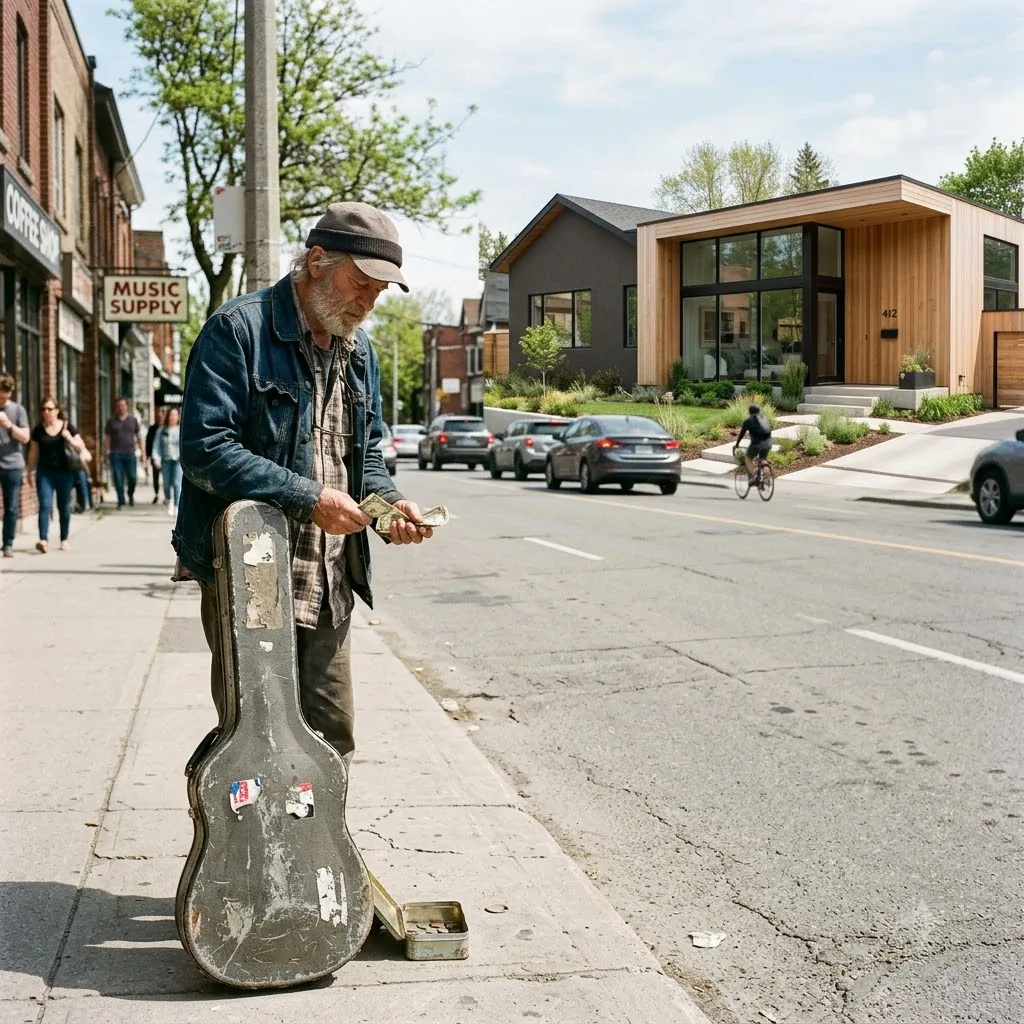
The man in the charcoal turtleneck stared at the open guitar case. He swallowed hard, his Adam’s apple bobbing sharply in his throat. He didn’t offer a clumsy apology. He didn’t try to hand the Gibson back. The brutal weight of Silas’s reality had shattered the man’s pristine, curated morning, but the mechanical instinct of a financier remained. He looked at the cracked screen of Silas’s phone, then pulled up his own banking app.
“Phone number?” the man asked. His voice was a thin, raspy whisper, stripped entirely of its previous patronizing authority.
“Phone number,” Silas said, reciting the ten digits.
The man’s manicured thumbs moved over his screen. A few seconds later, Silas’s phone vibrated against his palm. He looked down at the spider-webbed glass. A push notification from his bank pierced the glare of the sun: *Transfer received. Available balance: $1,452.14.*
Silas didn’t say thank you. He didn’t nod. He turned his back on the porch, leaving the open case and the 1934 Gibson L-00 resting on the composite wood like a casualty of war. He walked across the cobblestones, picked up his dented plastic bucket, and grabbed his unplugged amplifier by its rubber handle. He didn’t look at the police cruiser. The officer inside simply rolled up his window, satisfied that the neighborhood noise complaint had been resolved. The corner of Elm and Maple was perfectly, devastatingly silent.
Silas walked six blocks to the nearest bank branch, the heavy amplifier banging rhythmically against his thigh. He withdrew three hundred dollars in crisp twenties and fifties, leaving the rest of the funds digital for the pharmacy. He caught the cross-town bus, sitting in the very back, staring blankly at the passing storefronts. The vibrant, chaotic city he had played to for four years now felt entirely foreign, a vast machine that only extracted and consumed.
At 3:15 PM, Silas pushed through the double glass doors of the Oak Creek Care Facility. The lobby smelled aggressively of lemon bleach and boiled vegetables. He walked straight to the administrative desk and laid the stack of bills on the laminate counter. The facility manager, a tired woman with reading glasses perched on the end of her nose, counted the money with practiced efficiency. She didn’t ask how he got it. She just typed a few keystrokes into her terminal, hit enter, and slid a carbon-copy receipt across the desk.
“She’s cleared for the month, Silas,” the manager said, not meeting his eyes. “Try not to let it get to the wire next time.”
“There won’t be a next time,” Silas said softly. The manager didn’t seem to hear him, already reaching for a ringing telephone.
From Oak Creek, it was another four blocks to the specialty pharmacy. The transaction there was entirely digital, but infinitely more painful. One tap of his debit card against the card reader wiped out the remaining thousand and forty-five dollars. The pharmacist handed over a small, unassuming white paper bag containing a single plastic bottle. Thirty pale pills. Capecitabine. Poison meant to kill the poison.
It was past five o’clock when Silas finally walked into his wife’s room at the end of the second-floor hallway. The vertical blinds were drawn against the fading autumn sun, casting the room in long, gray shadows. The space was dominated by the rhythmic, mechanical hiss of the oxygen concentrator. His wife lay in the narrow mechanical bed, looking terribly small beneath the thin thermal blanket. Her skin held a faint, jaundiced pallor, her cheekbones sharp and pronounced. She was asleep, her chest rising and falling in shallow, fragile increments.
Silas set the white paper bag on the nightstand next to her plastic water pitcher. He placed his empty bucket and the dead amplifier in the corner of the room. He sat down in the vinyl visitor’s chair, the cushion hissing as it accepted his exhausted weight.
He looked down at his hands. He rubbed his right thumb over the heavy, yellowish callouses on his left fingertips. They were thick and hard, built up over thousands of hours of pressing steel strings against mahogany. Without the guitar, the callouses would start to soften in a few days. In a month, they would peel away entirely, leaving smooth, unblemished skin behind.
The immediate panic was gone. The suffocating pressure of the four o’clock deadline had vanished, but the vacuum it left behind was filled with a quiet, terrifying dread. He had won the day. He had kept a roof over her head and secured the chemicals keeping her alive. But the brutal math had not changed; it had only been delayed.
He stared at the plastic pill bottle protruding from the paper bag. Thirty pills. One month. When the bottle was empty, the rent at Oak Creek would be due again. The pharmacy would demand another thousand dollars. But the 1934 Gibson L-00 was gone. The corner of Elm and Maple, the neighborhood that had sustained them through the lunch rushes and tourist seasons, was dead to him now. He had burned the last of his history to buy thirty days of future. Silas leaned forward, resting his elbows on his knees, and buried his face in his calloused hands, listening to the relentless, invisible ticking of the clock.