Story code: ST-001891
Part 3: The Brutal Math
The white police cruiser drifted to a halt at the curb, its tires settling into the dip of the storm drain with a heavy squeak of rubber against concrete. The cherry lights on the roof were dark, but the threat was absolute. Silas watched the passenger-side window hum downward, revealing the dark silhouette of the officer inside. He didn’t wait for the patrolman to speak. He didn’t run, and he didn’t argue.
The panic that had been suffocating him for the last hour suddenly evaporated, leaving behind a cold, hollow vacuum in his chest. The math was absolute. He had fifty-two dollars in his checking account. He had forty dollars in wrinkled bills and scattered silver in his pocket. The citation demanded fifty-four dollars and ninety-five cents just to unlock his legal right to make a living on the sidewalk. The facility manager demanded three hundred dollars by four o’clock.
The timeline had shattered. The daily hustle was over. There was no more time for nickels and dimes, no more time to smile at tourists passing by.
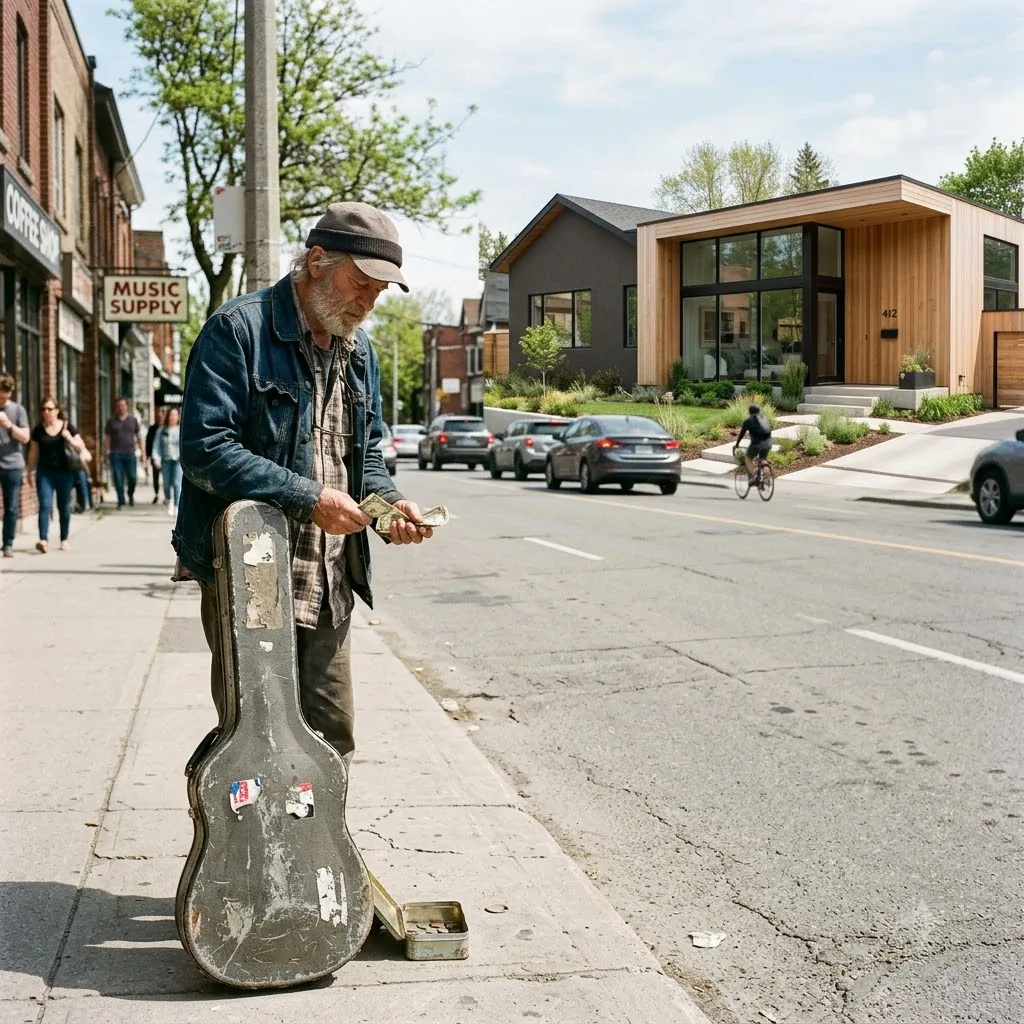
Silas knelt on the cobblestones. He reached out and gently laid his calloused hand over the strings of his acoustic guitar to mute the residual hum of the street. It was a 1934 Gibson L-00. The sunburst finish was crackled with age, the mahogany back smoothed by decades of friction against his chest. It had belonged to his grandfather, passed down through hands that had worked just as hard to survive. It was the only thing of true value Silas had ever owned, a piece of living history that sang with a deep, resonant warmth that modern wood could never replicate.
He lifted the instrument and set it gently into the faded red velvet of the hardshell case. He closed the heavy lid. He snapped the four brass latches shut. The sharp clicks sounded like a bank vault sealing closed.
He stood up, gripping the worn leather handle of the case, and turned his back on the police cruiser.
Silas walked straight across the narrow street. He ignored the officer calling out to him from the squad car. He stepped up onto the curb, walked past the freshly planted decorative grasses, and climbed the three wooden steps onto the pristine porch of the renovated modern bungalow.
He stood directly beneath the blinking blue eye of the smart camera. He pressed the illuminated doorbell. It echoed inside the house with a soft, melodic chime, a sound designed for a life completely divorced from panic, a life of scheduled package deliveries and polite dinner guests.
The heavy oak door pulled open a few seconds later. The man in the charcoal-gray turtleneck stood in the expansive foyer, his smartphone already gripped tightly in his manicured hand. When he saw Silas, his eyes darted over Silas’s shoulder to the police cruiser idling across the street. A smug, victorious smirk touched the corners of his mouth.
“I warned you,” the man said, his tone dripping with patronizing calm. “I told you I had them on speed dial. You’re making a terrible mistake coming to my door. I can have you arrested for trespassing.”
Silas didn’t raise his voice. He didn’t clench his fists. He simply knelt on the pristine welcome mat and laid the heavy case flat on the porch deck. He flipped the four brass latches and opened the lid.
The harsh afternoon sun caught the aged, honey-colored spruce top of the Gibson. Against the stark, monochromatic modernism of the porch, the vintage instrument looked like a beating heart.
“It’s a 1934 Gibson L-00,” Silas said, standing slowly. His voice was completely flat, stripped of all pride, anger, and ego. “Original sunburst finish. Adirondack spruce top. It was appraised three years ago at forty-five hundred dollars. I am selling it to you right now for exactly one thousand, four hundred dollars.”
The man frowned, his smug expression faltering into genuine confusion. He lowered his phone a fraction of an inch. “What are you talking about? I don’t play guitar. Get off my property before I have those officers collar you.”
“One thousand, four hundred dollars,” Silas repeated, his dark, exhausted eyes locking onto the man’s face. “Cash or a direct wire transfer. Right now. You work in finance, right? You flip properties. This is a flip. You can put this on a vintage collector’s forum tonight and triple your money by tomorrow morning.”
The man let out a short, incredulous scoff. “Are you insane? Why would I buy a street beggar’s guitar-”
“Because you just took my corner,” Silas interrupted. His voice wasn’t loud, but the raw, trembling gravity of it cut through the crisp autumn air like a serrated blade. “Because I have until four o’clock. If I don’t hand the facility manager at Oak Creek three hundred dollars by four o’clock, they pack up my wife’s room and wheel her into the lobby. She has Stage IV pancreatic cancer. She weighs eighty-five pounds. She can’t walk.”
The man blinked. The annoyance in his eyes stuttered, completely short-circuiting.
“The other eleven hundred,” Silas continued, the brutal math tumbling out of his mouth with the practiced, agonizing precision of a man who had run the numbers a thousand times in the dark, “is one thousand and forty-five dollars for her Capecitabine refill. Oral chemotherapy. She lost her insurance when she got too sick to work her shifts at the bakery. And the last fifty-five dollars is for the noise citation you just gave me, complete with the city’s four-dollar and ninety-five-cent convenience fee.”
Silas stepped back, leaving the open case on the mat. The vintage guitar rested like a sacrificial offering on an altar of gray composite wood.
“Fourteen hundred dollars,” Silas said, his voice cracking slightly on the final number. “That’s the math. That’s what it costs to keep her inside today. You didn’t just turn off an amplifier. You cut the wire. You won. I’m done playing. So buy the guitar. Take the massive profit. Just give me the money so I can save her.”
The man looked down at the beautiful, ancient instrument. Then he lifted his gaze, looking past Silas. He stared at the empty, dented plastic bucket across the street, the scattered pennies resting by the storm drain, and the police cruiser waiting to enforce his noise complaint.
The sleek silver coffee mug in the man’s hand began to shake, a tiny, rapid tremor that sent a ripple across the surface of his dark roast. The color drained entirely from his face, leaving behind a pale, horrified slackness as the reality of what his single phone call had actually dismantled seemed to crash over him. He opened his mouth, staring at the shattered musician standing on his pristine doorstep, but no sound came out.